Quick Take
- Narration: Michael Crouch handles the tonal complexity well, he keeps the darkly absurdist premise grounded without deflating the genuine horror that runs underneath the anecdotes.
- Themes: Complicity and survival under tyranny, the intimacy of domestic service, food as political proximity
- Mood: Darkly fascinating, with a disquieting warmth that follows from the chef narrators’ own complicated relationships with their employers
- Verdict: Witold Szablowski has found an angle on twentieth-century dictatorship that genuinely illuminates something new, the view from the kitchen is not just a clever premise, it is a way of seeing power that no other approach produces.
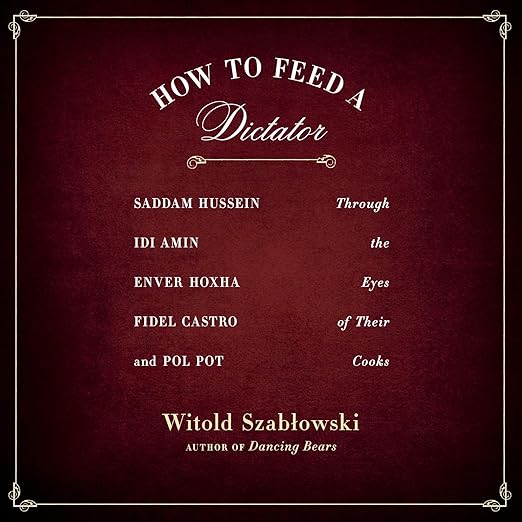
I was deep into a reading period of political history when a colleague put How to Feed a Dictator in front of me with the observation that it would be the strangest thing I read all month. She was correct. I started it on a Friday evening expecting something between gonzo journalism and culinary memoir, and what I found was something considerably more unsettling and considerably more humane than either of those categories would suggest. I finished it in two sittings, neither of which ended when I had planned.
Witold Szablowski is a Polish journalist who spent years tracking down the personal chefs of five of the twentieth century’s most violent rulers: Saddam Hussein of Iraq, Idi Amin of Uganda, Enver Hoxha of Albania, Fidel Castro of Cuba, and Pol Pot of Cambodia. He found them, convinced them to talk, and recorded their accounts over meals, sweet-and-sour soup, goat-meat pilaf, bottles of rum, games of gin rummy, in ways that make the act of eating together part of the book’s argument about what food and proximity mean in relation to absolute power.
The Premise as Method
The book’s central insight is that the chef occupies a unique position in relation to power: close enough to observe the private person beneath the public tyrant, constrained enough by the relationship’s fundamental asymmetry to have no real agency in what they witnessed, and alive long enough after the regime’s end to speak about it with the particular clarity of someone who survived something they did not fully understand at the time. These are not dissidents. They are not true believers. They are skilled workers who cooked for powerful men and lived with the consequences of that proximity for the rest of their lives.
Multiple reviewers note that the dictators who emerge from these accounts are not the monsters of historical summary. They enjoyed simple home cooking. They had preferences and habits and moments of apparent humanity. That is not a rehabilitation, the book is clear-eyed about what each of these men did to their people, but it is an insistence on seeing power at the level of appetite and routine rather than ideology and spectacle. The contrast between that domestic intimacy and the scale of the violence happening outside the kitchen is what gives the book its distinctive and disquieting texture.
Michael Crouch and the Tonal Tightrope
The comparison to Anthony Bourdain in the marketing is apt in one specific sense: both Bourdain and Szablowski understood that food is a way of talking about things that are otherwise difficult to talk about directly. But Szablowski is working in a register that is darker and more politically serious than most food writing, and the audiobook succeeds in part because Michael Crouch’s narration holds that tonal complexity without collapsing it into either comedy or solemnity.
Crouch is a reliable narrator for this kind of material, he can sit with irony without underlining it, and he can let the chefs’ accounts breathe without editorially signaling how the listener is supposed to feel. The Idi Amin section, which includes the question of whether Amin actually ate human flesh, requires exactly that kind of restraint: playing it for shock value would be cheap, and playing it for historical gravity alone would miss the book’s commitment to letting the cook’s perspective speak for itself without authorial intervention.
Five Dictators and the Shape of a Portrait
The book is organized as five separate portraits, each following a similar structure: Szablowski finding the chef, establishing the relationship, conducting the interviews, and then rendering the account in the chef’s voice rather than as journalistic summary from the outside. The structural choice to keep Szablowski’s own presence in the frame, the meals, the gin rummy, the rum, is important because it prevents the book from feeling like a parade of gruesome anecdotes organized for maximum effect. The journalist’s presence keeps reminding you that these are old people living with old memories, not exhibits in a museum of atrocities, and that Szablowski is sitting across a table from them in real time.
The Castro section is particularly interesting because the chef’s relationship to his employer was more ambivalent and longer-lasting than the others, and Castro’s obsession with a particular cow, mentioned in the synopsis, turns out to be a window into a very specific kind of control that the book explores with more care than the anecdote initially suggests. The Pol Pot section carries the most moral weight because the context, two million Cambodians dying of hunger while Pol Pot ate whatever he requested, is present in the silence of the account rather than in its explicit statement. Szablowski trusts the listener to feel that contrast without being told to feel it.
Who Will Value This, Who Will Not
Listen if you are interested in twentieth-century political history approached from an unexpected angle, if you find the question of complicity and survival genuinely complex rather than settled, or if you want nonfiction that takes food seriously as a lens on power rather than as lifestyle content. The book pairs naturally with Hannah Arendt’s thinking on the banality of evil without ever becoming academic. Skip if you need your nonfiction to have clear moral categories and satisfying conclusions, Szablowski’s book is interested in the uncomfortable middle ground where survival and proximity to evil cannot be cleanly separated, and that discomfort is the point rather than a flaw. At eight hours and thirteen minutes, it is precisely the right length: long enough to develop each portrait fully, short enough to maintain the book’s concentrated intensity throughout.
Frequently Asked Questions
Does the book engage with the question of whether the chefs bear moral responsibility for serving these regimes?
Yes, and without resolving it neatly. Szablowski’s method is to let the chefs’ own accounts make the complexity visible, these were people who needed to survive, who often had no real choice about their employment, and who lived for decades afterward with the weight of what they witnessed. The book resists judgment while making the moral dimensions fully visible.
Is the Idi Amin section as graphic as the rumors about his cannibalism would suggest?
Szablowski addresses the cannibalism question directly and with historical care. Michael Crouch’s narration handles it with the same restraint, the section is not sensationalized, but it does not avoid the subject either. Listeners who are sensitive to graphic historical content should be aware that the book’s treatment of each dictator’s violence is honest and unflinching.
Which of the five chef portraits is most developed, and which is the briefest?
The Castro section is among the most developed, partly because of the duration of the relationship between Castro and his chef and partly because of the relative accessibility of Cuban culinary culture as context. The Hoxha section covering Albania is somewhat less familiar to Western audiences and benefits from Szablowski’s care in establishing the Albanian political context before moving into the kitchen accounts.
The NPR comparison to Anthony Bourdain is in the marketing, how accurate is that description of the book’s tone?
Accurate in the sense that both Bourdain and Szablowski use food as a way into larger political and human questions, and both maintain a journalist’s curiosity about the people doing the cooking rather than only the food being cooked. But Szablowski is working in darker and more politically serious territory, this is closer to Ryszard Kapuscinski than to Parts Unknown.