Quick Take
- Narration: Kevin Foley reads with clean professional delivery, keeping technical content accessible without over-dramatizing the material.
- Themes: Trading strategy and risk management, psychological discipline in financial markets, moving from beginner to consistent practitioner
- Mood: Instructional and grounded, with an honest acknowledgment that the book alone will not make you profitable
- Verdict: A well-structured introduction to day trading strategy that sets realistic expectations, more honest about its own limitations than most books in this space.
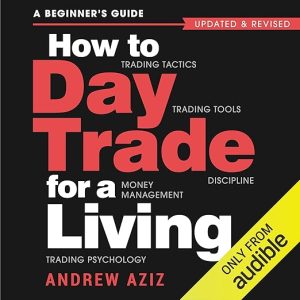
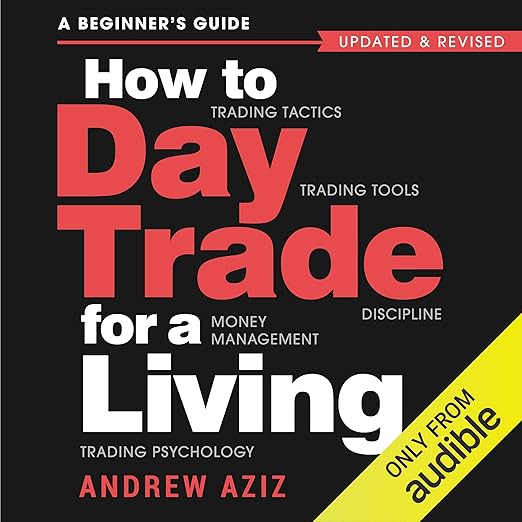
Day trading books occupy a peculiar space in the financial self-help genre. Most of them are long on promise and short on the kind of granular, applicable instruction that would actually help someone avoid the losses that characterize the first year of retail trading. Andrew Aziz’s How to Day Trade for a Living distinguishes itself early by doing something most books in this category do not: admitting, in plain language, that reading it will not make you profitable. That caveat, delivered in the opening pages, tells you something meaningful about the author’s approach to the rest of the material.
I came across this title in a conversation with a reader who described it as the book he wished he had read before losing money learning the hard way. He had set it aside initially, returned to it a year later, and found it gave him the conceptual foundation to finally approach trading systematically rather than instinctively. That arc, initial dismissal, return with fresh eyes, genuine utility, came up in multiple reviews, and it is worth noting because it suggests the book rewards rereading more than a single pass.
Our Take on How to Day Trade for a Living
Aziz structures the audiobook around seven core trading strategies: ABCD Pattern Trading, Bull Flag Momentum Trading, Top and Bottom Reversal Trading, Moving Average Trend Trading, VWAP Trading, and Support and Resistance Trading. For each, he covers how to identify the stock, what indicators he uses, entry and exit timing, and stop-loss placement. That specificity is the book’s chief virtue. He is not gesturing at concepts, he is describing a repeatable process, which is what separates a useful trading book from the philosophical hand-waving that fills many entries in this genre. Reviews from readers across multiple countries consistently highlight the risk management and trader psychology sections as particularly well-executed.
Why Listen to How to Day Trade for a Living
Kevin Foley narrates with clean professional delivery that keeps the technical content moving without either monotonizing it or over-dramatizing strategy descriptions. At under seven hours, the audiobook is efficiently sized, Aziz explicitly kept it short so listeners could complete it rather than losing steam by the middle, a self-awareness that is reflected in the pacing. The accompanying PDF, available in your Audible library, handles the visual chart examples and tables that inevitably get compressed in audio format, so downloading it before listening is worth the extra step.
What to Watch For in How to Day Trade for a Living
Aziz is direct about the book’s limitations: it is a foundation, not a complete system. Sustainable trading profitability requires practice, appropriate software, and ongoing education beyond what any single audiobook can deliver. Intermediate traders who already understand the basics may want to skip to Chapter 7 as the author himself suggests, where the strategy overviews begin in earnest. The book also leans toward individual retail stock trading on US markets, so listeners interested in forex, options, or futures will find the strategy examples less directly applicable. One reviewer noted the book helped him recognize what he did not know about trading, which is precisely the function a foundational text should serve.
Who Should Listen to How to Day Trade for a Living
The trader psychology sections that reviewers highlight are genuinely useful in a way that separates this book from the purely mechanical strategy guides that dominate the genre. Aziz understands that knowing when to enter and exit a trade is only half the problem. The other half is the emotional management required to follow your rules under live market conditions. For beginning traders, that acknowledgment is as practically valuable as any individual strategy he describes.
Beginning traders who want a structured, honest introduction to day trading strategy will get the most from this. Intermediate traders who have been operating on instinct and want to formalize their approach may find Chapter 7 onward genuinely useful. Anyone expecting a shortcut to consistent profits should be redirected by the author’s own caveat in the opening pages. This is a starting point for serious learners, not a finished system.
Frequently Asked Questions
Does the audiobook cover all seven trading strategies in enough detail to actually implement them?
Aziz covers each strategy’s setup, entry, exit, and stop-loss criteria, but he is clear that practice and additional tools are necessary for implementation. The PDF companion in your Audible library handles the visual components that audio cannot convey.
Is this book relevant for trading outside the US stock market, such as forex or crypto?
The strategies are primarily illustrated with US equities and stock market mechanics. Traders focused on forex, crypto, or other markets will find the concepts transferable but the specific examples less directly applicable.
How does Kevin Foley’s narration handle the more technical chart-description sections?
Foley reads clearly and keeps the pacing consistent, but the chart-based strategy examples are significantly easier to follow with the accompanying PDF open alongside the audio.
Is this book appropriate for someone with no prior trading experience at all?
Aziz designed it for beginners and explains foundational concepts clearly, but he is honest that the book is a starting point. Listeners with zero market knowledge may benefit from pairing it with introductory materials on how stock markets function before diving into strategy.