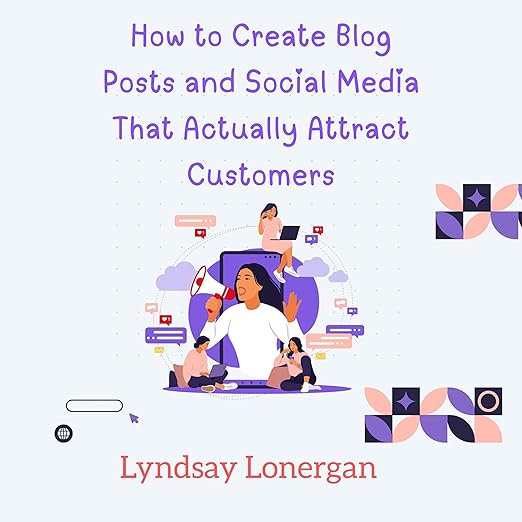
Lyndsay Lonergan's audiobook How to Create Blog Posts and Social Media That Actually Attract Customers opens in a familiar situation for its target reader: you have a small business, a freelance practice, or a blog, you have posted consistently for months, and the engagement numbers tell you that something is not connecting. The content goes out. The likes come in. But the customers do not. Narrated by Myriam Berger and running exactly one hour, this is Lonergan's direct answer to that specific problem. The precision of the runtime is itself a statement of intent: this is not a comprehensive content marketing education. It is a focused intervention.
Berger's narration is well-matched to the material. The book is written in a conversational register, addressing the reader as a peer with a problem rather than a student in a course, and Berger preserves that directness without flattening it. For an audiobook that will be consumed primarily by people who are not habitual listeners but who are trying to solve an immediate business problem, the accessible delivery matters more than most reviewers acknowledge. Berger reads with warmth and structural clarity, making the progression of sections audibly distinct even without visual chapter markers.
The Principles Are the Product Here
The book's core argument is familiar in content marketing circles: most small business content fails not because the creator is a bad writer but because the content is organized around what the business wants to say rather than what the target customer is actually looking for. Lonergan spends the opening section reorienting that relationship, asking listeners to map the questions and search behaviors of their ideal customers before writing a single word. It is straightforward advice, but hearing it framed as a prerequisite rather than a bonus step changes how seriously most listeners take it. The sequencing matters, and Berger's delivery makes the sequence clear.
The social media section addresses a gap that content marketing books from even a few years ago left largely open: the distinction between content that generates passive engagement and content that moves a reader toward an actual transaction. Lonergan is direct about the fact that these two goals require different structures and different calls to action. An Instagram post that accumulates saves is not the same as one that generates a booking, and the audiobook is honest about why the metrics that feel good are not always the ones that matter for revenue.
At one hour, the content is necessarily selective. Lonergan prioritizes the framework over the examples, which is probably the right call for the format. Longer books in the content marketing space sometimes spend so much time on case studies that the underlying principles become hard to isolate. Here, the principles are the product, and the one-hour constraint forces a clarity that more sprawling treatments lack. Listeners who want to go deeper after completing this audiobook will have a clearer framework for evaluating what the longer books are actually doing and which elements apply to their specific context.
Berger Compensates by Staying Highly Organized
The audiobook format is an interesting choice for material that is inherently visual, since writing headlines, structuring calls to action, and formatting for skimmability are all things that benefit from seeing examples. Berger compensates by being highly organized, making the structure of each section audibly clear. Listeners who follow along with a notepad will get substantially more out of the one-hour runtime than those who try to absorb it passively. This is less a book you listen to for inspiration and more a working session you schedule with a pen in hand.
For entrepreneurs and freelancers who spend the most time executing and the least time stepping back to evaluate their content strategy, the one-hour format is a feature rather than a limitation. It is a book you can listen to between client calls or during a lunch break and walk away from with a concrete change to make to your next piece of content. That accessibility distinguishes it from longer, more comprehensive guides that require blocking several hours and significant sustained attention.
B2B and Regulated Industries Do Adaptation Work
The book does not differentiate strongly between industries, which is both a strength and a limitation. The framework Lonergan presents is genuinely platform-agnostic and industry-agnostic at the level of principle, making it widely applicable. But listeners working in specialized niches such as B2B services, regulated industries, or highly technical fields will find themselves doing significant adaptation work to move from the examples Lonergan uses to their own contexts. That is an accurate description of the book's scope rather than a criticism of it.
No rating data is available for this title, which limits the ability to calibrate expectations against a broader listener consensus. At one hour, the investment is low enough that the risk of mismatch is manageable. If you sample the first ten minutes and find Berger's tone and Lonergan's framing useful, the full runtime will deliver what it promises and leave you with a practical starting point for rethinking how you approach each piece of content.
One Hour, One Notepad Page, One Changed Approach
This audiobook is designed for exactly the audience it names: entrepreneurs, freelancers, bloggers, and small business owners who are producing content but not converting readers into customers. If you already work with a dedicated content strategist, the material will be foundational rather than new. If you are the entire marketing department for your own business and want a clear starting framework, the one-hour runtime and practical orientation make this a productive use of time that is genuinely scarce.
Listen with something to write on. The value of this audiobook is not in the listening itself but in the applying, and Berger's organized delivery makes it easy to capture the action steps in real time without pausing and rewinding constantly. One hour, one notepad page of takeaways, one changed approach to your next piece of content: that is a reasonable and realistic outcome for the right listener.
At a Glance
- Narrator: Myriam Berger delivers a conversational, friendly performance that matches the book's beginner-friendly tone, accessible without being patronizing, and clear enough for a tutorial-style listen.
- Subjects: Content marketing for small business, blog writing fundamentals, audience conversion strategy
- Tone: Practical and encouraging, direct without jargon
- Bottom line: A solid one-hour primer for small business owners and freelancers who want a clear, no-nonsense framework for content that actually converts, best consumed as a focused session with notes.