Quick Take
- Narration: Jolenta Greenberg narrates solo, which works well for a book built on her personal voice, her warmth and self-deprecating humor land consistently, though listeners who want Kristen Meinzer’s skeptic counterpoint will feel her absence.
- Themes: Self-help skepticism, personal transformation, friendship and collaboration
- Mood: Candid and warm, like a long brunch with a friend who has done the reading so you don’t have to
- Verdict: Fans of the By the Book podcast will find this a satisfying companion piece; newcomers get a genuinely useful and honest distillation of what fifty self-help books actually taught two people.
I came to this one on a long Sunday drive, somewhere in the middle of a stretch of highway where the scenery had stopped being interesting. I’d been half-heartedly cycling through podcasts when I remembered I’d queued up How to Be Fine weeks earlier, telling myself I’d get to it when I had a proper block of time. The irony of listening to a book about improving one’s life choices while procrastinating on exactly that book was not lost on me.
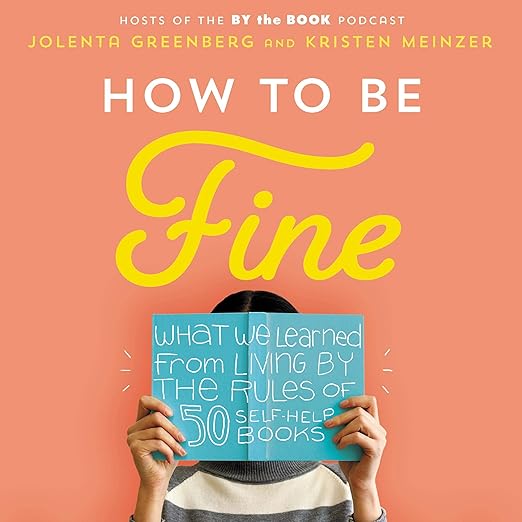
Jolenta Greenberg and Kristen Meinzer have spent years doing the work that most of us talk about doing but never get around to: actually following self-help books to the letter, not selectively and not ironically, but for real. Their podcast By the Book grew out of a very specific dynamic, Jolenta the true believer, Kristen the skeptic, and How to Be Fine is the book-length synthesis of what fifty of those experiments actually produced. It is not a self-help book in the conventional sense. It is something more useful: a critical audit of the genre, written by two people who lived it.
The Podcast That Became Something Else
One of the more interesting things Greenberg acknowledges here is that the show changed her. She went in hoping to find a book that would fix everything; she came out the other side having discovered that the most useful gains came from accumulation rather than revelation. That shift from magical thinking to earned pragmatism gives How to Be Fine its backbone. The advice that made it through the filter of lived experience, tracking finances, reducing clutter, finally calling a therapist, feels earned rather than prescribed. The advice that didn’t survive, various schemes involving rigid morning routines and personality typing, gets an honest postmortem.
The structure of the audiobook mirrors this back-and-forth rhythm. Greenberg moves through categories of advice: getting off your device, practicing positive self-talk, downsizing, going outside. Each section draws from specific books without becoming a listicle. She’s a good synthesizer, pulling threads together without losing the personal texture of the original experiments. The humor is present but never performs itself. When she describes memorizing her husband’s phone number as a genuine achievement, it lands because of what it reveals about how thoroughly she had outsourced her own memory to her device, not because it’s a punchline.
What Kristen’s Absence Costs the Audiobook
The rating of 3.9 points to something real. The podcast’s engine runs on friction, between Jolenta’s openness to belief and Kristen’s structural skepticism. That tension is what makes a conversation rather than a monologue. How to Be Fine is explicitly co-authored, but Greenberg narrates alone, and while her narration is warm and unaffected, listeners who have spent time with By the Book will notice the missing half. The book compensates with more interiority from Jolenta’s perspective and less of the back-and-forth debate, which makes it feel slightly less dialectical than its source material. Reviewer P. Evans called it a conversation with a dear friend, which is accurate, but the podcast is two friends, and one seat at the table is empty.
This is not a fatal problem. Greenberg’s voice is assured and personal, and she is genuinely funny without trying to be. But first-time listeners should know they’re getting one of the two perspectives, and fans who want the complete experience will want to pair this with the podcast itself, which remains one of the better critical approaches to self-help available in audio form.
Which Advice Actually Survived
One of the book’s most genuinely useful contributions is its taxonomy of what worked and what didn’t. The list of practices that held up, seeing a therapist, tracking finances, getting outside, reducing digital clutter, is not surprising in itself. What is interesting is the honest accounting of why other practices collapsed: because they required a personality type neither woman has, or because the promised outcomes were so abstract as to be unmeasurable, or because the books themselves were built more on reassurance than on mechanics. This is valuable work. The self-help genre is enormous and largely unaccountable, and Greenberg’s approach to it is genuinely rigorous even when the prose is casual.
The supplemental PDF that accompanies the audiobook adds a layer of value if you’re listening with a notepad nearby. It is not required for the experience, but the workbook-style elements give those who want to engage more actively a place to land.
Who Should Listen and Who Should Skip
Listen if you are a fan of By the Book and want the long-form synthesis. Listen if you are curious about self-help but exhausted by its promises. Listen if you want something that is honest about the gap between what self-help books claim and what they can actually deliver. Skip if you’re looking for a single prescriptive program to follow, or if the absence of Kristen Meinzer will feel like reading a conversation transcript with every other line removed. This is a book that rewards listeners who already have some appetite for genre meta-commentary; it’s less useful as a standalone self-improvement resource than it is as a companion to a broader conversation about why we turn to these books in the first place.
Frequently Asked Questions
Do I need to have listened to the By the Book podcast before starting this audiobook?
No, but it helps. The book stands on its own as a critical synthesis of self-help advice, but the podcast provides the dynamic between Jolenta and Kristen that the book can only partially replicate. If you haven’t heard the show, consider listening to a few episodes first to understand what kind of experiments the book is drawing from.
Why does Jolenta narrate alone when the book is co-authored with Kristen Meinzer?
The audiobook credits Jolenta Greenberg as the sole narrator. The book itself is written from both perspectives, but the audio production places the narration entirely in Jolenta’s voice, which means listeners don’t get Kristen’s skeptical counterpoint delivered in her own register. It’s a notable gap for podcast fans.
Is the supplemental PDF companion essential for understanding the audiobook?
No, the core content works fine without it. The PDF supplements the workbook-style elements of the book for listeners who want to track their own takeaways or engage more actively with the advice categories Greenberg discusses.
The rating is 3.9, which is lower than I’d expect for a well-reviewed podcast tie-in. What’s pulling it down?
Most listener criticism points to the missing Kristen Meinzer dynamic. The podcast’s appeal is built on two very different personalities testing the same material; the book, narrated only by Jolenta, loses that argumentative texture. Listeners who come expecting the back-and-forth often find a somewhat flatter experience than the show delivers.