
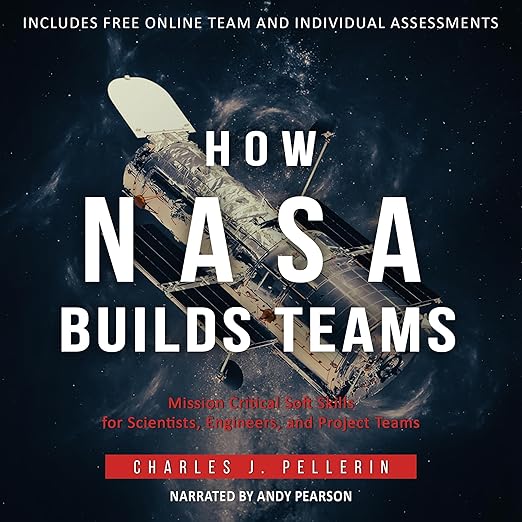
Charles Pellerin's professional background is unusual among leadership authors. He was NASA's Director for Astrophysics and the person who initiated the mission to repair the Hubble Space Telescope's flawed mirror, one of the most technically complex and publicly consequential repair missions in space history. That mission emerged directly from the teambuilding methods described in this audiobook. The credibility of How NASA Builds Teams is grounded in that concrete fact: Pellerin is not presenting a leadership framework developed in a corporate training room. He is describing a methodology that was tested against the actual stakes of space missions, narrated by Andy Pearson across 9 hours and 17 minutes.
The 4-D process Pellerin developed for NASA is designed specifically for technical teams who resist what he calls touchy-feely approaches to teambuilding. The framework uses a coordinate system borrowed from physics to analyze team performance into actionable elements, evaluating what Pellerin identifies as the key driver of team performance: the social context in which people do their work. That framing is what makes the approach palatable to engineers and astrophysicists who would dismiss conventional team-sensitivity training. The physics-derived language gives them a familiar structure for thinking about something they would otherwise avoid engaging with at all.
Fifteen Years Determining One Root Cause
Pellerin's central insight is structural: technical expertise alone cannot prevent catastrophic failure if the social environment of the team is dysfunctional. The Hubble mirror story is the book's most important case study, and Pellerin is candid about his own role in a situation where communication failures contributed to a flaw that cost hundreds of millions of dollars to fix. That honesty is the book's real credential. He is not describing a system that theoretically would have prevented problems. He is describing the system he built after experiencing a major failure and then spending fifteen years determining its root cause and designing around it.
The 4-D assessment framework is quantitative, which is what distinguishes it from most teambuilding approaches and makes it acceptable to technically trained professionals. The system uses a free online behavioral assessment to measure social context, gives team members shared vocabulary for describing their dynamics, and produces actionable data rather than the general interpersonal awareness exercises that engineering teams typically dismiss. Reviewers who came from aerospace careers described finding the methodology immediately applicable and unusually well-grounded in real operational experience, describing it as bound to be a classic in leadership and team building. That is not a casual characterization from that professional background.
Pearson's Right Balance of Precision and Narrative
Andy Pearson's narration brings methodical clarity to Pellerin's framework without draining the stories of their human interest. The anecdotes from Pellerin's decade as NASA's Director for Astrophysics are the book's most compelling material, and Pearson delivers them with the right balance of technical precision and narrative engagement. For listeners who learn organizational concepts best through concrete example, the NASA context provides a near-ideal setting: the stakes are extreme, the technical complexity is real, and the human dynamics are documented in ways that organizational behavior case studies in business schools rarely achieve.
The accompanying PDF referenced in the audiobook description adds reference material for those who want to implement the 4-D framework after listening. The free online assessment mentioned in the book makes the methodology immediately accessible. This is an audiobook that generates next actions rather than simply delivering ideas, which is a high bar for business and leadership audio. Pellerin's fifteen years of working closely with NASA and outside business teams after developing the framework gives him a depth of implementation experience that shows in the specificity of the guidance.
One Approach Among Several Evidence-Based Methods
The 4-D framework is presented with the conviction of a true believer, and some sections lean toward methodological promotion rather than neutral description. Listeners in organizational development fields may recognize that Pellerin's framework, while well-developed and useful, is one approach among several evidence-based team performance methods. The book does not situate the 4-D system within that broader landscape, and practitioners trying to evaluate frameworks comparatively will need to supply that context themselves.
The runtime of 9 hours and 17 minutes is substantial, and the methodology sections in the middle of the audiobook are denser than the anecdotal chapters and require more active attention. Pearson keeps the material moving, but the sections on the mechanics of the assessment framework are demanding rather than passive listening material. Reviewers with aerospace management experience described getting more from the book than general leadership readers might, because the NASA-specific context carries additional professional resonance for that background.
Essential Listening for Engineers Who Resist Soft Skills
This audiobook is essential listening for technical managers and organizational leaders who need teambuilding methods their engineers will not dismiss as soft. It is equally valuable for anyone who has experienced communication-driven project failure and wants a structured framework for understanding what went wrong at the level of team social context rather than individual performance. The NASA context makes it compelling for aerospace and engineering professionals, but Pellerin makes clear that the 4-D framework has been applied successfully across many industries. Listeners who want general leadership inspiration rather than a rigorous methodology with an online assessment component will find it more technical and specific than they expected. Those who want a system they can actually implement will find both the framework and the tools ready to use from the moment they finish listening.
A Few Questions About How NASA Builds Teams
Does this audiobook explain how to use the 4-D team assessment tool mentioned in the book?
Yes. Pellerin explains the framework and the free online behavioral assessment throughout the audiobook, and the accompanying PDF referenced in the listing provides additional reference material. The methodology is presented with enough detail to be implementable, not just conceptually understood.
Is How NASA Builds Teams relevant for organizations outside the aerospace and engineering sectors?
Pellerin explicitly addresses this. The 4-D framework has been applied in hundreds of NASA project teams and also in outside business contexts. The social context model of team performance is not sector-specific, and Pellerin provides examples from multiple organizational types throughout the audiobook.
How technical does this audiobook get, and will it be accessible to non-engineers?
The framework borrows concepts from physics, including a coordinate system for analyzing team dynamics, but Pellerin explains the principles clearly for non-technical audiences. The NASA stories that ground the methodology are told as human narratives rather than technical case studies. Most management professionals will find the content accessible.
Is the Hubble Space Telescope repair story told in enough depth in the audiobook to understand how teambuilding failures contributed to the original mirror flaw?
Yes, and it is one of the most compelling sections of the audiobook. Pellerin gives a candid account of how communication failures in a high-performing technical team produced a catastrophic outcome, and traces the path from that failure to the development of the 4-D system. It is both a cautionary tale and the practical origin story for the methodology.







