In Brief
- Narrator: Dr. Joey Faucette reads his own framework, the right pairing for a coaching model built out of his own interviews rather than a budget choice.
- Subjects: Leading through disruption, adaptability as a measurable trait, culture and strategy alignment, people before technology.
- Tone: Brisk, upbeat, and built for a manager with no spare hours.
- Bottom line: A well-judged seventy-eight-minute briefing, as long as you space out the weekly tasks instead of bingeing the whole thing.
Seventy-eight minutes buys you a nine-part change framework, and that arithmetic is the first thing to understand about this audiobook. Dr. Joey Faucette has compressed the T.R.A.N.S.F.O.R.M. model into just over an hour, roughly one letter every eight or nine minutes, and he narrates it himself. The verdict up front: as a briefing for a manager who is already drowning, it is well judged and genuinely usable. As a comprehensive treatment of organizational change it is not attempting that job at all, and reading it as one will produce a disappointment the book does not deserve.
Seventy-Eight Minutes Puts People Before Technology
The framework's source material is worth naming because it shapes the evidence. Faucette built the book from conversations with nine culture architects who appeared on his Work Positive Podcast, which means the backing is practitioner testimony rather than academic study. That carries an obvious cost and an underrated benefit. The cost is that nine interviews cannot establish what works across an industry. The benefit is that every element of the acronym arrived attached to somebody who had actually done it under pressure, which is why the chapters read like field notes rather than theory. Reviewer Trevor singles out one of them, the 'Adaptability Quotient' idea, describing it as a measure of how adaptable a person is and noting that Faucette backs it with data about the years ahead.
The acronym is doing more work than acronyms usually do. Each letter opens a genuine tension rather than a slogan: turmoil converted into triumph, vision held against uncertainty, adaptability treated as a measurable trait, self-knowledge, strategy aligned to culture, flexible confidence, one conversation at a time, adversity used as leverage, and people managed before technology. That last element is the sharpest, and Faucette states it as a warning rather than a platitude, arguing that expensive technology fails when the people side is neglected. In a period when most workplace advice runs the other way, a change book that lands on managing people rather than deploying tools is making a real choice.
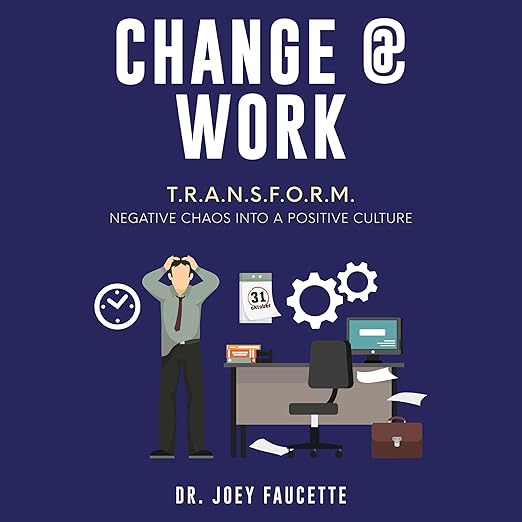
The title's typography is a small tell. Change @ Work uses the at sign the way an email subject line does, which places the book in the register of the workplace inbox rather than the business-school syllabus. That is consistent with everything else about it: the podcast origin, the mnemonic, the weekly task, and a promise addressed to 'people leaders exhausted from swimming upstream in negative chaos', as the publisher copy has it. Faucette is writing for someone who reads in the gaps between meetings, and every structural decision here serves that reader.
Worn-Out Managers Endorsed by a Worn-Out Manager
Audio suits the acronym format better than most people expect. A mnemonic exists to be heard and repeated, and hearing T.R.A.N.S.F.O.R.M. assembled letter by letter across an hour is closer to how the device is meant to work than reading it off a contents page. The compression helps as well. Reviewer shem orona valued precisely that discipline, calling the book 'clear and to the point and provided real world examples which helps a lot' in a subject that invites abstraction, and crediting it with refusing to overexplain.
Faucette narrates his own book, and for this kind of material that is the right call rather than a budget decision. The framework is his, the podcast conversations behind it are his, and a coaching model delivered by the coach carries an implicit claim a hired reader cannot make: this is how the author would put it to you across a table. Nobody in the review set comments on how the reading sounds, so the case for self-narration rests on the logic of the pairing rather than on listener testimony. The logic holds.
The most persuasive endorsement in that review set comes from someone with the right job. Andrei oversees a group of about twenty-five people and describes several years of restructuring, moving targets, heavy turnover, and no clear sense of where the group was headed. His review title, 'A framework that actually works in the chaos,' is exactly the claim this book most needs verified, and it arrives from a reader who was already exhausted, by his own account, before he started. A short book aimed at worn-out managers being endorsed by a worn-out manager is about as close to a fit-for-purpose signal as a listing of this size offers.
The Design Assumes Spacing, the Runtime Invites Bingeing
The DOT challenges are where the format fights the material. Each chapter closes with one specific Do One Thing task meant to be implemented that week, which is a smart pedagogical device and a poor match for a seventy-eight-minute file most listeners will finish in one sitting or two. The design assumes spacing; the runtime invites bingeing. A listener who wants the actual value should treat the audio as a first pass and then return chapter by chapter over nine weeks, which is more discipline than a short business title usually demands and worth saying plainly before purchase.
The second caution concerns depth. Nine framework elements in seventy-eight minutes averages under nine minutes each, and some of those elements, culture and strategy alignment in particular, are subjects other authors have given entire books. Faucette is writing a briefing rather than a manual, and the concision several reviewers praise is the same property that leaves a manager facing a specific structural problem without a specific structural answer. The rating picture reinforces that reading: a 4.8 average across fifteen ratings, every written review sitting at the top of the scale, describes an early and enthusiastic audience rather than a broad and tested one.
Nine Practitioner Conversations, Openly Acknowledged as Such
People leaders in the middle of an actual disruption are the target, and the book knows it. Anyone steering a team through restructuring, turnover, or a strategy reset, and who has neither the appetite nor the hours for a four-hundred-page management text, will find the length a feature rather than a compromise. It also serves a manager who wants shared vocabulary to hand a team, since an acronym is easy to repeat in a meeting and repeatability is half of what makes any framework stick. Podcast listeners already following Faucette's interviews get the compressed version of ground they know.
The mismatch cases are equally clear. Research-backed organizational change theory, with citations and comparative case studies, is not what this length of book can deliver; it draws on nine practitioner conversations and says so openly. Skeptics of positivity-branded business advice should also know what they are buying, because the framing is unapologetically upbeat and treats attitude as a lever rather than a symptom. A manager after sector-specific guidance, whether that means healthcare staffing, software delivery, or retail floor operations, will have to do the translation alone. What the book supplies is a structure for thinking during upheaval, delivered fast by the person who built it, and on those terms it is well made.
Before You Listen
How long is the Change @ Work audiobook and what does it actually cover?
One hour and eighteen minutes, covering all nine elements of the T.R.A.N.S.F.O.R.M. framework plus a Do One Thing task after each chapter. That works out to under nine minutes per element, so expect a compressed briefing on leading through disruption rather than a full treatment of any single component.
Does the audiobook stand on its own without a print copy?
Yes, with one caveat. Nothing in the description depends on charts or worksheets, and the acronym is designed to be heard. The weekly tasks are spoken instructions, so keep a notes app open if you intend to act on them, since audio moves past a challenge before most people have written it down.
What is the T.R.A.N.S.F.O.R.M. framework built on?
Conversations with nine culture architects featured on Faucette's Work Positive Podcast. That makes the evidence base practitioner testimony rather than academic research, which gives the chapters a field-notes quality and also means no claim here is supported by the kind of comparative study a management scholar would expect.
Is this useful for someone who does not manage a team?
Partly. Adaptability, self-awareness, and responding to adversity translate to any career, and an individual contributor riding out a reorganization will recognize plenty. The framing, the examples, and the weekly tasks all assume you have people reporting to you, so a non-manager should expect to adapt roughly half the material.