Quick Take
- Narration: Will Stauff handles the broad, essayistic material with a confident register that suits Uria-Recio’s ambitious scope, the narration gives the material appropriate gravitas without becoming pompous.
- Themes: AI’s societal impact, geopolitical AI competition, human-technology coexistence
- Mood: Expansive and provocative, covering enough ground to unsettle comfortable assumptions about the next decade
- Verdict: An ambitious, wide-ranging survey of AI’s implications across economics, geopolitics, and culture, most valuable for general readers who want a structured framework for thinking about the subject rather than a technical treatment.
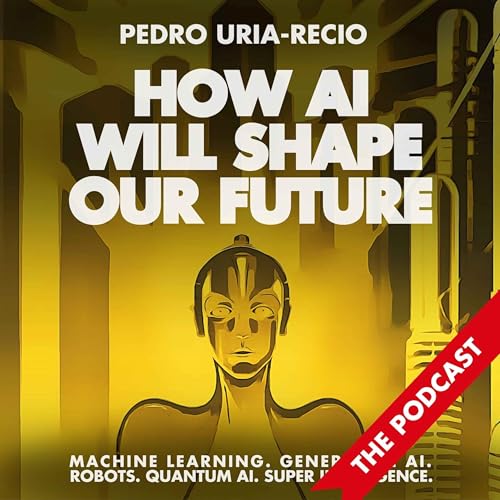
I should note something about this audiobook before the review proper: the synopsis contains a line that identifies this as the podcast version of Uria-Recio’s book, which is a transparency issue worth flagging at the outset. The content appears to be the same material as the full book, but listeners who encounter that podcast framing in the metadata may reasonably wonder what they are actually purchasing. Based on the 17-hour-and-57-minute runtime and the breadth of the material described, this is a substantial production rather than a podcast repurpose. I am treating it as the full audiobook. If you are a podcast listener who discovered Uria-Recio through Acast, the book represents the deeper, more organized version of those ideas.
Pedro Uria-Recio brings a genuinely unusual combination of credentials to this subject. He is a former McKinsey consultant who went on to serve as a Chief AI Officer, which means he has seen AI from both the strategy and the implementation side. That dual perspective shapes how he frames the questions this book asks. He is not primarily a technologist explaining capabilities, nor primarily a philosopher speculating about futures. He is someone who has watched AI decisions get made in boardrooms and government ministries, and the questions he asks reflect that vantage point.
The Historical Foundation That Earns Its Place
The book opens by anchoring readers in the history and evolution of artificial intelligence before moving toward the central question of what societies should expect from AI in the coming decades. Some readers will find the historical framing slow, particularly in the early chapters that move from Aristotle and Leonardo to Kubrick and Sam Altman. I found it genuinely useful. Uria-Recio is not padding the book; he is building a mental model for readers who lack the context to evaluate the present-day claims that fill AI discourse. The mythological and philosophical antecedents he traces give the contemporary AI conversation a depth that most pop-science treatments skip over.
Professor Paul Morrissey’s endorsement of the book as brilliantly navigating the transformative impact of AI on humanity is notable. Academic endorsements of popular AI books are not unusual, but the specificity of his praise suggests engagement with the actual content rather than a courtesy blurb. The complementary assessment from Pascal Bornet, who describes it as providing a unique perspective combining technology, economics, geopolitics, and history, is accurate to the book’s ambition.
The Geopolitics Chapter Is the Book’s Center of Gravity
Uria-Recio is most distinctive when writing about AI’s geopolitical dimensions. The China-America axis of AI development is familiar territory, but his treatment of how AI might reshape political identity, accelerate authoritarianism, and render traditional notions of truth unreliable goes further than most comparable titles. The concept of Super Intelligence being worshiped and political life centering on species identities is speculative, but Uria-Recio earns the speculation by grounding it in existing trends rather than pure extrapolation.
His analysis of what AI authoritarianism would actually look like at a practical level, including freedom redefined and truth rendered obsolete as operational tools rather than abstract risks, is the section where his McKinsey background pays off most clearly. He is describing failure modes he has thought about in institutional contexts, not just imagined from a distance.
What This Book Is and Is Not
With no reviews on the audiobook edition as of this writing, the rating data offers nothing to work with. What the endorsements and the book’s architecture suggest is a serious, accessible survey of a subject that is genuinely difficult to write about without either oversimplifying or becoming inaccessible. The J. Palmer review that describes it as vast in its breadth and intelligent in its insights, touching on likely every question about AI’s impact, is probably an accurate assessment of the book’s strengths and its limitation.
That limitation is a real one. A book that covers ancient history, future predictions, political implications, employment, education, synthetic biology, quantum computing, and geopolitics in under eighteen hours is making a breadth-versus-depth tradeoff. You will come away with a richer framework for thinking about AI than most pop-science books offer, but not with the specialist depth you would get from dedicated volumes on any of those subfields. Will Stauff’s narration handles the range of the material with consistency, which matters for a book that moves between technical explanation and philosophical speculation in the same chapter.
Frequently Asked Questions
Does the synopsis reference a podcast version, is this the full audiobook or a repurposed podcast?
The synopsis does reference the podcast, which is worth noting. However, at nearly 18 hours long, this is a full-length production rather than a simple podcast repurpose. The content covers Uria-Recio’s complete argument across the book’s full arc. If you listened to the Acast podcast, this is the expanded and organized version of that material.
Is this book technical enough for AI professionals, or is it aimed at general readers?
It is primarily aimed at informed general readers rather than AI engineers or data scientists. The strength is in societal, geopolitical, and historical framing rather than technical depth. Professionals working in AI will likely find the conceptual material familiar, but the geopolitics and philosophical sections may offer perspective not covered in technical literature.
How does this compare to other big-picture AI books like The Coming Wave by Suleyman or Human Compatible by Russell?
Uria-Recio’s book is more panoramic than either of those, attempting to cover economics, culture, geopolitics, and philosophy in a single volume. Suleyman’s Coming Wave focuses more tightly on AI risk from an industry-insider perspective. Russell’s Human Compatible goes deeper into AI safety as a technical problem. Uria-Recio is best for breadth of context; those titles are better for depth on specific dimensions.
What does Uria-Recio mean by ‘species identity’ becoming a political axis?
He argues that as AI and synthetic biology blur the boundary between human and machine, political life may increasingly organize around questions of what it means to be human rather than traditional ideological divides. It is speculative, but he grounds it in existing AI governance debates and the trajectory of enhancement technologies.