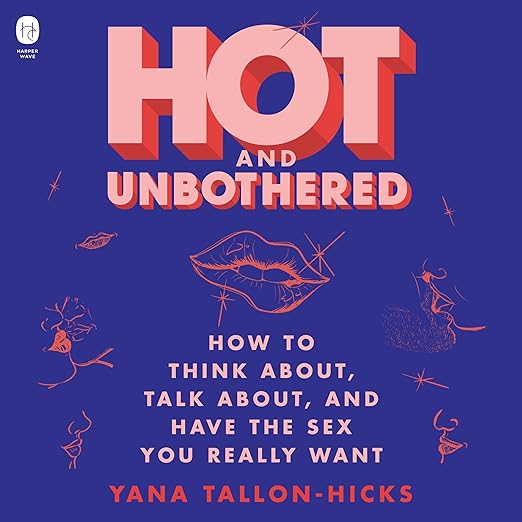
Sex education books fall into two broad failure modes: the clinical variety that processes desire as a medical problem to be solved, and the lifestyle variety that wraps shallow advice in breathless enthusiasm. Hot and Unbothered by Yana Tallon-Hicks manages to avoid both traps with some consistency. As an audiobook, this title runs just over ten and a half hours, narrated by Kristin Condon, and it works from a specific professional position: Tallon-Hicks is a sex therapist who developed these frameworks with real clients in real sessions, not a wellness personality packaging intuition as expertise.
The structure begins with something genuinely useful, which is the dismantling of the concept of good sex as a seamless, naturally occurring event. Tallon-Hicks argues that the ideal of effortless, instinctive sexual compatibility is not only unrealistic but actively harmful, because it leaves people who struggle with the gap between expectation and experience feeling fundamentally broken rather than simply underprepared. That opening premise distinguishes the book from most of its category peers immediately.
Client-Tested Frameworks Built for LGBTQ+ Listeners
The therapeutic framing here is the book's strongest asset. Tallon-Hicks draws directly from programs she developed for her therapy clients and workshops, which means the exercises and frameworks have been tested against actual human complexity rather than theorized in the abstract. The book is explicitly LGBTQ+-inclusive in a way that goes beyond surface acknowledgment. It builds its definitions of desire, identity, and partnership from the ground up in inclusive terms, which makes it a genuinely different resource for queer listeners who have historically found themselves edited out of mainstream sexual wellness content.
Kristin Condon's narration serves the material well. The subject matter requires a voice that can deliver frank anatomical and emotional content without either clinical detachment or performative enthusiasm. Condon finds a middle register that matches the book's own tone: warm, precise, and unhurried. The accompanying PDF, which supplements the worksheets and exercises from the text, adds practical value for listeners who want to use the book as an active workbook rather than passive listening material. The combination of structured exercises and substantive conceptual content gives the ten-hour runtime real density.
The range of topics covered is considerable. After dismantling the myth of effortless good sex, Tallon-Hicks moves through self-inventory, the psychological architecture of shame and secrecy, desire identification, barrier navigation, communication frameworks for current and new partners, and strategies for addressing common stumbling blocks and backslides. Each section builds on the prior one in a sequence that feels clinical in the best sense: ordered, purposeful, and evidence-informed.
Kristin Condon Voices Shame Without Judgment
The audio format works particularly well for the conversational and reflective sections, where Tallon-Hicks walks through the psychological architecture of shame, secrecy, and low self-esteem as they intersect with sexual identity. These are not easy subjects in text; they benefit from a voice that can modulate between the theoretical and the personal. The book moves from self-inventory exercises to partner communication strategies to troubleshooting tricky conversations, and the progression feels earned rather than imposed.
The LGBTQ+-inclusive design deserves more than a passing mention because it is structural rather than cosmetic. The book does not treat heterosexual monogamy as the default with additions bolted on for other configurations. It builds from the premise that desires and relationships take many forms, and that the tools for understanding, communicating, and fulfilling those desires should be available to everyone regardless of identity or partnership structure. That design choice significantly widens the book's usefulness beyond the conventional sexual self-help audience and is one of the primary reasons the audiobook carries the very high rating it does.
Worksheets Work Better on the Page
The ten-hour runtime is substantial for a book of this type, and some sections cover familiar ground for listeners who have already engaged with consent frameworks, shame resilience, or relationship communication literature. The worksheets are also easier to use in print than in audio form, which means the listening experience is most effective for the conceptual and narrative sections rather than the structured exercises. Condon reads the worksheets clearly, but completing them requires pausing, which can interrupt the listening flow.
The rating of 4.9 from 44 listeners is impressively high and relatively consistent across responses, with reviewers noting both personal and professional utility. One reviewer described annotating the book extensively for reference with clients, which speaks to the material's density and applicability as a professional resource. Listeners approaching this expecting a light, entertaining take on sexuality will find it more rigorous than expected. That is a strength, but it is worth managing expectations around the level of engagement the book asks for.
Therapists and LGBTQ+ Listeners Both Find Value
This audiobook works best for adults who want a framework-based approach to understanding and communicating their sexual desires, particularly those who have found conventional sex education inadequate or exclusionary. LGBTQ+ listeners, people working through shame or identity questions around sexuality, and anyone navigating new or changing partnership dynamics will find the most resonance here. It also has genuine value as a professional resource for therapists and educators in relevant fields.
Listeners looking for explicit erotic content will not find it here. This is a therapeutic and educational resource, not erotica. The frank language is in service of clarity and normalization rather than arousal. Anyone approaching it expecting stimulating content rather than substantive instruction will be disappointed by the analytical register, which is worth knowing before purchase rather than after.
In Brief
- Read by: Kristin Condon brings a warm, professional tone that matches the book's therapeutic register, keeping the explicit material grounded without stripping it of warmth.
- At its heart: Sexual self-discovery, communication and consent, shame and identity
- Vibe: Frank and affirming, written from a clinical but human perspective
- Short version: A genuinely substantive sex education resource that earns its place among the better books in this category, particularly for LGBTQ+ listeners who have felt excluded from mainstream sexual wellness content.