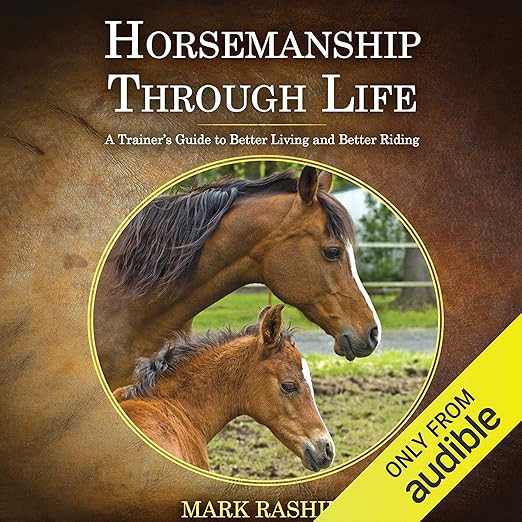
I first heard Mark Rashid's name from a rider at a clinic in upstate New York, someone who had been training horses for thirty years and still talked about Rashid the way people talk about a teacher who changed something fundamental. That kind of reputation tends to either hold up or collapse under scrutiny. In Rashid's case, it holds.
I listened to Horsemanship Through Life on a Saturday morning with the windows open, which felt appropriate. The book is short, just over seven hours, but it moves at its own pace, and there were several passages where I stopped to think before continuing. That is not something I say often about an audiobook in the pets and animal care category.
Passive Leadership, an Authority That Never Announces Itself
Rashid is very clear about what this book is and is not. It is not a technique manual. It is not a training guide in the conventional sense. It is a meditation on the principles that shape good horsemanship, and by extension, the principles that shape a good life. That framing could easily tip into vague self-help territory, but Rashid keeps it grounded by being specific. The anecdotes are real, the horses are named and characterized, and the observations about animal behavior are precise enough to be useful rather than decorative.
One of the recurring ideas in the book is what Rashid calls passive leadership: the concept that effective authority does not announce itself but demonstrates itself through consistency, honesty, and genuine attention to the other party's experience. He develops this through horse examples but makes the application to human relationships explicit and thoughtful. A reviewer who attended his clinics in Massachusetts notes that reading the book felt like encountering the same person she had watched work with horses in person. That kind of consistency between public persona and written voice is rarer than it should be.
An Audiobook Suited to Rashid's Conversational Prose
The audiobook format suits this material particularly well. Rashid's prose has a conversational quality, and Chamberlain's narration honors that without over-performing it. The pacing is unhurried, which matches the book's central argument: that patience is not a passive state but an active discipline. There were moments during my listen where the measured pace of the delivery reinforced the ideas on the page in a way that reading silently might not have achieved.
For riders who have encountered natural horsemanship as a category, Rashid's approach is worth distinguishing from the broader movement. Several reviewers note that they initially dismissed him as just another natural horsemanship practitioner before encountering his work directly. His focus is on communication rather than dominance or imitation of herd behavior, and that distinction has practical implications. The book explains that distinction more clearly than most critical writing about the subject does.
Brief by Design, Harder to Visualize for Non-Riders
Listeners who are not horse people at all may find the middle sections, which get more technically specific about rider position and feel, slightly harder to visualize without context. The book is ultimately accessible to non-riders, and Rashid does his best to translate the principles into terms that apply beyond the arena, but a baseline familiarity with horses is helpful. The book rewards patience from any listener, but riders will get more from it simply because the specific examples will land more immediately.
The book is also brief relative to its ambitions. At seven hours, it does not exhaust any of its themes, and several reviews note wishing it were longer. That brevity is both a strength and a limit. Rashid does not overstay his welcome or repeat himself, but listeners who want extended case studies or a more comprehensive framework will need to look elsewhere in his catalog.
Kin to Books About Mastery, Trust, and Craft
This is an obvious choice for anyone who rides horses, trains horses, or lives and works with them in any capacity. Rashid's perspective on equine communication is practically useful and philosophically grounding in a way that most horsemanship books are not.
Beyond that audience, it will appeal to readers drawn to books about learning, teaching, and the dynamics of trust. Think of it as belonging to the same general territory as books about mastery and craft, approached from an unusual and quietly compelling angle. If you have found yourself returning to writers like Robert Pirsig or Wendell Berry for their thinking about attention and care, this will feel like familiar company.