The Short Version
- Narration: Larry Peterson takes on a direct, first-person instructional voice; no specific listener feedback on his performance is on record, but the register fits a practical safety-first riding primer.
- Themes: Horse psychology over dominance, safety-first instruction, building a genuine rider-horse partnership
- Mood: Practical and encouraging, with a repeated safety-first drumbeat
- Verdict: A solid audio primer for total beginners preparing for real lessons, not a substitute for visual, hands-on instruction.
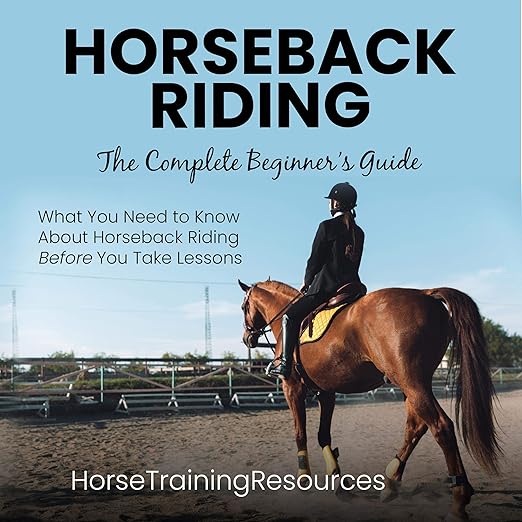
Charlie Hicks opens this audiobook the way any good riding instructor opens a first lesson: with safety, repeated for emphasis, before a single word about tack or technique. Horseback Riding: The Complete Beginner's Guide runs a lean three hours and sixteen minutes, and Hicks uses nearly all of it working through what a total novice needs to know before ever swinging a leg over a saddle, treating a thousand-plus-pound animal with a mind entirely its own as the central fact any new rider has to respect from day one.
Safety, Safety, Safety, Repeated for a Reason
Hicks's core argument is that riding success has almost nothing to do with physical dominance over a much larger, much stronger animal, and everything to do with understanding a horse's actual limitations and instincts. The direct-address teaching style, 'I can only assume that you are serious about horseback riding,' 'you'll hear me throughout this book talk about safety, safety, safety,' puts the listener in the position of a student getting one-on-one instruction rather than working through a dry reference text, and that framing suits the audio format naturally.
The book's central reframe, that a horse is a partner with its own mind rather than an obstacle to be managed, runs through every chapter, from horse psychology and physical characteristics to the mental and physical preparation a rider needs before getting anywhere near a saddle. That partnership framing is echoed almost word for word by reviewer dotchris, who specifically credits Hicks for addressing 'the need for a rider and horse to build a relationship based on mutual trust and confidence,' requiring respect flowing in both directions.
A real pedagogical logic sits behind Hicks repeating 'safety, safety, safety' rather than stating it once: repetition is how instruction actually works when the stakes are physical and the audience is brand new to a genuinely unpredictable animal. The synopsis is explicit that success depends on both physical preparation, speed, strength, coordination, and mental preparation, learning to read an animal that 'has a mind of his own,' and Hicks structures his instruction to hit both halves rather than treating riding as a purely physical skill to be drilled.
Larry Peterson Voices a Lesson for Any Age
Larry Peterson takes on Hicks's first-person, conversational instructional voice, and the practical, safety-first register the book demands is a reasonable fit for that kind of direct-address material, though no specific listener feedback on his performance is attached to this listing. Reviewer Sunshine82's assessment is worth noting regardless of narrator: despite years of riding experience already, she still found the material 'very beneficial to my horsemanship knowledge,' which suggests the content itself has value beyond a first-timer's introduction.
Reviewer busyguy calls the opening section on horse psychology 'marvelous and intuitive,' 'very, very helpful to the newbie,' which lines up with what the synopsis promises: a foundation in how a horse thinks before any hands-on instruction begins. Combined with dotchris's trust-and-respect framing, the reviews consistently point toward the same strength, a book that treats horsemanship as relational rather than purely mechanical.
The word 'complete' in the title is worth checking against the actual runtime: at three hours and sixteen minutes, this is complete in the sense of covering the necessary conceptual ground for a first-timer, not in the sense of an exhaustive, multi-week curriculum. Reviewer dotchris's five-star assessment and Sunshine82's praise for content 'for all levels of horsemanship' both suggest Hicks delivers real value within that scope rather than promising more depth than a three-hour format could honestly provide.
The synopsis specifically frames the book as being for 'anyone of any age,' a broader audience claim than many beginner guides make, and Sunshine82's own experienced-rider perspective finding value here alongside busyguy's newbie-focused praise suggests that age-and-experience breadth holds up in practice rather than existing only as marketing language.
Poor Pictures in Print Become No Pictures in Audio
The single biggest caveat sits right in reviewer busyguy's own review title: 'excellent brief summary, very poor pictures.' That's a complaint about the print edition's illustrations, and it matters more, not less, for the audiobook, since whatever visual value those pictures had in print disappears entirely in an audio-only format. A beginner's guide to horse anatomy, tack, and body positioning is exactly the kind of material that benefits from visual reference, and listeners should expect none here.
Busyguy calls the book 'brief, concise and a quick read,' and that compactness has a practical upside beyond just respecting a listener's time: a guide this short is genuinely easy to revisit in full right before an actual first lesson, functioning as a quick refresher rather than a one-time listen that gets set aside and forgotten.
This sits within a broader category of beginner animal-care and outdoor-sport guides built for audio, where the format's core tension is always the same: practical physical skills benefit from demonstration, and audio can only describe, not show. Horseback Riding handles that tension about as well as the format allows by front-loading conceptual and safety material, the part that translates cleanly to audio, ahead of anything requiring visual demonstration.
Listeners should also note the tags field files this under 'Pets & Animal Care' alongside its sports-outdoors genre listing, a reasonable double classification given how much of Hicks's material concerns understanding a horse's psychology and welfare rather than pure athletic technique.
Cheap Test of Interest Before Buying a Helmet
Complete beginners preparing for their first real riding lesson are the clearest audience, and the book works especially well as preparation to bring into an actual lesson with an instructor, giving a new rider useful vocabulary and a working mental model of horse psychology before ever touching a saddle. Parents vetting a first riding experience for a child, or adults considering the sport for the first time, will find the safety-first framing reassuring rather than alarmist.
Anyone considering horseback riding as a new hobby, rather than already signed up for lessons, will find the low time investment, just over three hours, makes this an easy way to test genuine interest before committing money to boots, a helmet, or a full riding program, without a full weekend clinic's worth of time on the line if the interest doesn't end up sticking.
The book's structure, safety and psychology first, hands-on technique second, mirrors how most in-person riding programs actually sequence a first lesson, which means listeners who complete this audiobook before their first real session will likely find the material reinforcing rather than contradicting what an instructor tells them. That alignment between the book's own pedagogy and standard riding-instruction practice is a quietly reassuring sign that Hicks's approach reflects real teaching experience rather than a generic outline assembled without direct instructional background.
Visual learners hoping for diagrams of proper hand position, tack assembly, or mounting technique should treat this as a companion to hands-on lessons rather than a standalone visual reference, since Hicks's own material depends on pictures the audio format simply cannot carry over.