Quick Take
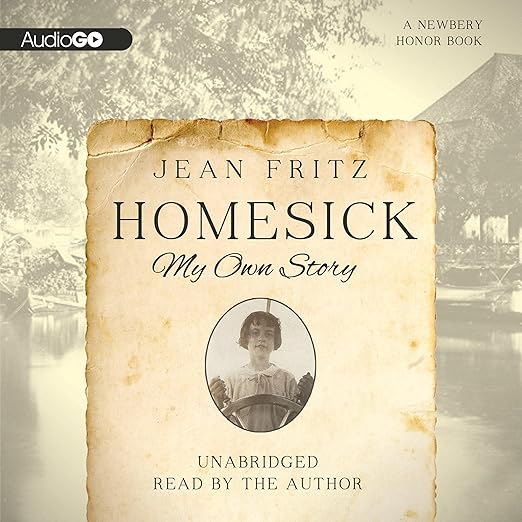
- Narration: Jean Fritz reading her own childhood memoir is one of the most significant audio pairings in middle-grade biography. Her voice carries the lived authority that no other narrator could supply.
- Themes: Belonging and cultural displacement, Third Culture Kid experience, the longing for a home you have never lived in
- Mood: Wistful and honest, with flashes of comedy and genuine unease
- Verdict: A classic of middle-grade autobiographical writing, and Fritz’s self-narration elevates the audiobook into something qualitatively different from the print version.
I was a literature student before I was a critic, and the books I studied that stayed with me longest were the ones written from the seam between cultures, accounts of people who belonged fully to two worlds and, as a consequence, felt they belonged completely to neither. Jean Fritz’s Homesick: My Own Story is one of the best accounts of that experience ever written for a young audience, and the audiobook brings something the print version fundamentally cannot: Fritz’s own voice.
The book is a fictionalized autobiography, a category that Fritz pioneered in children’s literature. It draws directly from her own childhood in Hankow, China, where she grew up as the daughter of American missionaries during the turbulent political years of the 1920s, a period of growing nationalism that made the foreign presence in China increasingly precarious. Fritz was twelve during the period the book covers, and her retrospective account of that time has the quality that only genuine memory can produce: specific textures, specific fears, and a specific longing for a country, America, that she had never lived in but had been taught to love as home.
The Third Culture Experience as Literature
There is a reader review that notes the experience of encountering this book as someone born and raised in Hankow a hundred years after Fritz, and that intergenerational resonance speaks to what Fritz achieved. She was not writing about an exotic childhood for an American audience’s consumption. She was writing about the interior experience of a child who belongs nowhere quite completely, who loves the Yangtze River and the mountains of China genuinely while also genuinely feeling that she does not belong there. That double allegiance, that double homesickness, is the emotional core of the book.
The political context, foreigners becoming increasingly unwelcome, evacuation possible at any moment, is handled at exactly the level a twelve-year-old would process it: as background anxiety that occasionally becomes foreground crisis. Fritz does not explain the Nationalist movement or Chinese-foreign relations with the analytical clarity of an adult retrospective. She renders it as a child experienced it, which is a more honest approach and a more powerful one.
Author-Narration as Primary Document
Jean Fritz reading her own childhood memoir is an event in itself. Her voice carries decades of perspective on the material, and when she reads the passages about longing for America, you hear both the child who felt that longing and the adult who understands what it meant. This is not something a professional narrator, however skilled, can reproduce. It is one of those rare audiobook pairings where the author-narration is not just an added value but a qualitative transformation of the experience.
The reviewer who found the book too short, who wanted more, was responding to exactly this quality. Fritz’s voice and perspective make you feel the limitation of what she chose to include, the way the book ends with the arrival in America rather than the full reckoning with what that arrival meant. That restraint is a literary choice, and Fritz’s own reading of it makes the restraint more legible as a choice rather than an oversight.
What Might Disappoint and What Will Not
The book covers only about two years of Fritz’s childhood, and the narrative ends before the America she longed for has had time to answer the longing. Some listeners, particularly adults who pick this up alongside children, will feel the incompleteness of that arc. The book that follows, China Homecoming, addresses the adult return, but that is adult memoir rather than children’s biography, and its tone is quite different. Taken on its own terms, Homesick is complete: it is the story of a longing, not the story of its resolution.
Who Should Listen and Why It Has Lasted
This is a book for children aged nine and up and for adults who were once those children. It has lasted because it tells the truth about a specific kind of childhood without making that childhood exotic or pitiable, and because Fritz’s prose, even in a children’s context, has the compression and specificity of serious literary writing. The audiobook, with Fritz narrating her own experience, is the version of this classic that belongs on any serious children’s listening list.
Frequently Asked Questions
Is Jean Fritz’s self-narration a significant asset, or is this one of those cases where author-narration adds little?
It is a significant asset, arguably the reason to choose the audiobook over the print version. Fritz’s voice carries the lived experience of the material in a way no other narrator could approximate, and her reading illuminates the retrospective dimension of the fictionalized autobiography.
How does this fictionalized autobiography differ from a standard memoir?
Fritz compresses and lightly fictionalizes some of the events for narrative clarity, but the emotional truth and the specific details of her Hankow childhood are autobiographical. The fictionalization is more a matter of scene construction than invention of events.
What historical context do listeners need to understand the political backdrop of 1920s China?
The book is designed for readers without prior knowledge of Chinese history, and Fritz renders the political situation at the level a child would have experienced it. Listeners will absorb the essential context from the narrative itself, though adults may find additional background enriching.
Is Homesick appropriate for children who are themselves Third Culture Kids or who have experienced similar cultural displacement?
It is particularly resonant for those listeners. Fritz was writing from personal experience of cultural in-between-ness, and the book has consistently found its most devoted readers among children who recognize their own double allegiance in her account.