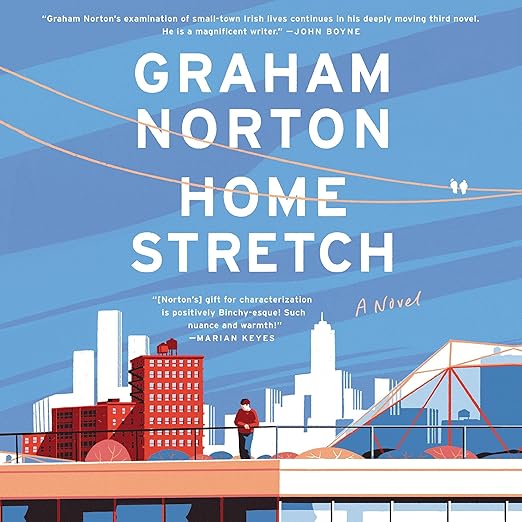
I started Home Stretch late on a Friday evening, thinking I would listen to the first hour and put it down. I finished it the following afternoon. Graham Norton's novel has the quality that the best Irish fiction has always had, a surface warmth and wit that conceals genuine cruelty underneath, the cruelty not of malicious people but of small communities and the silences they enforce. By the time I understood what Connor had been carrying since 1987, I understood why he could not go back.
The fact that Norton reads his own novel is a significant part of why this works as an audiobook. His voice has been in our living rooms for years, and that familiarity creates an intimacy that a hired narrator, however talented, could not replicate in the same way.
The novel opens in 1987 with a car accident the day before a wedding. Three young people die; three survive. Connor, the driver, lives but cannot live in the town that holds the dead and their grieving families. He leaves for Liverpool, then London, then New York, and Norton follows him through each stage of displacement with a sociologist's eye and a comedian's ear for the telling detail. The novel is formally conventional, the emigration narrative is one of Irish fiction's oldest templates, but Norton makes it feel necessary by understanding that the contemporary dimension of Connor's secret is what transforms a familiar story into a timely one.
Multiple reviewers have compared the book to Maeve Binchy, and it is a comparison Norton himself would likely accept as the highest compliment. The Irish social texturing is precise: the way grief distributes unevenly through a small community, the way old resentments attach themselves to new tragedies, the way a person can leave and leave and leave and still find the past waiting.
What Makes Home Stretch Worth Hearing
Norton's narration is the audiobook's decisive advantage over the print version. He does not need to announce that a scene is funny or sad; his voice contains both simultaneously in the way that Irish speech often does. The dialogue lands particularly well, the rhythms of rural Cork speech are present without caricature, and the transitions between Connor's Irish past and his eventual New York present are managed with a lightness that makes the emotional impact of the latter sections more acute, not less.
The Sunday Times called it compelling, bighearted, and emotionally precise, and that description holds in audio. The three qualities reinforce each other through Norton's reading: the bighearted quality is in his warmth, the emotional precision is in his restraint, and the compulsion comes from a plot that never quite lets you settle into the comfortable expectation that things will resolve cleanly.
Things to Know Before Starting Home Stretch
The novel deals with homosexuality in rural Ireland in the 1980s, and this is where some readers have found the treatment of period attitudes more confrontational than expected. One reviewer, noting antiquated attitudes re being gay, seemed surprised by the novel's willingness to sit inside the specific shame of that era rather than soft-pedaling it from the vantage of the present. Norton was himself a young gay man in Ireland in the 1980s, and his understanding of what that meant institutionally and socially gives these sections an authority that cannot be faked.
The novel's second and third acts, Connor's life in London and New York, are somewhat less tightly plotted than the Irish sections. The secondary characters in those settings are less fully realized than the people Connor leaves behind, which may be intentional (exile attenuates connection) but can make the middle portion feel slightly thinner.
Who Graham Norton Is Writing For
Essential listening for anyone interested in Irish literary fiction, in emigration narratives, or in the specific atmosphere of what it meant to carry an unspeakable secret through the decades before social change caught up with private reality. Maeve Binchy readers will find exactly what those reviewers promised: the same social precision applied to darker material. Listeners who want their literary fiction without the specifics of gay history in rural Ireland should know those elements are central rather than incidental to the book's concerns.
Questions Listeners Ask
Is Home Stretch Graham Norton's first novel, and how does it compare to his other fiction?
It is his second novel, following Holding, which also featured small-town Irish life and secrets. Home Stretch is considered by most readers and critics to be the stronger work, more thematically ambitious and darker in its exploration of what shame does over a lifetime.
Does Norton's experience as a television host affect how he performs the audiobook, does it feel performed in a showbiz sense?
The opposite, actually. Norton reads with a restraint that may surprise listeners who know him from his television persona. The wit is present but never pushed, and the emotional scenes are handled with a quietness that makes them land harder than a more theatrical reading would.
Multiple reviewers compare Home Stretch to Maeve Binchy, is that comparison primarily about setting, or does it reflect something about Norton's prose style?
Both. The Irish social observation and the ensemble of characters caught in a web of long-held feelings are Binchy hallmarks. But several reviewers also note a similarity in cadence and the way Norton, like Binchy, allows humor and pathos to inhabit the same sentence without either canceling the other out.