Quick Take
- Narration: Liz Hauck reads her own memoir with a quiet steadiness that mirrors the book’s emotional register, never overselling the more difficult moments.
- Themes: Grief and continuity, community across difference, food as connection
- Mood: Tender and honest, with moments of real humor alongside real difficulty
- Verdict: One of the more quietly affecting memoirs in recent years, and Hauck’s decision to narrate it herself was the right one.
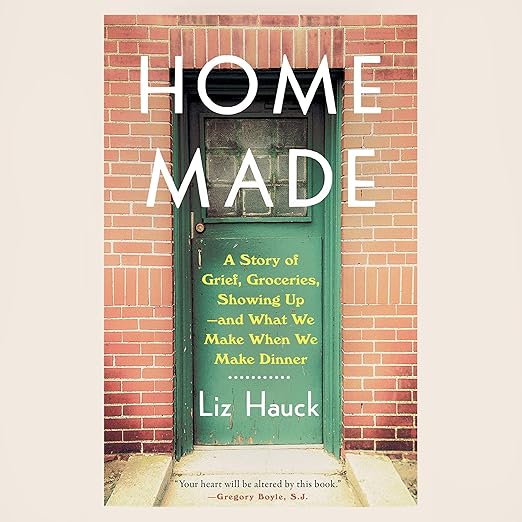
I came to this one on the recommendation of a colleague who said simply, read it and then tell me you don’t feel differently about shared meals. I started it on a Sunday afternoon and finished it well into the evening, not because it is a fast book but because it kept pulling me back before I was ready to set it down. Home Made is the kind of memoir that doesn’t announce itself as important. It builds quietly, through accumulated detail, toward something you don’t see coming until it has already moved you.
Liz Hauck was a high school teacher in Chicago when her father died before they had the chance to launch a cooking program they had planned together for teenage boys in state care. She decided to start it anyway. What followed was nearly three years of weekly two-hour cooking sessions with a rotating group of court-involved youth, and this book is her account of what happened around that table. The New York Times named it an Editors’ Choice. The description extraordinary, which appeared in their review, is not overstatement.
Our Take on Home Made
The book’s central question is deceptively simple: who are we to one another? Hauck is not an activist writing a manifesto, and she is not a social worker processing case studies. She is a teacher who showed up week after week, bought the groceries the kids chose, and cooked dinner with them. The discipline of that showing up, which she articulates as the cardinal rule of volunteerism, gives the book its spine. She does what she says she will do. She comes back. For young men whose experience of adults has often centered on broken promises and institutional abandonment, that consistency turns out to be radical in the most ordinary possible way.
What Hauck captures brilliantly is the specific texture of cooking with other people: the clumsy choreography, the improvisation, the way a kitchen forces a kind of negotiation and collaboration that is harder to avoid than in most social spaces. The conversations that happen while chopping vegetables or waiting for something to come out of the oven are different from conversations that happen face to face. That insight, which Hauck demonstrates rather than argues, is one of the reasons this book works.
Why Listen to Home Made
Hauck narrates her own memoir, and the choice is the right one. Her voice has the quality of someone who has thought carefully about what she is saying without over-rehearsing it. There are no performed emotions in this narration; when the book gets hard, she reads through it with a steadiness that communicates more than dramatic inflection would. Reviewers describe moments of laughing out loud and moments of holding their breath in stillness, and the narration supports both without telegraphing them. At twelve hours, this is a substantial listening commitment, but the pacing earns the length.
What to Watch For in Home Made
The book does not flinch from the systemic failures that brought these boys into state care in the first place. Hauck is clear-eyed about race, class, and the ways the institutions meant to protect vulnerable young people often compound their difficulties. She is not polemical about it, which makes the observations land harder. Readers who are interested in criminal justice, education, and the limits of volunteerism will find this book a more nuanced entry point than most. One reviewer described it as addressing race, education, and grief in an approachable way, and that is accurate. The difficulty of the material is present but it is never weaponized for emotional effect.
Who Should Listen to Home Made
This is for anyone who has ever wondered whether showing up in a small, consistent way actually matters, and who needs a book to remind them that it does. Readers drawn to memoirs about community, grief and continuity, and the intersection of food and human connection will find this deeply satisfying. It is also an excellent choice for listeners interested in education, youth advocacy, and the quietly transformative power of ordinary care. It is not a difficult listen, but it is a meaningful one.
Frequently Asked Questions
Do you need to know the boys individually to feel invested in the memoir?
No. Hauck introduces the young men with enough specific detail to make them feel real without turning them into archetypes, and the emotional investment builds through the cooking sessions themselves rather than through individual character arcs.
Is this memoir primarily about grief for Hauck’s father, or about the cooking program itself?
Both threads are present throughout. Her father’s absence is the reason the program exists, and the book traces how completing his unfinished project becomes a form of grieving that is also genuinely generative.
How does Liz Hauck’s self-narration handle the more emotionally difficult sections of the book?
She reads through the harder passages with a quiet steadiness rather than dramatic emphasis, which suits the book’s tone well. The restraint in her narration makes the emotional moments more affecting, not less.
Is Home Made suitable for listeners who don’t have a strong interest in food or cooking?
Yes. The food is a vehicle rather than a subject. The book is fundamentally about human connection, grief, and what it means to show up for other people. Cooking provides the frame; the content is entirely about relationship.