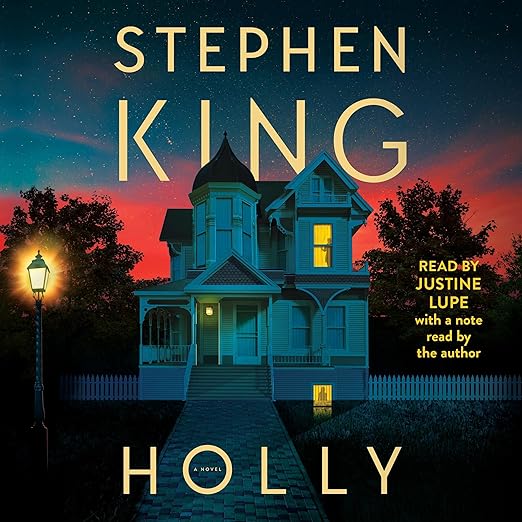
Penny Dahl calls a detective agency about a daughter who has vanished, and Holly Gibney has every reason to refuse the case. Her business partner is down with Covid, her very complicated mother has just died, and she is supposed to be on leave. She takes it anyway, which tells you most of what you need to know about the character Stephen King finally handed a book of her own. The audiobook runs fifteen hours and forty-seven minutes, and it belongs to Holly in a way her earlier appearances never quite did.
Is Holly Worth Your Time?
Rodney and Emily Harris are the reason this novel works. King introduces them in the second paragraph of his own description as married octogenarians, semi-retired academics, the picture of bourgeois respectability, and then states flatly that something is kept in their basement. Withholding the villains was never the plan. What the book withholds instead is the exact shape of what they are doing and how near Holly can get before they notice her, and that proves a more sustainable engine than a puzzle about identity would have been.
The four-star response on this page names the structure precisely: no supernatural factors here, a decent enough mystery even though you learn early on who did it. That same entry admits to being too disturbed to continue at points and continuing regardless, which is the most accurate account of the experience anybody has left behind. King has written frightening books before. He has not written many where the ordinary domestic detail of a crime feels this unpleasant, and the discomfort is engineered rather than accidental.
Justine Lupe reads for Simon & Schuster Audio, and not one response on this page says a word about the performance. Five people wrote at length about plot, politics, characters and King's late-career form, and every one of them was grading a book they read with their eyes. On a novel that lives almost entirely inside one woman's methodical, anxious interiority, that omission costs more than it usually would, and the sample becomes the only instrument left to you.
The Best Parts of Holly
Continuity is the first pleasure for anyone who has followed this character. The April 2024 five-star traces its own attachment back to the Mr. Mercedes Trilogy and reports hearing the author say on a podcast that he had fallen for her as well, and felt obliged at last to give her a book. That history pays off immediately. Holly arrives fully formed, with tics and habits and a competence earned across several novels, and King spends almost none of the runtime explaining her to newcomers.
Procedure is the second. King assembles the investigation out of parking lots, bicycles, security footage, a missing-persons timeline and the ordinary friction of asking strangers questions, and the tension comes from how slowly a careful person can close a gap. Set against that patience, the Harrises' domestic routine works as a second kind of method, which is what makes the parallel structure land instead of feeling schematic. Anyone who came to King expecting supernatural machinery will find none of it running here.
Fifteen hours is generous for a novel this contained, and the length does work rather than padding. King gives real room to Barbara and Jerome, to Penny Dahl's slowly collapsing hope, and to a pandemic setting he declines to treat as background texture. Masks, tests and a half-shut city shape what Holly can and cannot do, and the period functions as a working constraint on the investigation. Very little crime fiction written in those years managed to use the conditions rather than merely mention them.
Before You Commit to Holly
Politics sit right on the surface, and a buyer should know that before starting. The November 2025 five-star spends most of its length there, comparing Rodney to the kind of people who follow a certain politician and observing that King states opinions plenty of readers will dislike hearing. That entry is accurate about the book. King is not subtle regarding vaccine refusal, academic self-regard, or the particular cruelties his villains talk themselves into, and listeners who want crime fiction with no argument in it will find this one answering back.
A five-star filed from Germany calls the book a novella, which is worth pausing over. Nothing about this is a novella. The recording runs close to sixteen hours and the source is a full-length novel, so anyone scanning that response for a sense of the commitment involved would come away badly misinformed. It is a small slip, and a useful reminder that the star line on this page was assembled by readers describing objects of very different sizes.
Absent from this record is any sign that Holly Gibney has a history. The series fields sit empty, no reading order appears on the page, and the sole clue is the word returns in the second paragraph of the description. Decoding that requires already knowing King's catalog, which describes exactly the reader who needs no help. The novel does stand alone, and King builds in enough for a first-timer, but a buyer deserves to be told they are joining a character partway through her working life.
Should You Listen to Holly?
Crime readers who like a competent, unglamorous investigator are the core audience, and the August 2025 five-star describes that pleasure well: appreciation for the plot, the dialogue, the suspense, and specifically for Holly, Barbara, Jerome and Olivia as people worth the hours. That same response files the book alongside a run of contemporary thrillers finished in single sittings, which strikes me as a fair placement. This is a book that moves, with considerably more on its mind than most that move this fast.
Newcomers to King can begin here without difficulty, and I would still argue against it. Nothing in the plot requires prior reading, but half the satisfaction comes from watching a supporting player finally take the center of the frame, and that satisfaction is unavailable to somebody meeting her for the first time. If the Mr. Mercedes novels are within reach, spend those hours first. Holly rewards the detour more than almost any other late King title would.
Avoid it if pandemic settings still feel too near, if you want your horror supernatural, or if you would rather crime fiction kept its politics offstage. Avoid it too if graphic cruelty is a hard limit, since the Harrises' project is laid out in enough detail to genuinely upset a listener. What remains is King working in a register he has been sharpening for years, on a character who spent four novels earning the right to a title of her own.
Before You Press Play
- Narration: One credited reader from Simon & Schuster Audio for a novel that almost never leaves Holly's point of view.
- Themes: Grief and duty, methodical detective work, respectability as cover, pandemic-era isolation.
- Mood: Cold, patient and steadily upsetting.
- Verdict: The strongest of King's late crime novels, and stronger again if you have met Holly Gibney before.