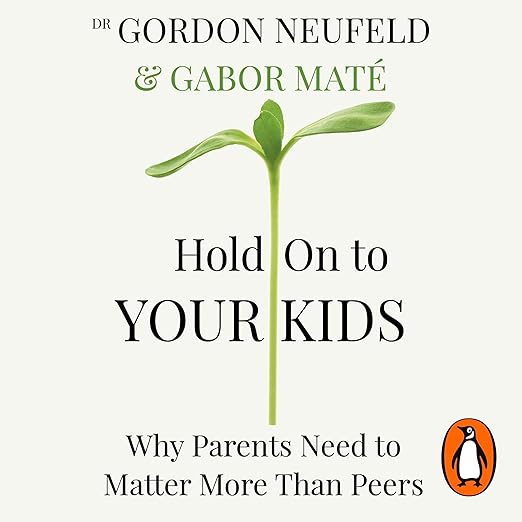
Gordon Neufeld and Gabor Mate's Hold On to Your Kids begins from a premise that many parents sense but struggle to articulate: that children taking their primary cues from their peers rather than their parents is not a natural developmental state, and that treating it as one has specific costs that accumulate over time. This audiobook, narrated by Daniel Mate, arrives in its updated edition with added material on the impact of digital devices and social media, and the added material lands with some force given how clearly the original argument anticipated the smartphone era's effects on peer dynamics.
Daniel Mate narrating his father's co-written book is a production choice that deserves acknowledgment upfront. It's unusual, and it gives the audiobook a particular texture. His voice carries a kind of lived familiarity with the material that a hired narrator wouldn't have; there's no sense of someone working to inhabit an argument from the outside. Whether that constitutes an advantage depends on the listener's prior views on the Mate family's public intellectual work, but as a narration performance, it is calm, clear, and appropriately measured for a book that is making careful claims rather than emotional ones.
Peer Orientation Displaces the Parent-Child Bond
The book's central concept is what Neufeld and Mate call peer orientation, the displacement of parental attachment by peer relationships as the primary source of a child's identity, values, and behavioral codes. Their argument is that this shift is not a neutral developmental transition but an active disruption of the natural hierarchy, and that it has measurable effects on children's anxiety levels, conformism, and capacity for genuine intimacy. The parenting literature is full of books that diagnose problems without offering tools. This one has both, and the balance is one of its genuine strengths.
One reviewer described a eureka moment reading the book, a sudden understanding of a daughter's behavior that had been opaque for years, and that kind of specific, applicable insight is what distinguishes Hold On to Your Kids from more theoretical parenting texts. The concept of "collecting" children, the small rituals and deliberate moments of connection that maintain the parent-child bond without drama or confrontation, is the practical core of the book, and Neufeld and Mate are good at translating it into everyday parental behavior. The audiobook gives these sections a particular presence; Daniel Mate's narration makes the recommendations feel like advice from someone who has lived adjacent to this research rather than someone presenting it cold.
Wordy Rubble Around Genuinely Powerful Ideas
The updated edition's additions on digital devices and social media are the material most relevant to parents navigating the current landscape. The original book was written before the smartphone became the primary medium of peer contact, and the update addresses that gap without feeling retrofitted. The argument about how peer orientation accelerates through digital connectivity is consistent with the original framework, and the audiobook is organized well enough that the newer material integrates naturally rather than sitting as an appendix.
At fourteen-plus hours, this is a substantive listen. Some reviewers described it as wordy, and that's an accurate characterization. The book repeats its core arguments more than once across its structure, which can feel redundant in audio format where skimming is not an option. But the repetition is also deliberate; Neufeld and Mate are building a conceptual framework that needs to be internalized rather than just noted, and the accumulation of examples and restatements has a persuasive function that listeners who arrive skeptical may find convincing. One reviewer described it as paradigm-shifting while also noting the excess of wordy rubble around the powerful ideas, which is a fair assessment of the book's stylistic texture.
Alarming Language, More Calibrated Actual Advice
The book's framing is sometimes more alarming than its specific recommendations require. Neufeld and Mate write about peer orientation as far from natural and potentially dangerous, language that can trigger defensive reactions in parents who have raised reasonably healthy children through ordinary social development. The actual advice is more calibrated than the diagnostic language suggests; the book is not arguing that peer friendships are harmful, but that parent-child attachment should remain primary. Listeners who find the apocalyptic-sounding passages overstated should stay with the practical chapters, where the tone becomes more constructive.
The book operates within a psychological framework that is broadly attachment-theory-based and will be most productive for listeners who already have some familiarity with or openness to that approach. Those who come from behavioral or cognitive frameworks may find some of the developmental claims less immediately convincing, though the specific parenting practices the book recommends are fairly portable across frameworks. The Naomi Klein and Guardian endorsements quoted in the synopsis signal the book's intellectual and political orientation, which is relevant context for listeners who want to know how the authors approach questions of child-rearing in relation to broader social critique.
Daniel Mate's Narration Beats Print for Many
Parents of children who have not yet reached adolescence will find the audiobook most immediately actionable. The book's recommendations are most applicable during the developmental window before peer orientation typically intensifies, and listeners who engage with it during those years have the most opportunity to implement the "reattachment" strategies the book describes. Parents of teenagers who are already deep in peer-oriented patterns will still find the diagnostic chapters useful, but the solutions become harder to apply as children age. Daniel Mate's narration makes the audiobook a better choice than the print edition for many listeners; the voice carries authority and warmth without pressure, which matches the tone the book is aiming for.
At a Glance
- Performance: Daniel Mate narrates his father Gabor Mate's co-written work, a choice that adds a layer of personal connection to the parenting material; his calm, measured delivery suits the book's careful argument.
- What it covers: Peer orientation versus parental attachment, the developmental costs of youth culture that displaces adult influence, practical strategies for re-anchoring parent-child bonds
- Feel: Urgent and concerned, but ultimately constructive rather than alarmist
- Our call: Hold On to Your Kids is the kind of parenting book that reframes a set of behaviors you've been observing without naming, and the audiobook's narration by the co-author's son gives it a dimension that print cannot replicate.
Does the Hold On to Your Kids audiobook require familiarity with Gabor Mate's other work to be useful?
No. The audiobook is self-contained and introduces its concepts without assuming prior knowledge of Mate's other books, such as When the Body Says No or In the Realm of Hungry Ghosts. Listeners familiar with his work will recognize consistent themes, but the book functions as a complete argument on its own terms.
Is the Hold On to Your Kids audiobook relevant for parents of younger children, or is it primarily focused on teenagers?
The book's most actionable recommendations are aimed at parents of children who have not yet entered the intense peer-orientation phase, which the authors associate with adolescence. That said, the diagnostic chapters apply across ages, and parents of teenagers will find the framework useful even if the preventive strategies are less easily implemented at that stage.
How does Daniel Mate's narration of the audiobook affect the listening experience?
Daniel Mate is Gabor Mate's son, and his narration of his father's co-authored work gives the audiobook an unusual quality of lived proximity to the material. His tone is measured and authoritative without being distant. Listeners who appreciate the sense that the narrator has personal investment in the content will find this an asset; those who prefer neutral professional narration may notice the difference.
Does the audiobook address social media and smartphones, or is it limited to the original 2004 edition's concerns?
The updated edition that this audiobook represents includes new material specifically addressing the impact of digital devices and social media on peer orientation dynamics. The additions are well-integrated into the original framework and do not feel like a separate appendix, making this version more current than the original.