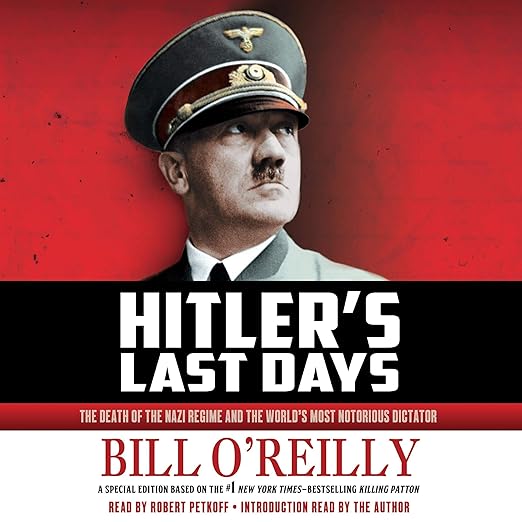
Macmillan Audio gives the collapse of the Third Reich four hours and one minute, and that constraint is the first thing to know about this audiobook. Hitler's Last Days is Bill O'Reilly's young-readers adaptation of Killing Patton, issued in June 2015 with Robert Petkoff reading. The print source is a full-length adult history; what reaches your ears is the compressed version, built for the classroom and pitched, in the publisher's own copy, at multiple aspects of the common core curriculum. Knowing that changes what you should expect from it. This is not a deep account of the war in Europe. It is a fast and narrowly aimed one, and the difference is worth naming before you press play.
A Closer Look at Hitler's Last Days
O'Reilly's frame is deliberately tight. By early 1945 the German Nazi State is finished, the Allied forces under George S. Patton and Dwight D. Eisenhower are taking Europe back, and the leadership of the Reich is out of moves. Adolf Hitler retreats to a secret bunker with his new wife, Eva Braun, and his dog, Blondi, and the book follows those three to the end. That is the spine. Campaigns, politics, the machinery of the regime: all of it folds in around that spine as context rather than getting examined on its own terms, which is how a subject this large fits into a single afternoon.
The approach buys something real. Deborah J. White, who marked the book four stars and came to it as an adult, singled out the passages on the bunker and the Eagle's Nest, and specifically the five tunnels cut through the mountain along winding roads. Those pages left White feeling claustrophobic. That reaction counts for more on audio than it would in print, because physical description is the one thing a recording delivers at full strength. Petkoff has to build those spaces in your head using nothing but the sentences, and the sentences were written to do that job for someone meeting this history for the first time.
Not every response found the pace right. Cindy Cruse, at three stars, called it great for learning history but a slow read, which is worth weighing if you are choosing between the recording and the page. Slow on paper and slow in your ears are different problems. A paragraph you would skim in a second takes its full measure of time once a reader speaks it aloud, and this adaptation's habit of restating context for a younger audience is exactly the kind of passage a print reader glides past.
What Makes Hitler's Last Days Worth Hearing
Momentum is the strongest argument for the recording. One response, filed under the handle Stinky Greg, describes a normal pace of several days per book and then finishing this one inside twenty-four hours, breathless at what was coming in the pages ahead. That is the effect the compression was engineered for, and it survives the move to audio intact. Petkoff keeps the tempo quick without pushing it toward melodrama, which matters in a book whose subject invites exactly that.
The single-reader format also suits the material better than a full-cast production would. This is reported history with a body count, not a drama, and the roll of names, dates and places needs a voice that can carry them cleanly rather than act them. Macmillan Audio credits Petkoff alone across the whole program, so every general, every aide and every location arrives in the same register. For a listener still sorting out who Patton and Eisenhower were in relation to each other, that consistency does quiet work.
Steve Carroll's five-star note gets at the other reason to press play: the book is chock full of information, flows well, and is not, in Carroll's words, a book for children despite the accessible surface. White's response supports that from the other side, pointing out how much of Killing Patton is folded in here, especially around the European Theater. If you have not read the adult volume, that overlap works in your favor. You get the argument of a much longer book at a fraction of its length.
Things to Know Before Starting Hitler's Last Days
Two of the five written responses praise something this edition cannot hand you. Michael P. Quintero's five-star line is fantastic book, many black and white photos, great read. Carroll mentions the pictures in the same breath as the prose. Photographs are a real part of how the printed version works on a young reader, and none of them exist in a recording. Nothing in the audio description flags the swap, so if the images are the reason you are buying, paper is the format you want.
A second oddity sits in the response column. The rating counter on the page reads four, while five written responses sit underneath it, dated across a stretch from October 2022 to February 2026. I am not going to run arithmetic on a 4.3 average built from four whole-star votes, because the number that displays depends on a rounding convention nobody publishes. Read the five bodies instead. They are more useful than the badge, and they disagree with each other in ways an average can never show you.
One more piece of metadata deserves caution: the page files this under teen and young adult while tagging it Biographies, and neither label is quite right. A biography follows a life. This follows a death, with roughly the last months of it in view. Carroll's enthusiasm for O'Reilly's books generally is also a reminder that some of the praise here attaches to an author's catalog rather than to this particular title.
Who Bill O'Reilly Is Writing For
Teenagers who need a way into WWII without three hundred pages of prelude are the core audience, and so are adults who want the bunker narrative in one sitting. Teachers get a clean four hours that maps onto curriculum use, and the descriptive set pieces, the tunnels, the confinement, the last days of a regime, hold up without any pictures at all. Anyone who already knows Killing Patton will recognize a great deal of the material.
Skip it if you want an argument about why the Reich collapsed rather than a chronicle of how its leader ended, or if the photographs are what sold you on the book in the first place. What the recording offers is a narrative aimed squarely at a reader who has not yet met this history, delivered by a voice that respects both the material and the age of its audience. Treat it as the opening chapter of a longer reading list rather than the whole of it.
Key Details
- Narrator: Robert Petkoff carries the entire program alone, holding a brisk documentary tempo instead of dramatizing a subject that would buckle under theatrics.
- Subjects: The fall of the Third Reich, a bunker endgame, WWII history scaled down for teen readers.
- Tone: Quick, plain-spoken, grim without wallowing.
- Bottom line: A four-hour entry point to 1945 for younger listeners, provided you accept that the photographs stay behind in print.