Quick Take
- Narration: Michael Ferraiuolo handles Jack’s cold professional exterior and the warming emotional register with genuine control, making the tonal shift from hitman efficiency to romantic vulnerability feel earned rather than abrupt.
- Themes: Redemption through unexpected love, mafia loyalty and moral cost, the past as an obstacle to the present
- Mood: Tense, propulsive, and quietly romantic
- Verdict: A well-constructed MM mafia thriller with more emotional texture than the setup promises, anchored by a protagonist whose guilt is specific enough to matter.
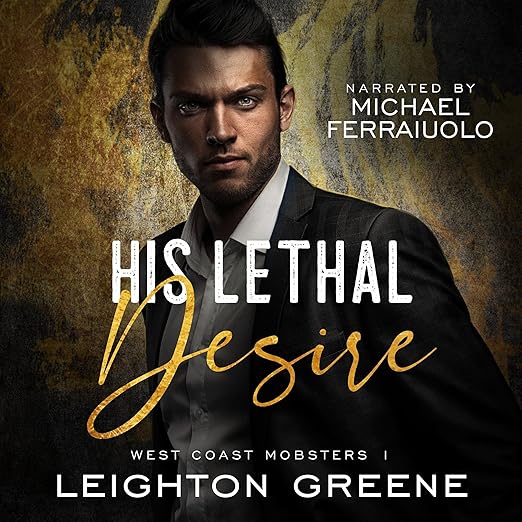
I listened to most of His Lethal Desire on a Sunday that had gone quiet earlier than expected. It was that kind of afternoon where you want something that keeps moving, that has genuine stakes, and that does not ask you to do too much interpretive work while still giving you characters you actually care about. Leighton Greene’s first entry in the West Coast Mobsters: Castellani Family series turned out to be exactly the right thing for that mood, and a considerably more emotionally invested piece of work than I had anticipated from the premise.
Jack is introduced as the Castellani Family’s best hitman, currently demoted to errand-running for a capo he despises, which is a dynamic that tells you immediately what kind of man he is: good at something morally costly, proud of his competence, humiliated by the demotion, and carrying enough accumulated guilt that he has written off the possibility of personal happiness as a matter of principle. When the Don summons him to find a missing Hollywood starlet, the case connects him to Miller Beaumont, the missing woman’s brother, and the attraction is immediate and unwanted on Jack’s side for reasons the novel handles with more intelligence than the genre usually bothers with.
What Makes Jack a More Interesting Hitman
The reviews that call Jack a hitman with morals are both accurate and slightly misleading. He is not presented as secretly a good man who never really hurt anyone. One reviewer from the series community is explicit about this: he has blood on his hands, and the novel does not pretend otherwise. What makes him interesting is that his guilt is specific and granular, not the abstract romantic guilt of a dark-romance protagonist who gestures toward a violent past without specifying it.
Jack knows exactly what he has done. The question Greene is asking is whether a person with that particular ledger has forfeited the right to the kind of life that Miller represents, and the novel’s answer is rendered through plot rather than delivered as a thesis. That restraint, letting the story argue rather than the narration explain, is one of the book’s quiet structural achievements.
The Mystery Thread and How Well It Holds
Annie’s death, when it comes, shifts the book from missing-person investigation to murder mystery, and Greene handles the pivot cleanly. The reveal of who killed Annie and why is built from information that has been present in the narrative throughout, which means it is fair rather than arbitrary, and the emotional consequences for both Jack and Miller land with the appropriate weight. The mystery does not overshadow the romance, but it gives the romance somewhere to go other than the predictable arc of attraction, conflict, and resolution that the genre sometimes substitutes for actual plot.
The disappearance of Miller’s sister Annie drives the plot, and Greene structures the investigation with enough genuine mystery that the resolution does not feel telegraphed. Several readers noted that the dual POV, alternating between Jack and Miller, takes a chapter or two to find its rhythm but pays off once established: Miller’s perspective provides the emotional counterweight to Jack’s controlled, tactical worldview, and the contrast makes both characters more interesting than they would be in isolation.
One reviewer mentioned being hooked almost entirely in one sitting after an initially slow entry, which matches my own experience. The opening chapters are doing a lot of setup work, and the payoff comes once the relationship between Jack and Miller moves past the initial circling. The mystery mechanics are solid rather than exceptional, but they serve their function: they give Jack and Miller reasons to spend time together that feel organic rather than contrived.
Ferraiuolo’s Performance and the Genre Challenge
MM mafia romance in audio presents a specific challenge: the narrator needs to sell both the violence and the tenderness without either undermining the other. Ferraiuolo manages this with more nuance than is typical in the genre. His Jack has the right quality of controlled restraint, a voice that sounds like a man who has learned to keep his reactions off his face, which makes the moments of emotional exposure more effective than they would be with a narrator who plays everything at the same register.
The action sequences have adequate pace, and he differentiates the secondary Castellani Family cast clearly enough to track a fairly large ensemble. At eleven hours and eighteen minutes, the listen is substantial but does not feel padded. Greene writes lean plot without cutting emotional depth, and that balance holds in audio.
Connecting to the Larger Universe
For listeners who find the mafia genre difficult to access because of the moral weight of the setting, it is worth noting that Greene handles the Castellani Family’s violence with specificity rather than glamorization. Jack is not presented as a hero who happens to be a hitman. He is presented as a man who made choices that have defined and constrained him, and the romance is compelling partly because Miller represents the cost of what Jack has forfeited. That framing, morally honest rather than morally convenient, is what separates the better entries in this genre from the ones that use the mafia as wallpaper for a love story that could take place anywhere.
His Lethal Desire is presented as the first entry in a spin-off series from a connected universe, and readers who encountered Jack as a secondary character in earlier books arrive here with additional context about his history with the Castellani family. The novel functions well as a standalone entry point, providing enough background that new readers are not lost, but there is additional resonance available for those who have been following the connected series. Multiple reviewers reported pre-ordering the sequel immediately upon finishing, which suggests Greene has constructed the kind of series opener that does its job: delivers a complete story while making you want to know what happens next to people you have come to care about.
Frequently Asked Questions
Does His Lethal Desire work as a standalone, or does it require reading earlier books in the connected universe?
It works as a standalone entry point to the Castellani Family series. The novel introduces Jack, Miller, and the family’s key figures with enough context that no prior knowledge is required, though readers who encountered Jack in Vow of the Vigilante will have additional background.
How explicit is the romantic content, and is that a significant part of the book?
The romance has spicy elements, but the book is not primarily erotica. The relationship between Jack and Miller develops through the investigation as much as through physical attraction, and the emotional arc carries as much weight as the physical one. Reviews describe it as spicy rather than graphic.
Does the dual POV structure affect the listening experience, or is it better suited to reading?
Ferraiuolo handles the POV shifts clearly, and the alternating perspectives work well in audio once the pattern is established. The first chapter or two may feel uneven as the structure settles, but listeners who stay with it consistently report the dual perspective as an asset.
Is the mafia world-building specific and detailed, or is it a generic backdrop for the romance?
It is more specific than generic. The Castellani Family has internal politics, a hierarchy with genuine consequences, and characters whose relationships to the institution vary in ways that matter to the plot. The mafia setting is load-bearing rather than decorative.