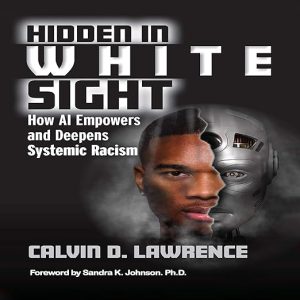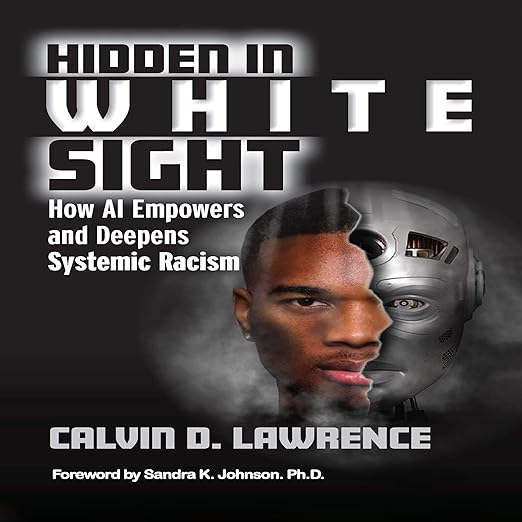
Calvin D. Lawrence opens Hidden in White Sight with a premise that sounds counterintuitive until you sit with it: artificial intelligence was introduced in part as a mechanism for removing human bias from decisions, but the systems built to implement it carry their creators' assumptions directly into their outputs. Lawrence, a Black data scientist and AI expert, documents this not as an abstract theoretical claim but through specific, sector-by-sector evidence spanning healthcare access, social scoring in academic contexts, loan applications, and the policing and judicial systems where these tools are most consequentially deployed. The audiobook, narrated by Cary Hite in a nine-hour-and-fifteen-minute performance, opens this analysis to listeners who may not have the technical background to read AI research literature but have direct stakes in what these systems decide about their lives and futures.
Hite's narration carries the dual register Lawrence works in throughout: the analytical rigor of someone trained in data science, and the personal stakes of someone for whom these biases are not abstract policy questions. Reviewer Jarrett Judkins specifically called out the parallels drawn between the Jim Crow Era and current day treatment of Black people in healthcare, real estate, and financial industries as the most striking content in the book, and that historical framing is one of Lawrence's most effective rhetorical choices. Algorithmic bias is not a new problem invented by machine learning; it is a continuation of structured inequality through new tools, and Hite's narration gives that argument the gravity it warrants.
Demystifying the Algorithmic Black Box's Feedback Loops
The phrase algorithmic black box appears in Lawrence's framing, and demystifying it is one of the book's explicit goals. Reviewer Tracy Brown described having little awareness that AI could be so biased before reading, and the book's success with that audience, people beginning to use AI tools without understanding their underlying structure, reflects how effectively Lawrence calibrates the technical content for a general readership. The mechanisms Lawrence explains, how training data incorporates historical inequity, how optimization objectives reflect the priorities of those who design them, how feedback loops amplify initial biases, are rendered in accessible terms without being reduced to oversimplification.
The political and structural dimensions are treated without false neutrality. Lawrence is an advocate as well as an analyst, and the book's recommendations, including a proposed AI Bill of Rights for affected communities, position it as a call for accountability rather than a detached assessment. Reviewer Diva Dee described the book as capturing key data and knowledge that describes how technology advancement continues to further the divide on racial and justice social equality. That framing is accurate and should be named as such: this is an informed advocacy text built on genuine expertise, not a neutral technology survey, and its recommendations reflect that clearly defined perspective.
Hite Shifts Between Clinical Language and Human Cost
The audiobook format works well for Lawrence's material because the combination of personal narrative, case study, and analytical framework benefits from a narrator who can modulate between registers across a long runtime. Hite manages the shift between the clinical language of data science and the human cost of biased outputs across nine hours with enough consistency that the book holds together as a unified argument rather than fragmenting into disconnected analytical sections. The case study approach, moving from healthcare to education to financial services to criminal justice, means each chapter can stand relatively independently while contributing to the cumulative case for systemic AI accountability.
The website hiddeninwhitesight.com referenced in the synopsis suggests supplemental material beyond the audio content, which is worth noting for listeners who want to engage further with the resources Lawrence has assembled. The audiobook functions as an accessible entry point to a larger project rather than a fully self-contained resource, and the website extends the conversation the text begins in ways the audio format cannot alone replicate.
Full Engagement Over Selective, Both-Sides Listening
The specific recommendations Lawrence makes, including the AI Bill of Rights framework, are embedded in an advocacy context that takes a clear position on contested policy questions around AI governance and regulatory accountability. Listeners expecting a both-sides presentation will find Lawrence's stance uncongenial. This is a book written from a specific perspective and with a specific community of affected people in mind, and its analysis and recommendations reflect that positioning throughout. That clarity of position is a strength for readers aligned with the framework and a friction point for those who are not.
The nine-hour runtime is appropriate for the depth of analysis Lawrence provides across multiple sectors, but listeners who want a brief overview of algorithmic bias rather than a detailed sector-by-sector examination may find it more than they need for their purposes. The content rewards full engagement more than selective listening, since the cumulative effect of the sector analyses is greater than any individual case study considered in isolation.
AI Developers Are Explicitly Named as an Audience
This audiobook serves anyone who wants to understand how AI systems perpetuate racial inequity in concrete, sector-specific terms, presented by a practitioner with both technical credentials and personal stakes in the analysis. It is particularly valuable for listeners who interact with AI-driven systems in healthcare, finance, or criminal justice contexts and want to understand the structural dimensions behind the outputs they encounter. AI developers and technologists are explicitly addressed as one intended audience for Lawrence's recommendations. Listeners seeking technical documentation or neutral policy analysis will need to supplement this audiobook with additional sources that offer the counterpoint perspectives Lawrence does not pursue.
Before You Press Play
- Narration: Cary Hite delivers Calvin D. Lawrence's personal and analytical voice with authority, grounding the technical AI content in the human experiences that frame each chapter.
- Themes: Algorithmic bias, racial equity in technology, accountability and the AI Bill of Rights
- Mood: Urgent and rigorously personal, combining data science expertise with lived experience
- Verdict: Lawrence's audiobook makes a compelling, specific case that artificial intelligence systems reflect and amplify existing racial inequity, with actionable recommendations for both affected communities and AI developers.
Common Questions
Does this audiobook address what listeners can personally do about algorithmic bias?
Yes, Lawrence explicitly includes recommendations for affected community members and introduces a proposed AI Bill of Rights as a framework for accountability. The audiobook positions listeners as potential advocates rather than passive subjects of technological systems they cannot influence.
At over 9 hours, can this audiobook be listened to in sections, or does it require full sequential engagement?
The sector-by-sector structure, covering healthcare, education, financial services, and criminal justice separately, means individual chapters have enough context to be understood independently. Listeners can navigate to specific sectors of personal relevance, though the cumulative argument for the full AI accountability framework is strongest when heard in complete sequence.