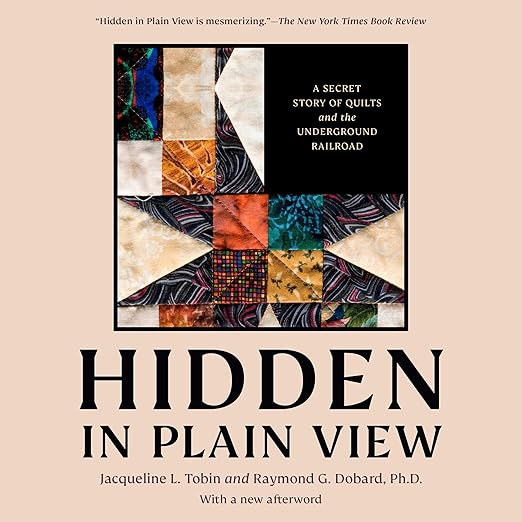
Ozella McDaniel Williams began a conversation that Jacqueline L. Tobin was not entirely prepared for. The year was 1993, the location was the Old Market Building in Charleston, South Carolina, and Williams, an African American quilter selling her work there, began reciting what turned out to be a coded message transmitted through three generations of her family: a set of quilt pattern names that corresponded, she explained, to stages of the Underground Railroad and instructions for navigating it. This audiobook, Hidden in Plain View, narrated by Janina Edwards, is the account of the three years it took for Williams's full narrative to unfold and the research Tobin and her co-author Raymond Dobard conducted to understand what Williams was describing.
Ozella's Quilt Code and the Historians Who Doubt It
The central argument here is both specific and remarkable: that enslaved people in antebellum America created quilts encoded with navigational information for the Underground Railroad, drawing on African textile traditions that had survived the Middle Passage, and that the code was transmitted orally from generation to generation precisely because written documentation was inaccessible and dangerous. Tobin and Dobard present this as Ozella's Underground Railroad Quilt Code, a system in which specific patterns, the monkey wrench, the flying geese, the bear's paw, the crossroads, the North Star, each conveyed particular instructions or waypoints. The coded message Williams recited includes five square knots on every two inches, the tenth pattern, escape on the fifth knot, and a route toward Ontario, Canada via what the code calls the bear's paw trail to the crossroads. The specificity of that encoded language is the book's most arresting feature.
The argument should be approached with awareness that it is contested. Some historians have argued that the documentary evidence for an organized, synchronized quilt code system is insufficient, and that Tobin and Dobard's case extrapolates from oral tradition in ways that exceed what the archival record confirms. Tobin and Dobard acknowledge the evidentiary limitations within the text and present their framework as a hypothesis for further investigation rather than a settled historical fact. The sections on African textile traditions and their preservation through the Middle Passage are the most thoroughly documented parts of the argument and stand with strong scholarly footing independent of the quilt code thesis. Dobard's art history background gives these sections depth that most popular histories of the Underground Railroad cannot match.
Janina Edwards Gives Quilt Patterns Their Proper Weight
Janina Edwards reads with a care for the material's weight that distinguishes her performance from a more mechanical delivery. The sections where Tobin traces the specific quilt patterns require a narrator who can make numerical and spatial detail feel significant rather than technical, and Edwards manages this through measured pacing and tonal variation that signals the significance of each component as it appears. The relationship between Tobin and Williams, the patience Williams demanded and the friendship that grew from it, is equally well served by Edwards's approach. At 5 hours and 33 minutes, the book is concise for its subject matter. Tobin writes densely enough that the shorter runtime does not feel truncated. The 4.6 rating from nearly a thousand listeners includes responses from both quilters seeking historical context for specific block patterns and Civil War historians approaching it as primary source material, suggesting the book successfully addresses both audiences.
Three Years of Trust Behind the Quilt Code
The most valuable parts of the book for listeners interested in material culture specifically are the chapters on how African weaving and textile traditions carried meaning and identity through the Middle Passage and persisted in American quilting practice. That thread of the argument is well evidenced and would be significant even if the quilt code thesis were entirely unsubstantiated. Reviewer Don Paige describes purchasing the book to help understand what specific quilt blocks represent, which is the most direct practical use case: if you are making a quilt with historical patterns and want to understand their possible histories, this book provides a framework regardless of where you come down on the evidentiary question.
The three years that elapsed between Williams's initial disclosure and her full telling of the code is itself a story about trust and the conditions under which certain kinds of knowledge can be transmitted. Williams did not simply share the code with any willing listener. She assessed Tobin's readiness over an extended period, waiting for something in the relationship to ripen before continuing. That patience, and the care it implies about how this knowledge should move in the world, is reflected in the book's own careful presentation of what is claimed and what is uncertain. Tobin does not present Williams's narrative as more than what it is: an oral tradition of uncertain age, transmitted through a family line, describing practices whose documentary confirmation is incomplete. The respect for that complexity is what makes the book's historical contribution durable even under scholarly challenge.
Best for Quilters Ready for a Contested History
Recommended for quilters, textile historians, and students of African American history who want a work that takes the intelligence embedded in material culture seriously. Also for Civil War historians who want a perspective on the Underground Railroad that operates outside the conventional documentary record. Approach with awareness that the central thesis is contested and present yourself with the book's own acknowledgment of its evidentiary limits. Listeners looking for a straightforward narrative history of the Underground Railroad should pair this with a more traditional account for context.
Quick Take
- Voice: Janina Edwards gives Jacqueline Tobin's investigative account a deliberate pacing that suits the unfolding of Ozella Williams's coded message, neither rushed nor overly solemn.
- Big ideas: African textile traditions and coded communication, the physical evidence of resistance, history embedded in material culture
- Atmosphere: Methodical and quietly revelatory, with the texture of genuine scholarly detective work
- Worth it?: A significant and original contribution to the history of the Underground Railroad that treats its central thesis with the academic care the subject deserves.