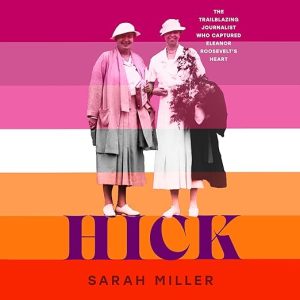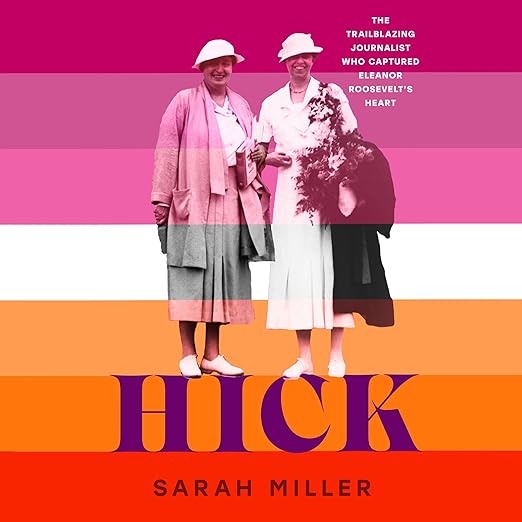
Content warnings on this page come from a five-star reviewer rather than from the publisher, which is the first thing worth knowing before handing this audiobook to a fourteen-year-old. The entry headed Well researched and well written lists physical abuse, sexism and homophobia, plus one more item the writer gives only as initials, and the same entry logs its own format as print before it says anything else. So the fullest account of what waits inside Sarah Miller's book was written by somebody holding a printed copy, on a listing selling twelve hours of audio. Lorena Hickok was on her own at fourteen herself, cooking and scrubbing for one family after another while she tried to finish school, and the publisher copy that describes that childhood mentions none of the harder specifics the reviewer bothered to list.
What We Made of It
The life arrives in a shape that suits young readers better than most biography manages. Hickok gets out of that childhood on a talent with words, then lands in the male-dominated newsrooms of the Midwest, earning bylines on everything from football to opera to politics, and by the age of thirty-five she is among the Associated Press's top reporters. Eleanor Roosevelt does not appear until the assignment to cover her during FDR's presidential campaign, and by the close of 1932 the copy has Hick in love with the wife of the president-elect. Most of the arc is a working woman's career, which is the smartest structural decision on offer here: the romance arrives to somebody the listener already knows how to root for.
Miller built the reconstruction from the 3500 letters that survive between the two women, and that source base sets the terms of everything the description promises. It also produces the one plain defect on the record, which spells the subject's surname two different ways: Hickok in the opening line, Hickock in the closing one, on a page selling a book about a journalist whose entire professional standing rested on getting names right. A buyer searching the correct spelling and a buyer searching the mistake will land in two different places, and only one of them finds this listing. Small carelessness, real consequence for discoverability, and nobody has fixed it in the months since release.
The Best Parts of Hick
One sentence in the review column outweighs everything else written here. The entry headed Story of Two Incredible Women calls the telling of the love affair respectful and not graphic at all. For a young adult title built around a romantic relationship between two adult women in the 1930s, that is the first question a parent or a school librarian will ask, and the publisher copy never goes near it. The same response describes Hickok as incredible and interesting rather than as a tragic figure, which matches what the description is selling: a career that ran on ambition and competence, with the private life braided through it instead of standing in for it. Anyone shopping for a discreet queer history for a teenager has their answer in that one line.
Accuracy is the other thing the page keeps returning to. The entry headed Great book grades the historical view of Mrs Roosevelt's life, personal and public, as very accurate, and calls the research sound, which is a specific claim rather than a general compliment. Set that beside the letters and the listening experience comes into focus: the interior life of both women reaches you through documents they wrote to each other, not through invented thoughts assigned to them afterward. Holding that for twelve hours is harder than it sounds, because correspondence is static and a life is not, and running the childhood and the newsroom years first gives the letters something solid to land on when they finally arrive.
What Might Not Land
Angel Pean holds the only voice credit on this file, and not one of the twenty-five people who graded it has written a word about the reading. Five of them wrote something; all five wrote about a book. That leaves the single biggest variable in a twelve-hour purchase entirely untested in public, which is a strong argument for spending ninety seconds with the sample rather than trusting a 4.9 that was earned by Miller's prose. Documentary narrative of this length asks a great deal of a reader's pacing, since the material moves from scrubbed floors to press rooms to a presidential campaign without changing register, and nobody on this page has reported back on how that lands.
Vocabulary in the column points the same direction. One response runs to two words and a period, headed Most enjoyable, and the two words are Great read. Every verb anybody uses is a reading verb. What the listing actually holds is a set of grades on Sarah Miller's writing, pooled onto a recording that arrived in May 2025 and has been discussed as text ever since, which is useful for deciding whether the book is worth your time and useless for deciding whether this edition of it is. The distinction matters more than usual at this length, and the star average will not make it for you.
The Right Listener for Hick
The four-star, headed Historic female journalist with ties to Eleanor Roosevelt, describes the balance the book strikes between storytelling and primary and secondary sources, and singles out Hickok as a pioneer for women in the workforce and in journalism specifically. That response identifies the listener this suits: somebody who wants the working life at least as much as the romance, and who is content to spend the opening stretch in domestic service and Midwest sports desks before the campaign years arrive. It also names the historical appeal precisely, a period the response says not many people would remember or know about, which is exactly the pitch a curious sixteen-year-old responds to.
Two groups should hesitate. School collections buying for younger middle-grade readers ought to weigh the content list that lives in the column and not in the copy, since the publisher's description offers no guidance at all on that front. And anyone hunting a full-dress Eleanor Roosevelt biography is in the wrong place, because she is the second subject of a book named for the first and does not arrive for a good while. Teenagers who want a queer history with an award shelf behind it and a genuine career at its center are exactly the readers Sarah Miller wrote this for.
At a Glance
- Read by: Angel Pean is the single credited voice, recording for Listening Library, with no public account of the performance anywhere on the record.
- At its heart: Depression-era journalism, a sapphic love story reconstructed from letters, class and self-invention.
- Vibe: Documentary and unhurried, with a quiet ache running under it.
- Short version: Strong young adult nonfiction for readers who want the newsroom as much as the romance.
How much of the Hick audiobook is actually about Eleanor Roosevelt?
Less than the framing suggests. By the description's own sequence, the childhood, the domestic work, the Midwest newsrooms and the rise to the Associated Press all come first. Roosevelt enters when Hickok is assigned to cover her during the 1932 campaign, so a listener expecting a joint portrait gets a reporter's career for a long while first.
What awards does the Hick audiobook listing claim?
Three, all of them for the book rather than the recording: a Stonewall Book Award Honor Book citation, plus Best Book of the Year selections from Shelf Awareness and School Library Journal. Worth reading as a signal about the writing and the research, and not as any indication of how the audio edition was produced or received.