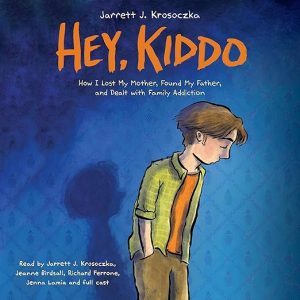
A memoir told in comics panels is a peculiar thing to hand to a narrator, and that peculiarity is why this audiobook is worth arguing about. Jarrett J. Krosoczka drew Hey, Kiddo as a graphic memoir: a mother in and out of rehab, a father whose name he did not know, two loud grandparents who took him in, and drawing as the thing he did instead of talking. Then he read it aloud in two hours and fifty minutes, and the result took an Odyssey Award.
Scholastic Audio Books released this in October 2019, and the awards line at the top of the description does something most publisher copy never manages: it makes a specific, checkable claim about the recording rather than about the book. The Odyssey Award is given for excellence in audiobook production. The Audie for Young Adult is an audio prize as well. Both are dated 2020. Whatever this production does with a book made of drawings, two juries thought it worked. An award for production is not an award for a story, and that distinction is the reason to choose this version over the paperback.
Jarrett Krosoczka's story is why any of it matters. In kindergarten a teacher asks him to draw his family, with a mommy and a daddy, and the drawing he could honestly make does not look like that. His mother is an addict, present and then absent and then present. His father is a blank he cannot even name. His grandparents, loud and opinionated and long finished with raising children, raise him anyway, and the book is as much about them as about her. Only as a teenager does he begin assembling the truth, reckoning with his mother and going looking for the father nobody had described to him.
Two hours and fifty minutes is short for a memoir and roughly right for this one, because the printed book carries an enormous share of its weight in pictures. One reviewer counts the pages with no writing on them at all, only art. That is what a buyer most needs to know, and the description never touches it: what happens to those wordless pages when the book turns into sound? Silence is one answer. Music is another. Simply reading aloud what the drawing showed is the third and least interesting.
The Strengths
Winning a production award for a graphic memoir is unusual enough to justify the purchase on curiosity alone. Comics and audio look like opposites. One works through what your eye sees and how fast it moves across a page; the other works through pace, breath and voice. A book that succeeds in both directions has solved a real problem. This one holds the trophies and gives no account whatsoever of how, which is a marketing failure rather than an artistic one.
The record stays silent on method. Nobody is listed beside Krosoczka, music and sound design go unmentioned, and nothing explains how panels become narration. Krosoczka holds the only credit, which for a memoir is the right instinct, since nobody else has standing to say these particular sentences. Whether that single voice is the entire production or the visible part of a larger one is left to guesswork, and an award for production excellence implies decisions nobody here has described.
Krosoczka reading his own childhood is the whole proposition, and it is a strong one. This is a book about a boy who could not say things and drew them instead. The adult saying them out loud, in his own voice, does something no hired reader could reproduce. The standing counterargument is that authors often read their own work badly. Nothing on this page addresses that, beyond two juries who evidently disagreed. On a memoir this specific about not being able to speak, their vote counts for a good deal.
What to Watch For in Hey, Kiddo
One rating. That is what the counter claims stands behind the 4.7 average heading this listing, and 4.7 cannot come out of a single whole-star vote under any rounding rule in use anywhere. Below that counter, five written responses sit in plain view, each carrying its own star grade. The two figures contradict each other openly. Treat the badge as ornament and the five responses as the evidence that actually exists.
Lynda D. posted in October 2018, more than a year before this recording came out in October 2019. So did A.Moore, who mentions receiving a digital advance copy in the spring and waiting impatiently for the official release. Both are responses to the printed book, written around its publication, and both now sit beneath an audio listing. Neither person could have heard a recording that did not yet exist when they wrote.
Comics readers should be clear about what they are trading away. A four-star reviewer likes that the book is built like a comic precisely because Krosoczka loved comics and drawing as a kid, and observes that many pages carry art in place of text. That match between form and subject is part of the book's argument, not decoration. In audio it has to survive as voice, and no listener can check the drawings that once carried it. Anyone wanting both ends up owning this book twice, which is a legitimate outcome and worth budgeting for.
Who Will Get the Most From It
Teachers, librarians and parents are the obvious buyers, and the responses settle the age question between them. One recommends middle grade and up. Another would keep it away from anyone under twelve, both because of how plainly it handles heroin, rehab and a parent who vanishes. The book softens none of that. A grandparent writing here, raising a grandson since he was eighteen months old for the same reason, wishes it could reach the kids who need it most and cannot get them to open it.
Younger children are the group to hold back, on the strength of what these reviewers recommend themselves. Adults who came for the drawings are losing the half of this book that cannot travel, whatever the awards say about everything else. Hand it to a teenager living with an addicted parent, or to a teacher who has one sitting in a classroom, and let two hours and fifty minutes do the work the panels used to do.
Common Questions
How does a graphic memoir work as an audiobook?
The page never explains, which is the frustrating part. What it does establish is that two juries rewarded the attempt: the 2020 Odyssey Award for excellence in audiobook production and the 2020 Audie for Young Adult. Reviewers of the print edition note whole pages carrying art and no text, so something had to replace them.
Who narrates the Hey, Kiddo audiobook, and did it win awards?
Jarrett J. Krosoczka is credited as both author and narrator, so the memoir is read by the person it happened to. The description claims two 2020 awards, the American Library Association's Odyssey for production and an Audie for Young Adult. No other performer, musician or sound designer appears anywhere in the credits.