
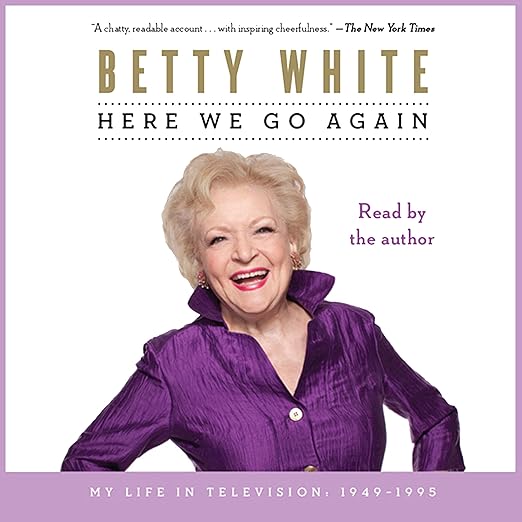
Betty White started working in radio and television when both were new enough that she was helping to invent what they were. Here We Go Again covers roughly five decades of that work, from her 1949 television debut through the various iterations of her career into the 1990s, and it does so in a voice that is unmistakably, irreducibly hers. I listened to it on a quiet weekday morning, and I found myself laughing out loud at several points, which is not something I expect from a memoir audiobook.
The book was first published in 1995, which means it predates The Golden Girls' full cultural reassessment and the extraordinary late-career renaissance that brought White to a new generation of fans. She is writing from inside a career that was already extraordinary, without the benefit of knowing how much longer it would continue or how beloved it would become. There is something clarifying about that perspective. She is not summarizing a legacy. She is accounting for work she was still in the middle of doing.
How Here We Go Again Holds Up
The anecdotes are specific and genuinely revealing. White moves through Hollywood on Television, her early daily live show; the various iterations of The Betty White Show; her time on The Mary Tyler Moore Show; and the Golden Girls years, not as bullet points in a career timeline but as inhabited experiences. She talks about the practical challenges of live television when there was no second take, about the colleagues she learned from and the friendships she built, about the particular social world of mid-century Hollywood as she actually encountered it.
Reviewer gailshop, who ordered memoirs for all four Golden Girls cast members after Rue McClanahan's death, noted the surprising age detail that Estelle Getty, who played the mother on the show, was actually only one year older than Bea Arthur, who played her daughter. White mentions details like this with the casual authority of someone who was there and still finds the logistics of television production genuinely interesting. That specificity is what makes the anecdotes feel like access rather than performance.
Why Here We Go Again Works as an Audiobook
The self-narration is the reason to choose the audiobook over the print version. White has spent her entire professional life in audio and visual media, and her sense of timing in the spoken word is exceptional. Reviewer A. Siwicki noted that "her writing with its many colloquialisms sounds as if she's just talking to us," and that quality comes through even more directly in the audio version, where she is in fact just talking. The humor lands the way humor lands when delivered by a professional comedian who has been calibrating timing for fifty years.
The running time is short, just under three hours, which reflects both the period coverage and the memoir's specific focus on her television career rather than her full life. This is not a comprehensive autobiography. It is a focused account of how she built and sustained a television career across extraordinary change in the industry, and it is priced accordingly in terms of the listening commitment it asks for.
Weak Spots in Here We Go Again
The brevity is both the book's greatest virtue and its most significant limitation. At under three hours, Here We Go Again moves quickly through periods that deserve more time. The Golden Girls years in particular feel compressed given how central that show became to White's cultural identity. This is a function of when the book was written; White published it while she was still actively working, not from the vantage point of retrospection.
Listeners who want comprehensive biographical detail will need to supplement with other sources. The book is selective in what it includes and what it skates past, and White's characteristic cheerfulness means that difficult professional periods are often addressed with a lightness that can obscure how challenging they actually were. Reviewer Amazon Customer from January 2025 captured the effect well: it is "lovely to live in her shoes for a while," and that quality of temporary habitation is what the book offers.
The Right Listener for Here We Go Again
Anyone who grew up watching Betty White in any context will find genuine pleasure in this. Fans of The Golden Girls will want this as a companion to the show. Students of television history will find the early chapters particularly useful, since White's account of 1940s and 1950s live television is the account of an eyewitness rather than a historian. The short running time makes it an easy recommendation for any listener, and the self-narration makes the audiobook the definitive version of the text.
Is the audiobook significantly better than reading the print version?
Yes. White's timing, her comic delivery, and the quality of actually hearing her voice tell these stories are irreplaceable. Multiple reviewers noted that the writing reads like conversation, and in audio form that quality becomes literal. This is one of the clearest cases in the memoir genre where self-narration is the superior format.
Does the book cover Betty White's personal life, or is it focused primarily on her career?
The memoir covers her career with anecdotes about personal relationships embedded in the professional narrative. Her husband Allen Ludden is mentioned with evident affection. It is not a deeply personal memoir about her emotional interior; it is primarily an account of how she worked and with whom.







