Quick Take
- Narration: Mike Peterson reads with calm authority, the right register for a reference-adjacent wellness guide that listeners may return to section by section rather than straight through.
- Themes: Accessible herbalism, traditional plant knowledge modernized, holistic self-sufficiency
- Mood: Calm, instructional, and quietly encouraging
- Verdict: A well-structured introductory guide for listeners curious about medicinal herbs but overwhelmed by more clinical or scattered alternatives.
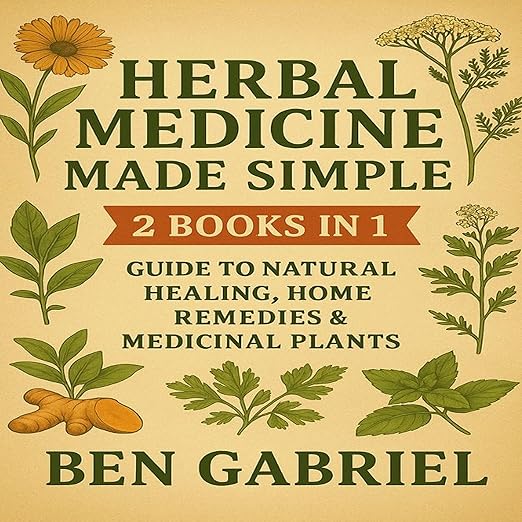
I tend to approach wellness audiobooks with a mix of genuine curiosity and occupational skepticism. The genre has a florid end and a useful end, and the distance between them can be hard to judge from a cover and a synopsis alone. Herbal Medicine Made Simple, a 2-in-1 collection by Ben Gabriel narrated by Mike Peterson, sits solidly in the useful end. It is a beginner’s guide, unambiguously so, and it seems to know exactly what it is trying to be. There is a reliability in that self-awareness that more ambitious wellness books sometimes lack entirely.
The book covers over 100 medicinal herbs, from chamomile and echinacea to ginger and lavender, alongside step-by-step preparation recipes for teas, tinctures, oils, salves, and infusions. It addresses common ailments including colds, headaches, stress, digestive discomfort, skin irritation, and insomnia. It also covers the practical skills of identifying, harvesting, drying, and storing herbs. For a single audiobook at just over five hours, that is an ambitious scope, and the 2-in-1 format means Gabriel is working with a combined manuscript that bridges ancient herbal wisdom and modern wellness practice in a single integrated listen.
Our Take on Herbal Medicine Made Simple
Mike Peterson’s narration is steady and clear, which matters more than it might seem for a reference work of this kind. Listeners who are note-taking, or who are listening while doing something with their hands, need a narrator who does not race through the practical sections. Peterson does not. The pacing allows the herb descriptions and remedy instructions to actually land rather than blur together. For a self-published wellness title with no professional reviews yet in its Audible listing, this is a better-produced listen than many comparable books in the genre. The 47 listener ratings averaging at a full 5.0 suggest an audience that found what they came looking for without significant disappointment.
Why Listen to Herbal Medicine Made Simple
The appeal is direct: if you have ever wanted to understand what echinacea actually does and why, or how to make a proper herbal tincture rather than buying one pre-made at a markup, this audiobook covers the practical ground without burying it in excessive clinical language or vague spiritual framing. Gabriel’s approach explicitly targets beginners, which means the book resists the tendency toward either technical density or the kind of new-age vagueness that makes herbalism texts frustrating at both ends of the spectrum. The structure moves from herb knowledge to practical preparation and remedy application in a logical, progressive sequence. You are not dropped into advanced formulation before the foundations are in place, and the treatment of each herb, covering properties, benefits, and uses, is clear enough to actually inform decision-making rather than just provide vocabulary.
What to Watch For in Herbal Medicine Made Simple
The audiobook format creates an inherent challenge for any instructional wellness text. Recipes and preparation methods are more useful with a visual reference, and the remedy instructions here are delivered aurally in a form that may send some listeners back to a written version for the specifics. If you are listening primarily to understand concepts and develop a general herbalism vocabulary, this works well. If you intend to follow the specific preparation recipes for teas, tinctures, or salves, you will likely want to take notes or pair the audio with a written companion. There are no listener reviews flagging inaccuracies, which is a meaningful baseline for a genre where misinformation can be a real problem. Listeners with existing knowledge of herbalism will find this beginner-targeted and may want something with more clinical depth and nuance.
Who Should Listen to Herbal Medicine Made Simple
The right listener here is someone who has been meaning to learn more about medicinal herbs and keeps bouncing off resources that are either too clinical or too diffuse. Gabriel’s framework is practical and structured, and Peterson’s narration makes it accessible rather than tedious. This also works well as background listening while gardening or working in a kitchen, where the subject matter and the physical activity reinforce each other. Skip it if you are an experienced herbalist looking for advanced cultivation, clinical applications, or sophisticated formulation content. This is a genuine introduction, and it delivers that promise without pretending to be more.
Frequently Asked Questions
Does the audiobook format work well for a book with recipes and preparation instructions?
It works for conceptual understanding and general herbalism vocabulary. For actually following the step-by-step recipes, most listeners will want to take notes or access a written companion. The narration is clear but preparation instructions benefit from visual reference.
Is the content scientifically grounded or primarily traditional and anecdotal?
The book presents itself as bridging ancient herbal wisdom and modern wellness practice. It does not cite clinical studies but also does not make outlandish claims. The focus is practical application rather than medical proof, so it is best approached as a wellness guide rather than a medical reference.
Is this suitable for someone with no prior knowledge of herbs or herbalism?
Yes, explicitly so. The book is designed for complete beginners and avoids assuming prior knowledge. The coverage of over 100 herbs is introductory rather than exhaustive, which suits someone building a foundation rather than deepening existing expertise.
How does the 2-in-1 format affect the listening experience?
The combined manuscript is presented as a single continuous listen at just over 5 hours. The format suggests two distinct sections, one on herb knowledge and one on practical preparation, but the overall flow reads as an integrated guide rather than two separate books stitched together.