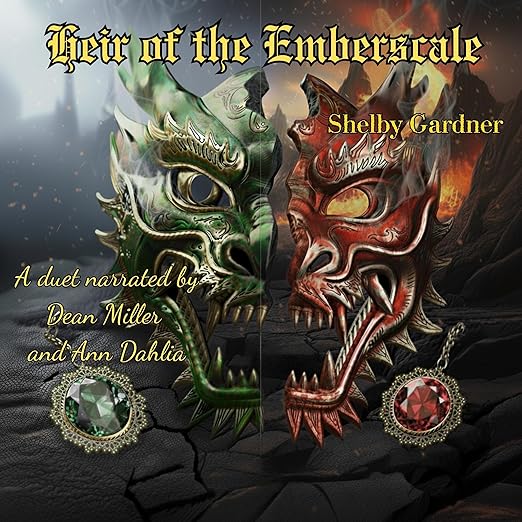
An ancient stone marks Elyria as royalty the moment she touches it, and from there this audiobook never really slows down. Heir of the Emberscale opens with Elyria living in 'brutal obscurity,' her own world's phrase for it, before the Aura Stone drags her toward a throne and a mate she never asked for: Tyrion, the possessive warrior-king bonded to the Ember Stone's power. Shelby Gardner is working in well-worn romantasy territory here, fated mates, forced proximity, a morally gray love interest, but the dragon-god mythology underneath gives this trilogy opener more mechanical texture than the tropes alone would suggest.
Elyria's Powerlessness Slowly Becomes Real Agency
The central engine of the plot is the stones' choice, not either character's, and that mechanic drives real tension: Tyrion kidnaps Elyria and forces her into what the synopsis calls a 'toxic partnership,' convinced his possessive control is the only thing standing between her and the 'destructive blight consuming their world.' That's a genuinely uncomfortable premise stated plainly rather than softened, dubious consent wrapped in destiny language, and Gardner leans into it rather than around it, which readers of this specific romantasy lane will recognize as the point rather than a flaw.
Beyond the central bond, the book layers in real stakes: a magical connection that forces Elyria and Tyrion to share dreams and destinies whether they want to or not, a dying world that needs their combined power to heal, and mythical dragon gods plus unnamed dark forces working against them both. Reinita Lindlau's review teases a specific turning point, chapter twenty, calling it worth multiple rereads without spoiling what happens, which suggests the midpoint delivers a real payoff rather than just extending the slow burn.
Tyrion's characterization leans specifically on grief-stricken warrior rather than simply ruthless king, and that distinction matters for how the possessive-mate trope plays out here: his control isn't framed as arbitrary cruelty but as a response to loss the synopsis doesn't fully explain upfront, a deliberate withholding that gives listeners a reason to keep listening past the character's harshest early moments. Genre-savvy romantasy readers will recognize this as the standard morally gray setup, where backstory pain gradually reframes behavior that reads as villainous in the opening chapters.
Elyria's arc runs in the opposite direction from Tyrion's: where he begins as the story's obstacle, she begins in genuine powerlessness, kidnapped and bound against her will, and her gradual reclamation of agency within a relationship that started as captivity is the book's real emotional throughline according to reviewers, more than the dragon-god mythology surrounding it.
The last Queen framing plants this squarely in prophecy-driven fantasy territory alongside the fated-mates romance, giving Elyria's arc a second engine beyond the relationship itself: not just falling for Tyrion, but growing into an inherited political role she never sought or trained for. That layering, personal transformation plus political destiny plus romantic bond all resolving together, is ambitious for a trilogy opener to set up, and how well it balances all three threads will likely determine how the sequel volumes are received.
Miller Voices Both a Warrior and a Captive
Dean Miller narrates both Elyria's fierce, defiant interior voice and Tyrion's grief-stricken possessiveness, a real range test for a single narrator handling dual-POV romantasy, and worth flagging directly the way any male narrator voicing a female-led romance deserves scrutiny. None of the three attached reviews comment specifically on narration quality, focusing entirely on plot, characters, and heat level instead, so that assessment has to rest on genre-fit reasoning rather than confirmed listener feedback on the performance itself, worth saying honestly rather than inventing a verdict the reviews don't support.
Jessica's review places the book directly alongside 'Throne of Glass' or 'Fourth Wing' for readers chasing that specific romantasy wave, awarding it an 8 out of 10 and calling it 'your next read.' Julie C. Miller's review adds an interesting wrinkle: personally acquainted with the author, she went in without expecting to enjoy a genre outside her usual reading and came out 'hooked' by chapter's end, a genuine conversion story worth weighing alongside the more genre-native enthusiasm elsewhere.
Self-published romantasy has become one of the most commercially significant corners of the entire audiobook market over the past few years, and Heir of the Emberscale sits squarely inside that wave: an indie author building a trilogy around a specific, proven trope combination, fated mates plus dragon mythology plus enemies-to-lovers, rather than chasing an entirely original premise. That's a legitimate creative strategy, not a shortcut; readers drawn to this specific trope stack want it executed well far more than they want it reinvented.
Reinita Lindlau's five-star review specifically praises the world Gardner built alongside the central romance, crediting her for supporting characters worth caring about too, evidence that the book isn't purely a two-hander focused only on Elyria and Tyrion's bond at the expense of its wider cast and setting.
Eighteen Ratings Is Still a Small Sample
Worth naming plainly: this is the 'explosive beginning' of a trilogy, per the synopsis's own description, which means the ending sets up future volumes rather than fully resolving the central conflict. Readers wanting a complete, self-contained story in one audiobook should adjust expectations toward a first-act payoff rather than a finished arc, standard for the genre but still worth stating before committing eight hours and fifty-three minutes.
The rating sample is genuinely small, 4.6 across just 18 ratings, and Julie C. Miller's disclosed personal connection to the author is worth factoring into how much weight any single review carries here. That doesn't undermine the book's quality, but it does mean the audience is still forming rather than fully established, closer to an early word-of-mouth stage than a title with thousands of independent voices weighing in.
The stones themselves, Aura and Ember, function as the plot's actual authority, choosing Elyria and binding her to Tyrion regardless of either character's consent, which raises the genre's familiar destiny-versus-free-will tension in a fairly literal, mechanical way. Listeners who find that device romantic, fate overriding personal choice in service of a greater bond, will read the setup very differently than listeners who find it uncomfortable regardless of how the narrative eventually justifies it, and the book doesn't fully resolve that tension by the end of its first volume.
Possessive-Mate Tropes Are This Trilogy's Selling Point
Fans of Fourth Wing and Throne of Glass-style romantasy, dragon-shifter and fated-mates trope enthusiasts, and readers comfortable with a dominant, possessive male lead and real heat level are the clear audience, exactly the readers Jessica's review is speaking to directly with its genre comparisons.
The consent-adjacent bonding mechanic deserves real attention before starting: readers sensitive to power-imbalance and forced-proximity themes in a fated-mate setup, or those who specifically want a fully resolved single-volume story rather than a trilogy's opening act, should know what they're getting into going in.
Does this audiobook conclude the story, or is it part of an ongoing series?
It's explicitly the opening volume of a trilogy, so the ending sets up future books rather than fully resolving the central conflict between Elyria and Tyrion.
Can a single narrator convincingly handle both the male and female lead in this audiobook?
Dean Miller voices both Elyria and Tyrion, a genuine range challenge for one narrator, though none of the attached reviews comment directly on how well the performance lands.