Quick Take
- Narration: Dave Asprey narrates his own work with the kind of easy authority you’d expect from someone who has spent decades on stages and podcasts, conversational, occasionally goofy, and completely at home with the material.
- Themes: biohacking and neurofeedback, mind-body optimization, consciousness and breathwork
- Mood: Energetic and data-forward, with occasional dips into genuine vulnerability
- Verdict: If you already have a Bulletproof coffee habit and want to go deeper into brain performance, this delivers real tools alongside the brand-building noise.
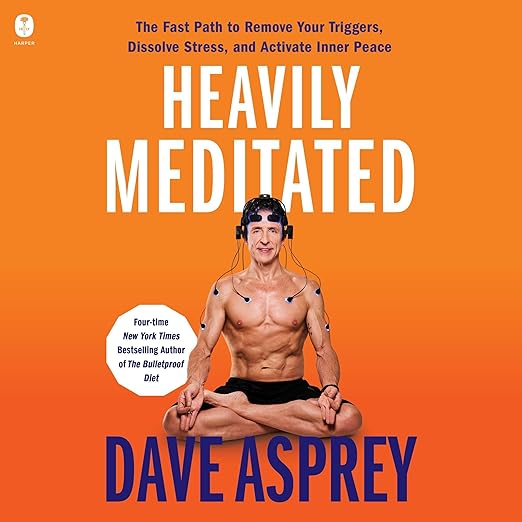
I started listening to Heavily Meditated on a Tuesday morning, earbuds in during a walk I take most days to clear my head before a long stretch of reading and writing. That context felt fitting: Asprey opens by describing the brain fog and chronic fatigue syndrome that plagued him in his twenties, and the contrast with his current, relentlessly optimized self is the engine the whole book runs on. I was somewhere around the breathwork chapter when I found myself actually stopping to breathe differently. That’s either a sign of a book doing its job, or a sign I am embarrassingly susceptible to suggestion. Probably both.
Asprey’s sixth book arrives after a long run of biohacking content, and the fatigue some readers feel toward the genre is real. One reviewer here described the book as a “Meh”, a collection of familiar concepts packaged in a style that can feel corny. That criticism is fair up to a point. If you have read widely in the wellness-performance space, you will recognize the building blocks: meditation as a tool rather than a practice, neurofeedback as a shortcut to what monks spend years achieving, the careful management of stress as a performance variable. None of this is new. What Asprey does is sequence it into something resembling a curriculum.
Our Take on Heavily Meditated
The organizing concept here is the “MeatOS”, Asprey’s tongue-in-cheek label for the biological operating system we are all running on, usually without reading the manual. The Reset Process, drawn from his neurofeedback center called 40 Years of Zen, sits at the center of the book’s practical advice. It is about identifying and dissolving the emotional triggers that drain cognitive resources without your awareness. Asprey describes this with reference to ego management, forgiveness practices, and the kind of somatic work that shows up in trauma therapy but reframed here for performance rather than healing. That reframing will feel either liberating or reductive depending on your prior relationship with these tools.
What genuinely surprised me was the chapter on sexual energy. Asprey treats it as a straightforward cognitive resource, neither prurient nor coy, and the matter-of-fact approach to something that most productivity books carefully tiptoe around is refreshing. The psychedelics section is similarly frank, grounded in his actual program rather than cultural enthusiasm. These sections feel earned rather than bolted on for relevance.
Why Listen to Heavily Meditated
Asprey narrates his own book, and that choice matters. His voice carries the informal authority of someone who has recorded hundreds of podcast hours, he is easy to follow, often funny, and occasionally self-deprecating in ways that keep the material from tipping into pure self-promotion. Dr. Anna Cabeca, a triple-board-certified physician, called it “smart, practical, and refreshingly doable,” noting that the nervous system work he describes has real clinical parallels in her own practice with perimenopausal women. That specific endorsement from a skeptical professional is more useful than the generic five-star praise. Author Izabella Wentz flagged its relevance for people working on root causes rather than symptom management, a framing that tells you something about the audience this book is genuinely built for.
The nearly ten-hour runtime allows Asprey to go beyond a survey of techniques. The EEG and neurofeedback sections in particular have enough specificity to be actionable rather than merely aspirational. He includes a supplemental PDF with the audiobook, which matters here because some of the frameworks benefit from a visual reference point.
What to Watch For in Heavily Meditated
Two legitimate criticisms circulate in the reviews. First, the “corny” factor: Asprey’s humor is broad and his self-confidence is absolute, and if that combination irritates you within the first hour, it will keep irritating you for nine more. Second, and more substantively: the book makes large promises about altering states of consciousness and accessing unlimited energy that it cannot fully deliver in text form. The Reset Process he describes lives in a residential program that costs considerably more than an audiobook. The gap between what the book teaches and what the program offers is real, and Asprey is not always transparent about it.
Who Should Listen to Heavily Meditated
This book will reward listeners who are already interested in the intersection of performance, neuroscience, and inner-life practices, and who are willing to tolerate Asprey’s brand voice as the price of admission. It will frustrate readers who want rigorous citations or who find the wellness-optimization framework philosophically objectionable. If you are new to meditation entirely, there are gentler starting points, but if you have been doing the basics for a while and want to understand the machinery behind why any of it works, this is a genuinely useful extension of that education.
Frequently Asked Questions
Does Dave Asprey narrating his own book add or detract from the experience?
It adds quite a bit. Asprey is a practiced communicator with a conversational delivery that makes complex neuroscience feel approachable. Listeners who enjoy his podcast style will feel right at home; those who find his persona grating in interviews should be aware that there is no buffer here between personality and content.
How closely does this book tie into his paid 40 Years of Zen neurofeedback program?
The Reset Process from that program is a central pillar of the book, and the concepts are explained clearly enough to be useful on their own. That said, Asprey does reference the in-person experience repeatedly, and some of the most advanced neurofeedback techniques described require professional equipment. The book is not a replacement for the program, but it functions as a solid theoretical foundation.
Is the psychedelics section practical or just theoretical?
It is more substantive than typical wellness-book coverage. Asprey draws on his own use and the research around psilocybin and other compounds, discusses set and setting, and positions psychedelics as tools within a broader cognitive development framework rather than recreational curiosities. He does not provide dosing protocols, and the advice skews toward supervised contexts.
How does this compare to his earlier Bulletproof Diet and Head Strong books?
Heavily Meditated moves further into psychological and consciousness territory than his earlier work, which focused more on nutrition and physical biohacking. The EEG and neurofeedback content in particular is more developed here. Listeners who found Head Strong useful will find this a natural next step rather than a rehash, though some foundational concepts do reappear.