- Voice: One credited reader, no second voice, on a file long enough that voice fit will shape your whole month of listening.
- Big ideas: Slow-burn romance under a war plot, enemies to lovers, contested bloodlines, palace intrigue.
- Atmosphere: Dense and propulsive, with a first act that takes its time.
- Worth it?: Book three earns its length for anyone already inside the saga, and offers nothing to a newcomer.
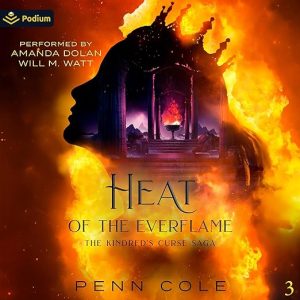
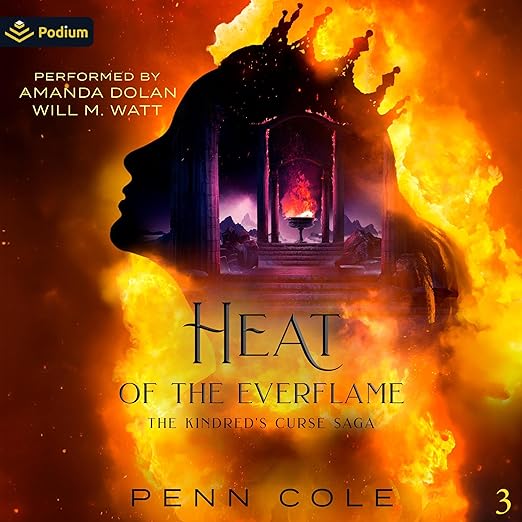
Book three of a four-book saga puts a reviewer in an awkward spot, because half of what happens here only lands if two earlier volumes are still fresh. Penn Cole's description does not pretend otherwise. It introduces Diem Bellator by name, calls the saga four books long, and spends its closing paragraph listing the other series you probably already love. What that paragraph never gets around to mentioning is the size of the object on sale, which is an audiobook running thirty-four hours and twenty-nine minutes.
Diem's War Leaves No Room to Breathe
Diem's coronation has already gone badly when this volume opens, and the fallout drives everything after it. War has started, the Descended and the Guardians both demand her allegiance or her death, and the mortals she swore to protect stand on the opposite side from the man she is falling for. Cole runs that bind for the full length of the book rather than resolving it early, which is the right call and also the reason the middle stretch asks so much patience. The journey Diem and Luther take across the realms exists to answer a question about her bloodline, and the answer arrives in pieces.
Dense Prose, One Untested Narrator
Length is the first thing the column brings up. The United Kingdom five-star opens by admitting a personal rule against anything over four hundred pages, then reports that so much happened the count stopped registering. That same entry nitpicks the one real cost of the density: the pacing turns overwhelming in places, and a few quieter stretches would have balanced the intensity. Both halves of that assessment strike me as right. Cole rarely lets a scene sit, and somewhere past the halfway mark the absence of a slow chapter starts registering as a deliberate choice rather than an oversight.
Everyone writing on this page is grading a novel they read. One found it through a recommendation after finishing another series and got hooked; another describes getting through a chapter a night while abroad; a third measures the whole experience in pages. Useful information about the novel, then, and none at all about the file Podium Audio produced. Amanda Dolan is the sole name in the narrator field, and the sample gives you the only minute on this page where that voice can be tested against weeks of listening.
Podium Audio Shrinks Thirty-Four Intimidating Hours
Meaty is the word the earliest response reaches for, twice in a row, before immediately telling you not to let that put you off. It flew by, that entry says, because the book stays packed and you get invested enough that time slips. I agree with the mechanism even where I would argue with the verdict. Cole writes short scenes, cuts between threads, and keeps a reveal or a reversal within reach at almost any point, which is exactly the construction that makes a very long file feel shorter than its runtime.
Romance readers get what the label promises. Cole's own copy names the tropes without embarrassment: slow burn, enemies to lovers, angst and romantic tension, banter. Diem and Luther spend most of the volume traveling together, the structure the genre built for precisely this purpose, and the political plot keeps interrupting them in ways that raise the temperature rather than lowering it. The Canadian five-star calls the worldbuilding epic and singles out the central love story as the reason the saga topped a personal year-end list, while admitting the heroine was frustrating in stretches.
Audio is where this length stops being intimidating. A book that puts off readers at four hundred pages becomes something you carry through a kitchen, a gym and a long stretch of driving, and the density that overwhelms on the page distributes itself more kindly across days. Podium Audio built its catalog on self-published fantasy romance of exactly this shape, and having one credited reader on a file this size matters more than it would on a three-hour title, because consistency of voice is most of what holds a saga together between installments.
Four Countries, Zero Words About the Recording
The Australian five-star supplies the most useful caveat in the column, because it separates a complaint from its cause. That listener found the opening stretch exceptionally slow and remembers being bored, then wonders whether the fault lay with the book or with the flight overseas that reduced the reading to a chapter a night. The honest answer is probably both. Cole spends the first act relocating a large cast and reintroducing a political map, and at this scale the setup occupies more hours than an entire short novel would.
Geography matters when you read this page. This column was assembled across four countries, which tells you the saga travels and also that the sample behind the star line is smaller and more scattered than the raw number implies. What those entries grade is a novel: page counts, chapters read at night, a recommendation followed, favorite quotes copied out. Take the aggregate as a verdict on Cole's story, and let the sample settle everything else.
Advertising has crept into the description in a way worth naming out loud. Its final two paragraphs stop summarizing this volume and start selling the saga, promising a feisty heroine, betrayal and intrigue, then listing A Court of Thorns and Roses, Throne of Glass, Blood and Ash, The Plated Prisoner, Grisha and Crowns of Nyaxia as the shelf it belongs on. Read that list as a marketing instrument rather than a description of book three. A buyer arriving from any of those titles deserves to know the copy was written to catch them.
Three Books Deep Before This War Started
Committed romantasy readers who have finished the first two volumes are the obvious audience, and they hardly need me to tell them to continue. The more interesting question is whether anyone should start the saga here, and the answer is no. This volume opens mid-war, assumes a coronation you did not attend, and turns on a heritage mystery whose stakes were assembled across two earlier books. The series field carries the number three beside the saga name, and that small digit is doing more work than any sentence in the copy.
Whoever wrote the lone four-star makes the case better than the marketing does. That response opens by recapping how the previous volume ended, with the man who raised Diem murdered as a message to her, then describes the pair fleeing Lumos and moving through several realms. Reading that recap is the fastest way to measure how much prior plot you would be missing. If none of those names mean anything, this is not your entry point, and the description only says so in its second-to-last paragraph, well after four paragraphs of plot that assume you already know these people.
Skip it if you want a tight book. Cole is not economical, and a volume that talked one reader out of a four-hundred-page rule will not convert anyone who wants a story delivered inside nine hours. Skip it too if slow burn frustrates you, since the saga is built on deferral and this installment defers again. What you get in exchange is scale: a magic system with rules, a war with sides worth arguing over, and enough room at this length for a relationship to develop rather than resolve inside a chapter.
Does the Heat of the Everflame audiobook work as a standalone?
No. It opens after a coronation that happened in the previous volume, assumes you know who the Descended and the Guardians are, and turns on a heritage mystery built across two earlier books. Penn Cole's description places it third in a four-book saga, so start at the beginning.
Is the audiobook more romance or more war plot?
Both run the whole way. The description frames the volume around Diem's forced choice between the mortals she protects and the people she has come to love, so the campaign and the relationship keep colliding rather than alternating. Expect slow burn, angst and banter threaded through a political plot that never pauses.
Why is this volume so long?
Book three carries a war, a journey across several realms, a bloodline reveal and a court plot at once, and Cole resolves none of them quickly. The Podium Audio recording runs thirty-four hours and twenty-nine minutes, roughly three ordinary novels, which is why the pacing complaints and the praise both point at density.
How explicit does the romance get in this installment?
Cole's copy sells slow burn, angst and romantic tension rather than constant explicitness, and by book three the tropes it names have had two volumes to build. Expect the physical relationship to advance meaningfully without becoming the organizing principle of a book that stays political for most of its length.