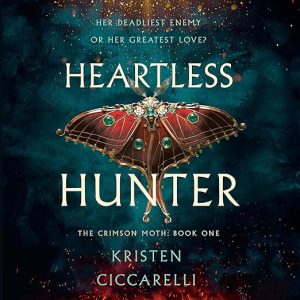
Rune spends her days performing vapidity at parties and her nights pulling witches out of a republic that wants them dead. Kristen Ciccarelli's audiobook runs twelve hours and eight minutes and opens the Crimson Moth duology, and the premise manages what romantic fantasy most often fumbles: it hands both halves of the couple a reason to lie that no amount of honest conversation can dissolve. He hunts what she is. She courts him to learn what he knows. Neither one can stop without giving something up.
Deception Runs Both Directions in This Romance
Deception running in both directions is what lifts this above the enemies-to-lovers shelf it sits on. Rune courts Gideon Sharpe to throw the hunters off her scent and harvest what he knows. Gideon, having worked out that the Crimson Moth has been using Rune's merchant ships to move renegade witches out of the republic, pretends to court her right back so he can get inside her social circle. Both are performing affection for operational reasons, both begin meaning it, and the description closes the loop with the only question the book needs to answer: what if she is the villain he has been hunting?
Fear, power and forbidden loyalty is how a March 2026 five-star sums up the world, with Rune working in secret to free captured witches and Gideon set on eliminating the figure he knows only as the Crimson Moth. That entry calls the result high-stakes and emotionally compelling in the same breath, precisely the balance the book aims at. Whether it lands for you depends on how complicated you need a fantasy world to be, and the written column answers that question in several different directions at once.
Politics sit underneath the romance whether the book wants them there or not. A ruling class overthrown, its survivors hunted and purged, a vigilante running an escape route through her own merchant ships: what the description is describing is persecution, and Gideon is loyal to the revolution that carried it out. The book does not resolve that tension, and a listener hoping it will reckon seriously with who deserved what is going to be waiting a long time. What it does instead is let the discomfort sit inside the romance, which is a defensible choice and worth knowing about going in.
Grace Gray Plays Vapid, Competent, and Hunted
Magic is a liability here rather than a power fantasy, and that inversion carries the whole book. Witches were the ruling class, a revolution ended that, their magic is described as waning, and they are now hunted for what remains of it. Rune's power is the thing most likely to get her killed, so every use of it costs her rather than thrilling her. Romantic fantasy generally promises escape into capability. This promises the reverse, and the socialite disguise works as a survival strategy rather than a costume, which gives the party scenes a genuine edge.
Pacing is the quality this book gets credited with most consistently. A March 2025 four-star that went in knowing only that witches were involved reports tearing through it, thanks the author outright for short chapters, and names the cat-and-mouse structure as the thing that held the engagement. Short chapters matter more in audio than on the page, because they hand a listener natural exit points across twelve hours. That same entry calls the atmosphere gothic with a regency-adjacent flavor and finds the magic system a bit different and interesting rather than merely familiar.
Grace Gray reads the whole thing for Listening Library, and the assignment is demanding: a heroine who has to sound like a vapid socialite in public and a competent operative in private, a witch hunter whose loathing has to come through before his affection does, and a ballroom full of people neither of them can afford to trust. Sixty-six ratings and five detailed written entries have accumulated on this listing, and none of them mentions the reading. On a twelve-hour story about two people misrepresenting themselves, that leaves the preview as the only evidence about the voice doing the misrepresenting.
When 3.75 Gets Rounded Up to Five
Stars are the first oddity, and it is not the usual complaint about inflated averages. At least two of the entries record a grade the five-point scale simply cannot hold. One four-star opens by announcing that its real figure is 3.75, rounded up. Another, written in a language other than English, says ten stars would be the right number and then awards the five that exist. A 4.4 average across sixty-six ratings is assembled out of clicks like those, which is worth remembering before anybody reads that decimal as precision.
Complexity is the second thing. A May 2025 five-star is refreshingly clear-eyed about what it enjoyed: not much complexity to the story, minimal worldbuilding that is very easy to follow, a magic system it calls generic, and complete immersion in spite of all three. That entry places the setting in the Gaslight era, though the description never names a period at all, referring only to a republic after a revolution. It also logs the heat level as a single chili, which is worth knowing on a page filed under teen and young adult whose own top blurb calls the book steamy.
Here the Romance Does the Heavy Lifting
Romantasy readers who want the romance load-bearing rather than decorative are the audience, and particularly those who like the slow version, where two people spend most of a book lying to each other with steadily increasing difficulty. Anyone who preferred the courtly-deception half of the genre to the battle half will be at home in the ballrooms. The duology structure matters as well: this is the opening volume, the copy says as much, and not every question it raises gets settled inside twelve hours.
Stay away if you need dense worldbuilding, because the book does not offer it and never sets out to, and stay away if you need to be surprised, since a cat-and-mouse shape telegraphs a fair amount of what is coming. Readers expecting the steaminess advertised at the top of the description should calibrate downward. Twelve hours is a long courtship, and the reason to spend them is not the magic system but the specific pleasure of watching two people who cannot afford to mean it start meaning it anyway.
Questions Listeners Ask
Is this audiobook appropriate for a younger teen listener?
The category is teen and young adult, and the plot turns on courtship, deception and a hunted minority rather than on graphic content. The blurb quoted at the head of the listing does call it steamy, so households with firm limits should preview a later chapter rather than trusting the category label by itself.
Is Heartless Hunter a standalone, or the beginning of a series?
It opens The Crimson Moth, which the copy describes as a romantic fantasy duology, and the series field records this as volume one. The description calls it the thrilling start, which sets the expectation that not everything raised across twelve hours and eight minutes will be settled by the final chapter.
Do the short chapters make this easier to listen to in pieces?
That is the practical advantage of the structure. A twelve-hour file broken into short chapters supplies natural stopping points, which matters on a plot built from alternating deceptions where losing your place costs you the shape of a scene. It suits errands and chores far better than a book of long unbroken sections.
Does the audiobook use one narrator for both Rune and Gideon?
The listing credits Grace Gray alone, so a single voice carries the socialite performance, the operative underneath it, and the hunter tracking her. Listening Library released the recording in February 2024. On a story built from two people misrepresenting themselves, the distance between those registers is exactly what a preview should be used to check.