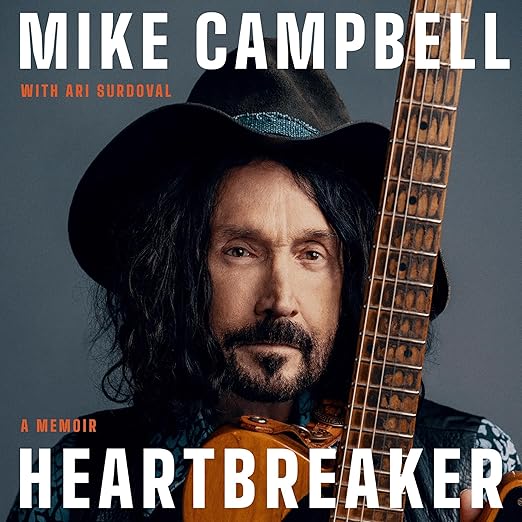
Gainesville, a rundown farmhouse, a broke student with the Vietnam draft looming and nowhere else to go: that is where the friendship at the center of this audiobook begins, and it is a better opening than most rock memoirs reach after two chapters of throat-clearing. Mike Campbell met a twenty-year-old Tom Petty in that house, and the two of them were inseparable from then until Petty's death in 2017. Heartbreaker runs fifteen hours and thirty-seven minutes, which is long, and the length is the argument: this is a whole life and not a highlight reel.
Fifteen Dollars and a Borrowed Radio Signal
Jacksonville is where the book actually starts, on the north side of it, in a household often only days ahead of homelessness with a single mother working minimum wage. After months of saving she bought her son a $15 pawnshop acoustic for his sixteenth birthday, and with a chord book and a transistor radio he taught himself to play. That detail is the entire memoir in miniature. Fifteen dollars, a borrowed signal from the air, and eventually a body of work most listeners can hum without ever having known the name of the guitarist who wrote the parts.
Petty is unavoidably the gravitational center, and one May 2025 response is refreshingly direct about resenting it: yes, Tom Petty, understood, but this is a book written by one of the Heartbreakers, and what that reader was digging for was not so much about Tom. That tension is the memoir's real structural problem. Campbell was lead guitarist from the band's inception in 1976 until 2017, he co-wrote a great deal of the catalog, and Petty never made a record without him. Being indispensable and being the story are two entirely different jobs.
Marcie is named in the publisher copy as the love of Campbell's life, met in Los Angeles at the point where the dream stopped being theoretical, and the fact that a name appears there at all signals what kind of memoir this intends to be. The description promises an astute observer of triumphs, tragedies and absurdities alike, with a songwriter's eye for the telling detail. Whether it delivers on the tragedies is where a memoir by an intensely private person usually gets tested, and 2017 sits at the end of the timeline, waiting.
Nobody Has Said a Word About the Recording
Craft is why a guitarist's memoir often beats a frontman's, and this one leans on it. A July 2025 five-star, from a self-described big fan of the band, singles out the stories behind the songs as the best material in the book and describes the telling as plain spoken, carrying candor, emotion and love. Session detail, writing partnerships, what a particular part was actually for: that is why people who cannot play a note still read musicians' memoirs. Campbell also co-wrote career-defining hits with Don Henley, which widens the territory well past one band's discography.
Songs aside, the thing that should sell this edition is that Campbell reads it. A memoir by somebody the copy calls brilliant, soft-spoken and intensely private, delivered in that person's own voice, is a materially different object from the same text on paper. It is also completely untested here. Not one of the five signed entries beneath the listing says a word about the recording, so nobody has publicly graded whether a soft-spoken guitarist sustains a memoir of this length behind a microphone. That is the honest position and it deserves stating plainly.
One Vote, Five Grades, Neither Explains 4.8
Count what is printed under this listing and you get five entries, each signed, dated and carrying a five-star grade. Now look at the rating counter, which reads 1, sitting beside a displayed average of 4.8. A single voter picks one whole star between one and five, and no whole number displays as 4.8. Whatever population produced that average, it is not the lone voter the counter admits to, and it is not the five people whose words appear here either, because five five-star grades average exactly five. The badge and the column are describing different rooms entirely.
Grades are not the only thing here inherited from the printed edition. One response describes being captivated by the sample pages on the retailer's site, then diving in the moment the book arrived, which describes a parcel and not a download. The publisher copy carries a starred trade review and describes Campbell opening up within these pages. Everything points the same direction: the evidence on this listing was assembled to sell a hardcover, and the audio edition has simply inherited it. The book is identical. The thing being graded is not.
What the Guy Beside the Frontman Contributes
Guitarists will take the most from it, and so will anybody who has wondered what the person standing to the left of a famous frontman actually contributes to the songs. A November 2025 response sums the appeal into a single sentence about the writing style and the stories told, while a January 2026 entry calls the attention to detail remarkable and puts the book at the top of a year's reading. Both are pointing at the same quality, which is specificity, and specificity is the rarest thing in this whole genre.
Casual listeners hoping for a scandal-driven rock memoir should look elsewhere, because the copy promises humility, collaboration and gratitude, and the written responses confirm that description instead of undercutting it. Anyone who came to the band through Full Moon Fever or Wildflowers gets the making of both. Anyone who has never knowingly heard the Heartbreakers will still find the Jacksonville chapters land, since a kid with a pawnshop guitar and a transistor radio is a story that survives without its soundtrack. Everything else is a bonus you can go and look up afterward.