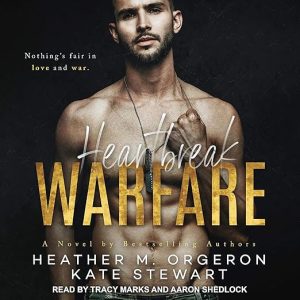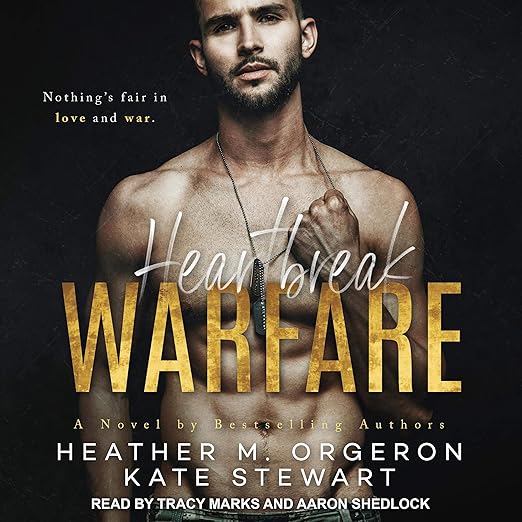
Judy Robichaud's response to this book names two writers: Heartbreak Warfare by Heather M. Orgeron and Kate Stewart. The author field on this audiobook names one. Nothing on the page acknowledges the second name and nothing explains its absence, so a listener arrives at an eleven-hour military romance without knowing whether one person wrote it or two. That is not a small omission in a genre where readers follow bylines, and it is the first thing to settle before buying. Everything else here, including a description that never describes anything, sits downstream of that same carelessness.
Is Heartbreak Warfare Worth Your Time?
The description is not a description. It is a letter, addressed to someone called Briggs and signed Scottie, and it works as a cold open rather than a blurb. Germany is where the two of them parted. A husband and a son were supposed to be enough. An ambush happened, then a hole in the ground, then a rescue that ended nothing for either of them. The letter asks for one last meeting and stops. As marketing it is effective. As information it is nearly useless: you cannot tell from it how many viewpoints the book uses, whose head you spend the most time in, or where it lands on heat. The only guidance offered is the three-word warning at the bottom, contains mature themes.
Orgeron's name is the one on the credit, and the reviewers who describe the reading experience are describing something intense. Mel supplies the tag list nobody else bothers with: military romance, love triangle, heart-pounding action, emotion-provoking angst, multiple point of view. That is a precise map of the machinery, and it beats the letter for practical use. Between the sheets book reviews reaches for theme instead of plot, writing that the story is about war and about what soldiers carry home, and that many are not lucky enough to come out the other side with their lives. Judy Robichaud's title, in capitals, promises a top ten read of 2018 and five big fat stars. The column is unanimous and it is loud.
The Best Parts of Heartbreak Warfare
Eight votes stand behind the 4.6 on this page, and the arithmetic is worth doing because it comes out unusually clean. Eight whole-star votes averaging 4.6 must total exactly 37 points out of a possible 40. The five people who wrote all gave five stars, which accounts for 25. The three who rated without writing therefore hold the remaining 12, an average of exactly four apiece. The quiet third of this audience liked the book noticeably less than the loud two thirds, and the badge is the only place their verdict surfaces at all. It is the most informative number on the listing, and it points somewhere the reviews do not.
Marks is credited for all eleven hours and two minutes, and that credit tells you something the description will not. A book built out of a letter from Scottie to Briggs, using multiple points of view according to Mel, is being read by a single voice. Dual narration is common in this corner of romance, so its absence here is a production decision a listener should know about in advance. Whether one reader can hold a love triangle across more than one perspective is the question this recording lives or dies on, and the page hands you a name and a runtime to guess with. Thin, but still more than the letter provides.
Before You Commit to Heartbreak Warfare
Scottie's letter mentions an ambush, a hole in the ground, and a trauma the two characters share, and the reviews confirm the book takes all of it seriously. Mel says plainly that it is not an easy read, then begins a sentence about triggers: if you have triggers to a. The body stops on the indefinite article, immediately before the first item. Whatever specific warning that reader was about to give, the page cuts it off, and nothing else on the listing fills the gap. For a romance whose own copy limits itself to three words about mature themes, that truncation is the most consequential piece of missing information available. Anyone who screens for particular content will have to look somewhere other than here.
Mel is also the only reviewer who arrives with a route: the recommendation came from a fellow bookstagrammer, which is a fair description of how this book found its readers. Two of these reviews consist largely of block quotes lifted from the text rather than judgments about it. Spellbound Reader gives most of the review over to a passage about a man who knows nothing of what we went through. The Italian response calls the book marvelous, says it touches complicated and painful subjects, admits to having both hated and loved it, and compares the experience to the film La La Land. As criticism the column is thin. As evidence of emotional impact it is overwhelming. Which of those two things you need decides whether this page can help you.
The Right Listener for Heartbreak Warfare
Romance listeners who want the genre's angst register at full volume are the target, and every visible grade agrees. Five reviewers, five five-star ratings, and three of them reach for the vocabulary of damage: decimated, wreck you, everything. If your ideal listen leaves you unable to start another book for a day, this is calibrated for you. Military romance readers get the specific setting: a deployment, an ambush, a marriage that survived a war and may not survive the peace. Readers who like a love triangle treated seriously rather than as a device have Mel's tag list as confirmation that one is present, and that it sits at the center rather than the edge.
Listeners who want to know exactly what they are walking into should be careful, because this page will not tell them. The description withholds the plot. The one review that starts listing content warnings is cut off before it names a single one. And the byline question stays open: a reader who tracks authors will want to establish whether Kate Stewart co-wrote this before deciding, since only the review column says so. Anyone allergic to unrelieved intensity should also note that not one of the five responses mentions a light moment, and that the three silent votes behind the badge average exactly four rather than five. Come for the letter at the top of the description, but settle the credit before you commit eleven hours to it.