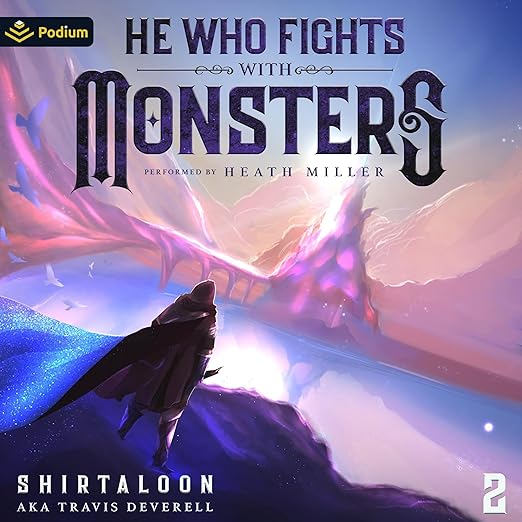
- Narration: Heath Miller handles Jason's irreverent voice with real ease, differentiating a wide cast without losing track of anyone during a 22-hour runtime.
- Themes: magical system progression, political conspiracy, found family and companionship
- Mood: Kinetic and comedic with stretches of genuine dramatic weight
- Verdict: A rewarding second chapter for committed fans of the series, though the rough editorial edges from its web serial origins are still audible.
Heath Miller Grounds Jason's Irreverent Second Arc
Craft matters in LitRPG precisely because the genre can so easily coast on wish fulfillment. Jason Asano, the protagonist of Shirtaloon's He Who Fights with Monsters series, started as a retail middle manager yanked into a high-fantasy world, and this audiobook follows him through his second major arc: a competitive city tournament that quickly becomes something far more dangerous. The challenge for any book two in a GameLit series is threading the needle between rewarding existing fans with earned progression and staying honest about where the story's seams show. Shirtaloon manages the first with real confidence; the second is where listeners will have to decide how much tolerance they have for rough edges.
Heath Miller returns as narrator and quickly proves himself one of the better voices working in LitRPG audio. His pacing captures Jason's characteristic irreverence without letting it swallow the book's genuine dramatic stakes, and he differentiates the growing cast of companions with enough consistency that listeners rarely lose track of who is speaking. For a story this dense with world mechanics and character interplay, that kind of navigational clarity in performance is not a given.
Greenstone's Tournament Sharpens the Series' Humor
The premise of the second installment is more layered than the first. A grand tournament draws young elites to the city of Greenstone, which gives Shirtaloon a structural frame for introducing new rivals and deepening the companion relationships Jason has built. Reviewers who loved book one frequently single out the humor as the real draw: 'A lot of funny repartee between Jason and literally every other character,' as one reader put it. That wit is still here, and it lands more often than not. Jason's irreverence has found its groove, and the comedic beats feel less performative and more organic than they sometimes did in the first book.
Conspiracy Widens Beneath Greenstone's Tournament Cover
What distinguishes this installment is the widening political canvas. City leaders are quietly unraveling a conspiracy of betrayal while the tournament provides cover for a much larger threat. Jason seems peripheral to this strand at first, but Shirtaloon draws the threads together with more patience than the genre usually demands. For listeners who enjoy the slow burn of watching a protagonist's earlier choices ripple outward in ways they could not have anticipated, that structural patience is genuinely satisfying.
The world of Greenstone also rewards the additional attention Shirtaloon gives it here. The first book established the geography and the essential faction dynamics; this installment populates that world with characters whose motivations extend beyond whatever immediate obstacle they present to Jason. The ex-King's ticked-off offspring, the arriving elites, the city's quiet leadership class: these figures have interests and fears that run parallel to the tournament narrative, and the overlap creates a more textured reading experience than a simple linear competition would allow.
Grammatical Errors and an Episodic Tournament Structure
One honest caveat that shows up in the reviews and is worth flagging before you commit twenty-two hours: the text carries a notable number of grammatical and spelling errors that survived into the audiobook preparation. One reader described it plainly: 'So many errors. Grammatical and spelling errors abound. Sometimes it was difficult to figure out what a sentence was supposed to say.' Heath Miller handles most of the stumbling prose gracefully, smoothing awkward constructions with his delivery, but occasionally the underlying text fights back. This is a web serial adaptation and carries that lineage, for better and worse.
The tournament structure is also a double-edged feature. It organizes the mid-section well, providing a succession of escalating contests that keep momentum up, but it can feel episodic in places, cycling through new challengers who function more as stepping stones than fully realized characters. Listeners coming from literary fiction may find the characterization of secondary figures thinner than they prefer. Those embedded in LitRPG will recognize this as a genre convention and move through it comfortably.
Companion Bonds Outlast a Rough Tonal Seam
The pacing issue is worth naming directly: the transition from the tournament's main bracket into the larger threat that emerges in the second half requires the story to shift registers, and that shift is not entirely seamless. The comedy and the political thriller elements are both genuine pleasures in their own right; when they have to occupy the same space simultaneously, the seams can show. Miller's narration helps smooth the tonal variation, but the structural challenge of the final third is a real one.
The companion dynamics also deserve recognition as a structural achievement for book two. Shirtaloon has spent enough time with this cast to let specific relationships develop in ways that were only sketched in book one. The dynamic between Jason and the companions he gathers for the tournament has genuine texture: their individual hesitations about working together, the particular ways they complement and undercut each other, and the moments where the comedy of their interactions gives way to something that reads like actual trust earned under pressure. Heath Miller handles this ensemble work with the same consistency he brings to Jason's solo voice work, which keeps the investment in the cast from feeling like it requires memorizing a spreadsheet. For listeners already committed to the world, these relationship developments are among the strongest reasons to continue past the first book.
Built Entirely for Already-Committed Series Listeners
This audiobook is for listeners who have already committed to the series from book one. It absolutely does not function as a standalone entry; the emotional payoffs here are entirely predicated on investment already made. For fans of Jason Asano who want more of his particular brand of self-aware adventuring, book two delivers on the series' promise while expanding its scope in directions that set up genuinely interesting conflict ahead. Heath Miller's narration makes the long runtime move faster than it reads on the page.
Listeners new to the series should start at the beginning. Listeners who were lukewarm on book one's humor or found the world mechanics overly detailed will not find this installment a significant departure from those patterns. The improvement is in scale and consequence rather than style. For committed fans of the series, the twenty-two hour investment is well-supported by Miller's performance and the genuine widening of stakes that the second book delivers.
Questions Listeners Ask
Do I need to have read the first book before listening to this audiobook?
Yes, absolutely. He Who Fights with Monsters 2 picks up directly from events in book one and assumes full familiarity with Jason's backstory, his ability system, and the world of Greenstone. Starting here would leave a listener disoriented within the first few chapters.
How long is this audiobook, and does the runtime feel earned?
The audiobook runs 22 hours and 1 minute. For LitRPG fans, that runtime will feel about right for the scope of what happens: a city tournament, a widening political conspiracy, and significant companion development. For listeners outside the genre, it can feel sprawling in its middle section.
Are the grammatical errors from the web serial version noticeable in the audiobook?
Some are. Several reviews note that the underlying text contains more errors than a fully edited novel would, and while Miller handles most of them gracefully in performance, occasional awkward constructions do break through. It does not derail the experience but is worth knowing going in.