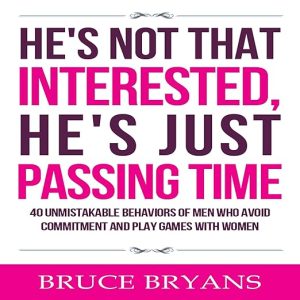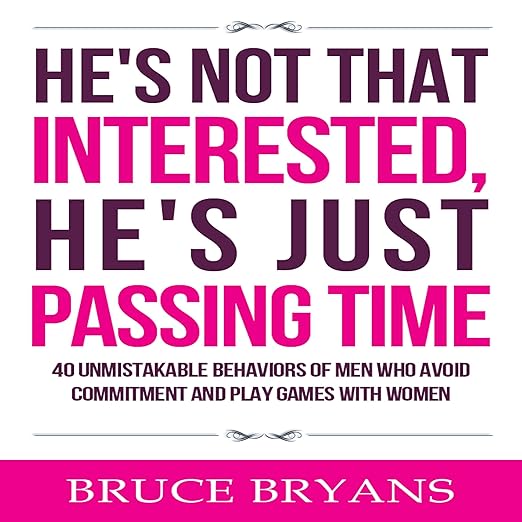
Dating advice audiobooks occupy a peculiar corner of the self-help category, one where the quality of the underlying insight matters far more than the delivery, and Bruce Bryans has built a small catalog of titles in the Smart Dating Books for Women series aimed squarely at a gap the genre tends to dance around rather than address directly. He's Not That Interested, He's Just Passing Time is among his most direct entries: the central argument is that "commitment issues" as most women understand the phrase are largely a polite fiction men deploy when what they actually mean is that they're not interested enough in this specific woman to commit. Dan Culhane's narration delivers that argument in a brisk two hours and twelve minutes in this audiobook, which is exactly as long as it needs to be for the claim it's making.
The audiobook's framing is deliberately provocative. Bryans opens by rejecting the therapeutic framing of relationship dysfunction and replacing it with a simpler behavioral model: men who are genuinely interested act interested, and men who maintain calculated ambiguity while staying accessible are not experiencing confusion. They are managing the situation. The distinction matters because it shifts the interpretive work back onto observable behavior rather than psychology, which is considerably less comfortable and considerably more useful. One reviewer captured the effect as experiencing "many yup, yup, yup moments," the recognition that behavior she had explained away through sympathy or patience had a simpler and less flattering explanation all along.
Dan Culhane Sounds Consultative, Never Preachy
What Bryans does well is behavioral specificity. Rather than offering general principles about confidence or self-worth, he catalogs specific patterns: the "someday" carrot, language that keeps a woman engaged without making any commitments, behaviors that signal a man is maintaining optionality rather than building something. One listener described recognizing "one major mistake which would have saved me the last few years of my life," a reaction that suggests the book is doing its intended job. This is not a book that makes you feel good about wasted time; it's a book that helps you recognize when time is being wasted so you stop wasting more of it. That's a meaningful distinction in a genre that often prioritizes comfort over utility.
Dan Culhane's narration is an interesting choice for this material. The book is addressed entirely to women, but Culhane reads with a tone that feels more consultative than preachy, which helps considerably. He keeps the content from sliding into the lecturing register that kills this genre of self-help. The short runtime helps enormously here too. At under two and a quarter hours, the argument is made and completed before it has a chance to become repetitive. Bryans earns credit for knowing when his argument is done and stopping rather than padding. The discipline of that brevity is itself a form of respect for the listener's time.
Specific Scenarios Beyond Vague Dating Platitudes
The audiobook format is specifically well-suited to this kind of behavioral checklist material. You can listen while driving or walking without taking notes, and the conversational structure means that even if your attention drifts briefly, the thread remains easy to pick up. The brevity also means you can return to specific sections easily. A listener described the book as helpful for a newer relationship, useful for confirming that what she was experiencing was genuine investment rather than someone passing time, which illustrates the dual utility of the content: it applies equally to identifying a problem and confirming the absence of one.
Bryans addresses several specific scenarios that the genre typically handles vaguely: men who may still be emotionally involved with an ex, men who are interested in casual connection but will never pursue commitment with a specific woman, and the language patterns men use to manage expectations downward while keeping a woman invested. The specificity of these sections is what separates this audiobook from broader dating guides that stay at the level of principle without ever getting to behavior. The advice is concrete enough to apply to a specific situation rather than needing translation before it's useful.
Deliberately Binary, Built for Clear-Cut Cases
The framework here is deliberately binary: interested or not interested, investing or passing time. Real relationships are rarely this clean, and listeners should hold the framework as a useful starting point for evaluating their own situations rather than an absolute diagnostic tool. The book is most useful as a lens for identifying clear patterns rather than as a verdict on ambiguous situations where other explanations might also be in play. Bryans's confidence in the framework is a strength when the situations are genuinely clear-cut; it can read as overly reductive when the emotional dynamics are more complex.
The audiobook carries a single verified listener rating, which makes community consensus harder to assess at scale. The reviews available are enthusiastic and specific, pointing to genuine utility, but listeners who rely heavily on large review samples before committing will want to note the limited rating pool. At two hours and twelve minutes, the commitment is low enough that the risk calculus is modest. The content either resonates with your specific situation or it doesn't, and that determination is usually clear within the first thirty minutes.
Reading Behavior Instead of Reading Intentions
This audiobook is most useful for women who are currently navigating a relationship or situation where the other person's level of genuine interest is unclear, and who want a framework for reading behavior rather than intentions. It's also well-suited for anyone who's had the experience of realizing, in retrospect, that what they interpreted as complexity in a partner was actually disengagement, and who wants a clearer filter for the future. Listeners who prefer their relationship guidance rooted in attachment theory or psychological depth rather than behavioral pattern-matching may find the approach reductive. At just over two hours, it costs very little to find out whether Bryans's framework resonates with your particular situation.
A Few Questions About He's Not That Interested, He's Just Passing Time
Is this audiobook part of a series, and does it need to be listened to in order?
It's part of Bruce Bryans's Smart Dating Books for Women series, but the audiobook stands completely alone. Each title in the series addresses a distinct question, and no prior listening is required to follow or benefit from this one.
Does the audiobook offer specific behavioral signs to watch for, or does it stay at the level of general advice?
It gets quite specific. Bryans identifies language patterns, behavioral signals, and situational markers that distinguish genuine interest from managed ambiguity. Listeners looking for concrete behavioral checklists rather than general principles will find this more useful than most titles in the genre.
How does Dan Culhane's male narration affect the experience of listening to an audiobook addressed to women?
Culhane reads with a consultative rather than preachy tone, which keeps the male-narrator dynamic from feeling awkward. The effect is closer to getting a candid read from a direct source than being lectured, which the content actually benefits from given its premise.
At two hours and twelve minutes, is this audiobook long enough to deliver meaningful insight?
For the scope of its argument, yes. Bryans makes a tight, specific case without overstaying. The brevity is deliberate rather than thin, and the focused runtime is one of the audiobook's genuine strengths compared to longer self-help titles that repeat their core insights for ten hours.