
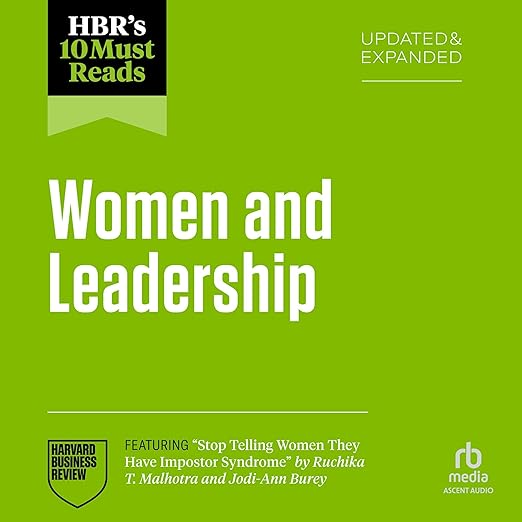
Fourteen articles sit under a title that promises ten. The description for this audiobook lists every one of them by name and byline, and counting takes about a minute: from How to Close the Gender Gap at the top to How Women Can Win in the Workplace at the end, the tally comes to fourteen pieces in five hours and twenty-nine minutes, roughly twenty-three minutes each. Nothing on the record explains the gap between the number on the cover and the number in the file, and a buyer counting articles rather than trusting the title gets a better deal than advertised.
A Collection That Argues Against Imposter Syndrome
Ammerman and Groysberg open the collection with the gender gap piece, and the six outcomes the copy promises tell you how the rest is organized: challenging stereotypes about women's leadership and vision, rooting bias out of hiring and promotion, practicing inclusive leadership in male-dominated industries, embedding sponsorship into leadership development, investing in on-the-job learning, and working collectively to drive change. That is a curriculum rather than an anthology, and the sequence has been chosen with some care.
Impostor syndrome gets argued against rather than coached, which is the most interesting editorial decision here. Ruchika T. Malhotra and Jodi-Ann Burey contribute a piece whose title instructs readers to stop telling women they have it, and placing that inside a leadership collection puts the anthology in argument with a framework much of the genre still sells. Frank Dobbin and Alexandra Kalev do something similar on the organizational side, proposing to achieve diversity goals without the programs built to deliver them.
Williams reads all of it, which is the structural fact of this format. Fourteen authorial voices, several of them writing in the first person about their own careers, arrive in one register, and a listener cannot see where a byline changes. In print the white space and the header do that work for you. In audio the transitions rely entirely on the reading, and a collection this varied asks a great deal of one voice.
Interviews Listen Differently Than the Essay Pieces
Sponsorship is the concept the collection presses hardest, and it earns the emphasis. Herminia Ibarra appears twice, once on vision with Otilia Obodaru and once on doing sponsorship right, and the practice that piece describes is the one most often confused with mentorship in the organizations that claim to be doing it. If you take one thing away from five hours, that distinction is the candidate.
Tannen turns up in interview form rather than as an essay, talking with three editors about making yourself heard, and Telle Whitney appears the same way in a conversation about whether the technology industry needs a reboot. Interviews listen differently from articles: shorter sentences, an audible logic of question and answer, and a natural stopping point every few minutes. They are the two easiest pieces in the collection to absorb while doing something else.
Babcock, Peyser, Vesterlund and Weingart supply the most immediately usable item, on taking on too many non-promotable tasks, which is the kind of finding that changes a decision the same week you hear it. Alongside Kathleen Reardon on the memo every woman keeps in her desk and Lisa Zigarmi's team on playing workplace politics, the practical half of this collection is stronger than the framework half.
The Audio Carries the Argument, the PDF the Evidence
Updated and expanded is in the title, and the record never says updated from what. No earlier edition is named, no publication year appears for the previous version, and no list identifies which articles are new and which were carried over. Anyone who owns the original collection has no way to work out how much of this they already have, which is a real cost on a five-hour purchase made of individually replaceable pieces.
PDF is where the exhibits went. The copy states that an accompanying file comes with the purchase, which is standard practice and worth taking seriously here, because research articles carry charts, tables and framework diagrams that do not survive being spoken. Plan on opening that file at some point, and treat the audio as the argument rather than the evidence.
Ratings do not exist on this page. Five months after the March 2026 release the counter is empty and nobody has written anything, which for a flagship series from a major business imprint means buyers are leaning on the article bylines and the brand rather than on anyone's experience of this specific recording. The names in the description are the reputational collateral here, and the description supplies plenty of them.
Data-Led Pieces Land Thinner by Ear
Managers with a promotion cycle to run are the clearest audience, followed by anyone building a leadership development program and looking for the current consensus in a form they can quote. Women in the middle of their own careers get the practical pieces, and a listener with no background in the literature gets a survey of it in a single afternoon, which is a genuinely efficient way to cover ground that would otherwise take a term.
Sustained argument is the thing this collection cannot offer, since it holds fourteen positions by different hands rather than one thesis developed across a book. Listeners who want stories rather than research will feel the same gap. And anyone who will not open the companion file should factor in that the data-led pieces land thinner by ear than they read on the page.
In Brief
- Narration: A single reader stands in for every contributor in the collection, none of whom read their own work, including the four editors conducting its two interviews.
- Themes: bias in hiring and promotion, sponsorship over mentorship, being heard in male-dominated rooms
- Mood: Brisk and evidence-led, closer to a briefing than a book
- Verdict: An efficient survey of the canon, provided you actually open the PDF.
Questions Listeners Ask
Which authors appear more than once on this audiobook?
Herminia Ibarra does, contributing the piece on vision with Otilia Obodaru and the sponsorship piece alone. Harvard Business Review itself carries a byline too, on the article about successful female networkers, which is the only house-written entry among individually credited pieces.
Is this audiobook part of a numbered series?
The series field reads HBR's 10 Must Reads with no number attached, and the collections are organized by theme rather than in sequence. Nothing here depends on another volume, so you can start with this one and never touch the rest of the run.
Does the audiobook offer practical steps or mostly research findings?
Both, weighted toward the practical. The six stated outcomes are all actions, from rooting bias out of promotion decisions to embedding sponsorship in development programs, and two of the pieces arrive as interviews rather than as studies, which keeps the register conversational.







