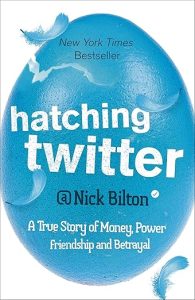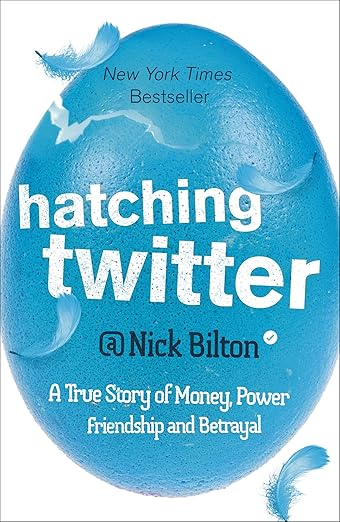
The context that surrounds this audiobook has only grown more complicated since Nick Bilton published the original text. Hatching Twitter, narrated by Daniel May, documents the founding and early turbulent years of Twitter through the intersecting stories of four co-founders: Biz Stone, Evan Williams, Jack Dorsey, and Noah Glass. At nine hours and thirty-five minutes, this audiobook gives the material room to breathe, and Bilton's reporting, built on hundreds of sources, internal documents, and direct interviews, supports the pacing. May's narration is well-calibrated for this kind of narrative nonfiction: he reads the material with forward momentum without sacrificing the precision that Bilton's investigative detail requires.
The audiobook opens in the context of what felt, at Twitter's peak, like one of the cleaner Silicon Valley success narratives: a small group of engineers builds a service that scales to hundreds of millions of users and reshapes global communication. Bilton's reporting dismantles that framing systematically. What he found, and what the audiobook communicates with considerable force, is a company built on fractured friendships, strategic betrayals, credit disputes, and the kind of ego-driven decision-making that can coexist, uncomfortably, with genuine product innovation. The four founders are rendered as distinct and sometimes sympathetic figures even as the story accumulates evidence of their failures toward each other.
Bilton's access was exceptional by the standards of tech journalism, and that access produces moments in the audiobook that feel genuinely revelatory rather than reconstructed. The internal emails and documents he drew on give the narrative texture that distinguishes this from the kind of tech biography assembled primarily from public record and interview synthesis. The conflicts between Dorsey and Williams in particular are rendered with enough specificity that the audiobook never reduces them to simple antagonist-protagonist dynamics. They are, by turns, each the protagonist of their own story and the antagonist of someone else's, which is both more honest and more interesting than a cleaner moral framing would allow.
Daniel May's narration handles the multiple-perspective structure well. The audiobook moves between characters and timelines without the disorientation that ensemble narrative can produce in audio format, where the reader cannot glance back at a chapter heading for reorientation. May achieves this through tonal and pacing differentiation rather than accent work, which is the right call for material this serious. The book is not satire and should not be read as such.
Noah Glass's Erasure From Twitter's Founding Story
The audiobook's treatment of Twitter's broader cultural and political impact is handled more briefly than the internal company drama, but the passages describing Twitter's role in the Arab Spring and in disrupting political communication deserve their place in the narrative. Bilton is careful not to overstate the causal claims, framing Twitter as a tool that enabled coordination rather than a cause of political upheaval, and that intellectual honesty strengthens the argument rather than diminishing it. At the time of the audiobook's production, Twitter was still a company with an uncertain but ongoing story; subsequent events have added retrospective weight to Bilton's portrait of its instability at the founding level.
For listeners interested in Silicon Valley specifically, the audiobook functions as a case study in how founding mythology and product reality can diverge dramatically. The story of Noah Glass in particular, a co-founder whose contributions are almost entirely erased from Twitter's official account of its own origins, gives the audiobook an edge of genuine injustice that most tech histories avoid confronting directly. Bilton names names and assigns credit with more specificity than the genre usually accommodates.
May's Pacing Carries the Densest Legal Passages
The audiobook was published in 2013, which means it precedes several developments that would come to define Twitter's later reputation: the political controversies of the 2016 election cycle, the years of platform abuse debates, and the eventual acquisition and rebranding. Listeners approaching this as a comprehensive account of what Twitter became will find themselves working with an incomplete picture. What the audiobook does exceptionally well is the founding period and the early scaling years, which it covers with a depth and narrative vividness that later accounts have built on rather than superseded.
The 4.5 rating across 2,237 reviews is strong for a nonfiction audiobook of this specificity, and it reflects a genuine audience that values investigative narrative over hagiography. There is a particular quality to well-sourced business journalism in audio format that print cannot fully replicate: May's pacing through the more densely documented passages, particularly the legal and financial disputes between the founders, keeps the material moving without reducing the complexity to a digestible summary. Listeners who want to understand how Silicon Valley companies actually function at the social and interpersonal level, rather than through the sanitized press-release version, will find this audiobook consistently rewarding on that specific front.
Best for Fans of Investigative Narrative Nonfiction
This audiobook is for listeners who enjoy investigative narrative nonfiction and are interested in Silicon Valley, platform politics, or the sociology of founding teams. The audio format suits the thriller-paced structure Bilton constructs from his reporting, and May's narration sustains that energy across nearly ten hours without the pacing fatigue that longer nonfiction titles can accumulate. Prior familiarity with Twitter as a platform helps but is not required; the audiobook provides enough context about what Twitter became for the founding-era conflicts to register with full weight.
Skip it if you are looking for a comprehensive account of Twitter's entire history including its later controversies, or if you find ensemble narrative in audio format more confusing than engaging. Readers who prefer linear, single-protagonist nonfiction may find the multiple-founder structure demanding. For everyone else, this is one of the more meticulously reported and narratively satisfying tech histories available in audiobook form.
Key Details
- Narration: Daniel May's narration brings appropriate urgency to Nick Bilton's investigative reporting, handling the overlapping timelines and multiple founder perspectives without losing the listener in the complexity.
- Themes: Betrayal and ambition in Silicon Valley, the price of founding mythology, power struggles in tech
- Mood: Propulsive and disquieting
- Verdict: An audiobook that reads more like a political thriller than a tech biography, and benefits from the audio format's capacity to sustain narrative momentum across complicated ensemble storytelling.
Before You Listen
Does this audiobook cover Twitter's later controversies, or does it focus primarily on the founding years?
Hatching Twitter was published in 2013 and focuses on the founding period through Twitter's early scaling years. It does not cover the platform abuse debates, the 2016 election period, or the later acquisition and rebranding. Listeners looking for a comprehensive audiobook account of Twitter's entire history will need to supplement this with more recent material.
Is this audiobook balanced in how it treats all four co-founders, or does it have a clear protagonist?
Bilton is notably even-handed in how he renders the four founders, giving each their moments of both sympathy and culpability. Noah Glass, the least publicly known of the four, arguably receives the most striking treatment, with Bilton documenting how his contributions were systematically erased from Twitter's founding narrative. The audiobook does not have a clean hero.
Does the audiobook hold up as a listening experience now that Twitter has changed so significantly since publication?
The founding-era material remains as compelling and relevant as ever, both as a document of how Silicon Valley companies actually function and as a portrait of how founding mythology diverges from reality. The absence of post-2013 events is a genuine gap, but the audiobook's core strengths are in the investigative depth and narrative craft rather than comprehensive historical coverage.