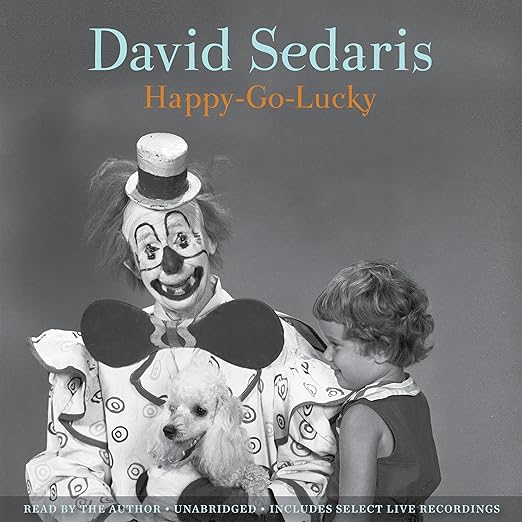
The Short Version
- Read by: Sedaris narrates himself, and decades of live public readings give him a deadpan comic timing no hired narrator could fully reconstruct from the page.
- At its heart: Pandemic disruption, grief and aging, family absurdity
- Vibe: Wry with a real melancholic undercurrent
- Short version: One of his most emotionally layered collections, essential for existing fans and a strong entry point for anyone new to his work.
Sedaris sounds different in Happy-Go-Lucky, and that difference is the whole point of this audiobook. His first essay collection since Calypso opens in familiar territory, learning to shoot guns with his sister, buying gummy worms to feed to ants, trading wheelchair jokes with his nonagenarian father, before the pandemic arrives partway through and quietly changes the register of everything that follows.
The shift is not dramatic or announced. Sedaris keeps his same wry, observational sentence structure throughout, whether he is describing muddy flea markets in Serbia or walking for miles through a nearly deserted city during lockdown, smelling nothing but his own breath. What changes is what sits underneath the jokes: grief for his father and sister, both gone by the book's end, and a genuine uncertainty about his own place in a suddenly unfamiliar America.
The title itself is worth pausing on: 'Happy-Go-Lucky' reads almost like a dare against the book's actual contents, guns, pandemic isolation, a father's death, a sister's death, and that gap between the breezy title and the heavier material underneath is a deliberate Sedaris move, not an accident of marketing.
Gummy Worms, Wheelchair Jokes, and a Sadder Tone
This is an Audie Award winner, and the essays here trace a specific arc from pre-pandemic normalcy through lockdown isolation and into an unsettled aftermath, storefronts empty or plastered with help wanted signs, graffiti carrying the contradictory slogans of the current moment. Sedaris does not editorialize about any of it directly. He describes what he sees and lets the accumulation of small, specific details do the work a more direct argument would otherwise have to do.
Reviewer suzy calls this 'a more thoughtful Sedaris,' noting correctly that some material previously appeared in The New Yorker but that the collection carries 'a sadder tone' overall, tied directly to the deaths of his father and sister during this period. That is an accurate read of the book's emotional center: still very funny, but funny in service of something heavier than his earlier collections tended to sit with.
The specific essay topics carry real range on their own: shooting guns with his sister well before anything else in the book turns serious, feeding gummy worms to ants in his yard out of pure idle curiosity, buying his nonagenarian father's affection through wheelchair jokes rather than sentimentality. Each vignette stays small and specific rather than reaching for a larger point, which is exactly Sedaris's long-running method: the meaning accumulates across essays rather than announcing itself in any single one.
Sedaris Essays Were Written for the Voice First
David Sedaris narrates his own work, and this is not a case where self-narration is merely a nice biographical touch. Decades of extensive live public readings, plus a long relationship with public radio audiences, have given him a specific deadpan timing that his own prose depends on structurally, the exact beat where a sentence tips from observational into absurd. A hired narrator, however skilled, would have to reconstruct that timing from the page. Sedaris simply delivers it.
Reviewer Bway Jack calls him 'this most literate of potty-mouthed raconteurs,' which captures something real about the audiobook experience specifically: hearing Sedaris's crude asides land in his own unhurried, faintly amused voice is a different, funnier experience than encountering the same lines cold on a page. The comic timing is inseparable from the performance in a way that is unusually true even among self-narrated memoirists.
Reviewer suzy notes some material previously ran in The New Yorker, which is standard practice for Sedaris collections built partly from shorter published pieces, and hearing those familiar essays folded into a longer audio collection, in his own voice, changes their texture from standalone magazine reading into something closer to a sustained, personal account of several difficult years.
Sedaris has spent decades testing new material at live readings before it ever reaches print, reading drafts aloud to real audiences and revising based on where the laughs land or fall flat. That process means the essays in Happy-Go-Lucky were, in a real sense, written for the voice before they were written for the page, which makes his own narration less an adaptation of the text and more a return to the format the material was actually built for.
Eat the Rich and Trump 2024, Same Breath
Listeners expecting the lighter, more consistently comedic register of his earlier collections should know going in that suzy's 'sadder tone' observation is accurate. This book sits with real loss, his father's death, his sister's death, in ways that some earlier Sedaris collections kept at more of a distance, and the pandemic material carries its own specific weight for anyone who lived through the isolation he describes.
The book's political and cultural material, the graffiti reading 'Eat the Rich,' 'Trump 2024,' and 'Black Lives Matter' in the same breath, is presented descriptively rather than as commentary, but it does mean the collection is unmistakably a snapshot of a specific, recent, contested moment in American life rather than timeless observational humor.
Higher Stakes but Still Recognizably Sedaris
Existing Sedaris readers, particularly anyone who finished Calypso and wanted to know what came next for him personally, will find exactly the mix of comedy and grief his recent work has been building toward. Fans of literary essay collections generally, and anyone processing their own pandemic-era disorientation, will find a genuine mirror here rather than just distraction.
Skip it if you specifically want pure, unmixed comedy without any grief material woven through it, or if crude, occasionally scatological humor is not your taste regardless of the emotional depth surrounding it. For everyone else, this is Sedaris doing what he does best, just with slightly higher stakes than usual.