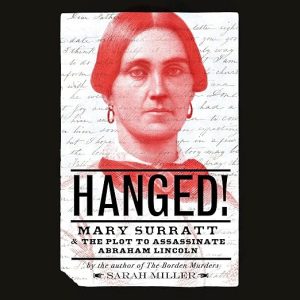
Mary Surratt became the first woman executed by the United States government on July 7, 1865, four months after Abraham Lincoln's assassination. Sarah Miller's Hanged!, narrated by Kate Udall, is a YA nonfiction audiobook that takes the question at the center of Surratt's story seriously rather than resolving it for the sake of a cleaner narrative: did she conspire with John Wilkes Booth, or was she, as her lawyer argued and as some historians have maintained ever since, a victim of catastrophic circumstance? The audiobook runs ten hours, and across that runtime Miller earns the right to leave the question genuinely open.
Miller is the author of The Borden Murders, another YA nonfiction title built around a case where the historical record does not permit certainty, and the same structural instinct is at work in Hanged!. She does not write toward a verdict. She writes toward a reckoning with what was actually known, what was merely suspected, and what was politically convenient to assert in the weeks after Lincoln's death. The distinction matters because the trial was conducted by a military tribunal rather than a civilian court, a choice that Mary Surratt's lawyer Reverdy Johnson fought vigorously and that historians have questioned ever since. Miller builds this context carefully so that listeners understand not just what happened to Surratt but why the legal framework made her conviction nearly predetermined regardless of the evidence. Her lawyer's best efforts could not overcome a system designed for speed and political resolution rather than evidentiary rigor.
What Works
Kate Udall's narration is well matched to Miller's tone. The prose in Hanged! is direct and controlled, the kind of YA nonfiction writing that respects its audience enough not to simplify the complexity or overstate the emotional beats. Udall follows that register accurately: she does not editorialize through performance, inserting emphasis where Miller has chosen restraint, but she also does not deliver the text flatly. The chapters dealing with the conditions of Surratt's imprisonment and the mechanics of the trial carry a measured urgency that keeps the listener engaged with material that might otherwise feel procedural without that quality of delivery.
One of the strongest aspects of this audiobook is the way Miller places Surratt in her full historical context rather than flattening her into a martyr figure. Surratt was a widow, a Catholic, a businesswoman, a slaveholder, and the mother of a Confederate secret service courier. Those facts coexist uncomfortably, and Miller does not resolve the discomfort. A reviewer noted that Surratt's Catholic devotion is obvious in the record and that the irrational behavior of the press and public is also thoroughly explored. Both observations are accurate. Miller shows how Surratt was simultaneously sympathetic in some respects and how her associations and household made her reasonable grounds for suspicion in others. The refusal to collapse that ambiguity is what makes this a serious historical account rather than a rehabilitation narrative or a condemnation in reverse.
Before You Commit to Hanged!
The sections dealing with the conspiracy itself, who knew what about Booth's plans and when, are where Miller's research is most evident and most useful for listeners trying to assess Surratt's actual culpability. She does not have access to evidence that the 1865 trial did not have, but she brings a contemporary historian's perspective on the evidentiary standards and the specific testimony that convicted Surratt, and she identifies gaps and contradictions with precision and without inflating them into certainties they cannot support. The testimony of certain witnesses that has been explored in the historical record is handled with the careful attention it requires, and Miller is consistent in distinguishing between what the historical record shows and what different interpretations of that record suggest.
The broader historical context surrounding President Andrew Johnson's famous characterization of Surratt as keeping the nest that hatched the egg surfaces repeatedly throughout the audiobook. Miller is effective at showing how a phrase like that, once spoken by a president with political reasons to want the conspirators convicted quickly and completely, functions as more than opinion: it shapes public perception and the legal climate within which the trial occurs. For listeners who came to this story primarily through the Lincoln assassination narrative rather than through Surratt's perspective, this reorientation is one of the most valuable things the audiobook provides.
At ten hours, this is a substantial listen for YA nonfiction, but the material genuinely requires the space. Miller is not padding; she is building a case from multiple angles and being honest throughout about what remains uncertain after more than 150 years of historical scrutiny. The pacing is appropriate to that ambition, and Udall's consistent delivery sustains the tone across the full runtime without fatigue.
Who It's For
Listeners aged twelve and up who are interested in American Civil War history, women's history, or the intersection of justice and political pressure will find this a rigorous and engaging introduction to a story that deserves wider recognition. Adults who read YA nonfiction for its clarity and narrative discipline will find Miller working at a consistently high level here. Those who want a definitive verdict on Surratt's guilt or innocence will not find it; this audiobook is not that kind of story, and its honesty about the limits of what history can determine is one of its primary virtues. Listeners who enjoyed Miller's The Borden Murders will recognize the same structural and investigative approach applied to a different and equally unresolved American case.
Key Details
- Read by: Kate Udall brings a controlled, serious register to Sarah Miller's YA nonfiction, matching the gravity of Mary Surratt's story without overdramatizing the genuine ambiguities that make it historically compelling.
- At its heart: Justice and its failure, women's legal invisibility in 1865 America, the politics of scapegoating
- Vibe: Measured and morally urgent, with the pace of a well-constructed legal argument
- Short version: Sarah Miller's portrait of Mary Surratt is rigorous, accessible YA nonfiction that treats its audience as capable of sitting with real historical uncertainty, making it one of the stronger audiobooks in the genre.
Questions Listeners Ask
Does this audiobook take a position on whether Mary Surratt was guilty of conspiring in Lincoln's assassination?
Miller deliberately does not resolve the question. She presents the evidence, the context, the trial's procedural problems, and the political pressures of the moment, and leaves the listener to weigh them. The ambiguity is the honest historical position, not a narrative evasion.
Is the Hanged! audiobook appropriate for middle-grade listeners, or is it strictly high school and up?
The content is serious and historically detailed, and the execution of Surratt is treated with gravity rather than sensation. Most recommendations place it at approximately age twelve and up, though younger readers with strong historical interests may find it accessible.
Is this audiobook a good complement to other Civil War history or Lincoln assassination resources?
Yes. Miller provides substantial historical context on the assassination conspiracy and the postwar political environment, making Hanged! a useful complement to broader Civil War listening, particularly for those who have not previously encountered Surratt's story as a central subject.