Quick Take
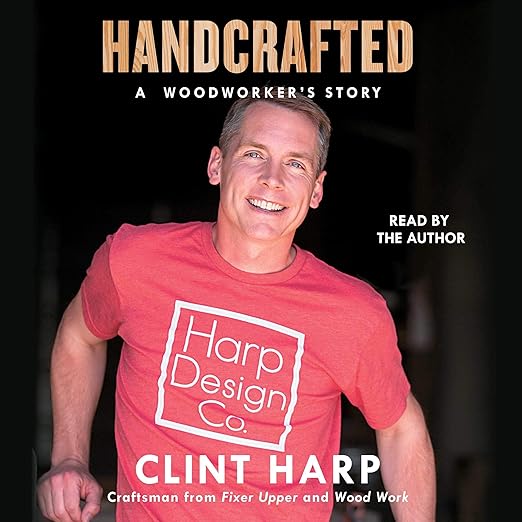
- Narration: Harp reads his own book with the same warmth and self-deprecating humor that made him watchable on Fixer Upper, and the authenticity of an author narrating their own story is an advantage here rather than a liability.
- Themes: Vocational risk and faith, the cost of following what you are built for, creative courage
- Mood: Warm, candid, and occasionally laugh-out-loud funny
- Verdict: A memoir that avoids the inspirational-fluff trap by staying close to the specific, messy financial reality of actually leaving a stable job to build furniture for a living.
I will be honest with you: I went into Handcrafted expecting something closer to a branded motivation manual, the kind of book that emerges when a TV personality decides their story deserves a cover. I was surprised by how much the reality resists that template. Clint Harp is a better writer than his Fixer Upper appearances suggest, and he is a considerably more candid one than I expected going in.
The setup is familiar enough in outline. Harp was working a sales job that paid the bills and stole his soul in the way that only a job you are fundamentally wrong for can. He wanted to build furniture. He had always wanted to build furniture, learned at his grandfather’s knee, and the distance between who he was being at work and who he was in his grandfather’s shop was the kind of gap that tends to either calcify into permanent numbness or eventually blow the whole structure apart. For Harp, with his wife Kelly’s support, it blew apart.
The Gas Station Encounter and What Came Before It
What Harp resists, and what makes the book work for readers who are not invested in the Fixer Upper brand, is the temptation to retroactively make all the early struggles feel inevitable and instructive. He is careful to note the randomness of the gas station meeting, the genuine possibility that the family’s finances could have collapsed before it happened, the ways in which the outcome required luck as well as persistence. That honesty about the role of chance in his particular success story is rarer in this genre than it should be.
The moment Harp meets Chip Gaines in a gas station parking lot has the quality of a myth by this point, polished by retelling. But Harp’s account of what came before and after that encounter is what gives it weight. He does not skip the period when the family was genuinely close to financial collapse, when the leap of faith had started to look less like a leap and more like a fall. The book is useful for anyone in a similar position precisely because it does not pretend the risk resolved cleanly or quickly.
There were misadventures on Fixer Upper, miscommunications with producers, furniture that did not turn out as intended, and the constant negotiation between artistic integrity and what a client or a TV schedule actually needs. Harp writes about all of this with a dry humor that keeps the narrative from tipping into self-congratulation. One reviewer described his voice as informative and witty at times, which is accurate and perhaps undersells him: the humor is more consistent and less occasional than that framing suggests.
Jimmy Carter and the Habitat Thread
One of the less-expected dimensions of Handcrafted is the Habitat for Humanity material. Harp’s work building homes for the organization, and the encounter with President Jimmy Carter that this produced, is woven through the memoir in a way that grounds the more personal carpentry narrative in something larger. The blurb from Carter quoted in the synopsis did not come from nowhere: Harp’s faith is present throughout the book, but it is not the aggressive kind that shuts out readers who do not share it.
It operates more as the bedrock of his decision-making: the conviction that the work you are meant to do exists, that finding it is worth the cost, and that the discomfort of the search is not a sign you are wrong. Several readers noted finding the book inspiring without having expected to, and specifically noted that it prompted them to think about their own version of the same decision. That is not a common outcome for celebrity memoir, and it is a credit to how specifically Harp tells his own story.
The Self-Narrated Audiobook Question
Harp narrating his own memoir is the correct choice here, but it is worth noting why. His delivery is relaxed and specific in a way that a professional narrator would have had to work considerably harder to approximate. He knows when to speed up, when to sit in a story, and when to let a pause do the work. One reviewer noted that his voice carries the same sincere quality he projects on screen, and that this made them feel they were getting the real account rather than a publicist-managed version.
That impression holds. Harp is not a polished audio performer, but he does not need to be. The slight roughness is part of what makes the narration feel honest rather than curated. Listeners who prefer highly produced, theatrical audiobook performances may find the register too conversational, but for a memoir of this kind, conversational is the right mode.
What Handcrafted Is Not
A note on the audiobook production itself: Simon and Schuster Audio has recorded this at a consistent quality level, and Harp’s familiarity with his own material means he never sounds like he is sight-reading or losing the thread mid-sentence. For listeners who have encountered poorly produced self-narrated memoirs where the author’s inexperience with the microphone creates uneven pacing or excessive retakes, this is a much more comfortable experience. Harp has enough broadcast experience from Fixer Upper that the audio environment is not alien to him, and it shows in the confidence of the delivery.
This is not a woodworking manual. There is almost no practical technique here, no instructions for joinery or finishing or selecting timber. It is a memoir about the decision to pursue the craft, not a guide to the craft itself. Fixer Upper fans will get the behind-the-scenes material they came for, but the book rewards readers who are not fans of the show and simply want the story of a person who built a life by accepting the financial risk of doing what he was built to do. That story is told with enough specificity and humor to earn its six and a half hours.
Frequently Asked Questions
Do I need to be a Fixer Upper fan to appreciate Handcrafted?
No. The Gaines connection is present but functions as context rather than the central subject. The book is primarily Harp’s story, and the Fixer Upper chapters feel like one chapter of a longer life rather than the whole point of the memoir.
How much practical woodworking content is in this book, versus memoir and inspiration?
Very little practical technique. Handcrafted is a memoir about the decision to pursue the craft, not an instructional guide to the craft itself. If you are looking for woodworking method, this is the wrong book. If you are looking for the story of someone who built a life around it, this delivers.
Is the faith dimension of the book heavy-handed, or is it integrated naturally?
It is integrated naturally. Harp’s Christian faith shapes his worldview and his decision-making, and the book does not conceal this, but it is not written as a conversion narrative or a sermon. Readers who are not religious will find it readable without feeling targeted.
At six hours and twenty-four minutes, does the memoir sustain its momentum, or does it drag in places?
It sustains. Harp moves between the childhood-and-grandfather material, the sales-job years, the early carpentry struggles, and the Fixer Upper period at a pace that keeps the narrative from settling into any one mode for too long. The runtime feels appropriate rather than padded.