- Voice: Scott Gillis has to keep answer letters, frequency values and worked math unambiguous with no page to glance back at.
- Big ideas: Amateur radio licensing, FCC regulations, structured self-study, exam strategy
- Atmosphere: Methodical, patient, workmanlike
- Worth it?: Strong on the Technician half and weaker on the General, and only worth buying if you will also open the PDF.
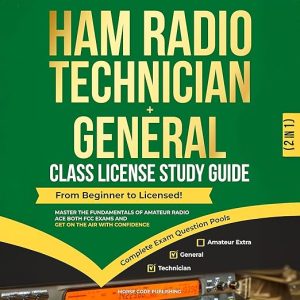
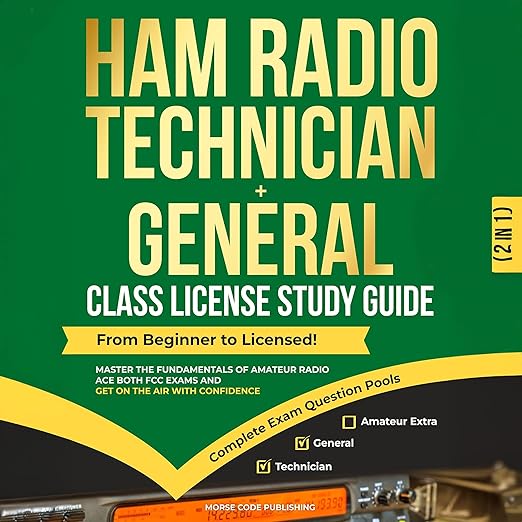
Twenty-eight hours of exam preparation is an unusual thing to meet in an audiobook, and the first honest question about this one is whether the format can carry the job at all. The product bundles two guides in a single purchase: a Technician's study guide keyed to the 2022 to 2026 question pool, and a General's study guide keyed to the 2023 to 2027 pool. Scott Gillis is listed as the narrator. The publisher promises "full practice exams," "interactive exercises" and "step-by-step guidance to tackle all math problems," every one of which is a page-shaped thing being offered in a medium you cannot write in.
An accompanying PDF comes bundled with the audio, and the copy says so directly. That document is where a good deal of the value of this purchase actually lives. Answer letters, band charts, question numbers and worked arithmetic all need somewhere to be looked at, and twenty-eight hours of continuous speech is not that place. Buy this expecting to study entirely on headphones and you will be studying half of what you paid for.
Structure is what genuinely distinguishes this bundle, and two independent reviewers land on it before the marketing copy gets a chance to. The publisher claims that "Both guides are organized in a learning-focused order rather than the confusing sequence of the official question bank." A five-star notice endorses exactly that, praising "how the author organizes everything logically, rather than just throwing the FCC question pool at you randomly." Another five-star review puts it as material "all presented in a logical, easy-to-follow format," setting it against what it calls the "disjointed official question pools." When a publisher's central claim survives contact with two separate readers, it is worth taking seriously.
Scope is the other thing the reviews get right, and they are refreshingly unromantic about it. A four-star notice draws the boundary precisely: "The material is covered in a reasonable amount of detail but it is still a study guide, focusing on teaching you what's needed for these exams." Nobody here is promising an education in radio engineering. Another reviewer calls the text "well-structured, starting with fundamental concepts and gradually progressing to more advanced topics," and lists coverage of "radio theory, operating procedures, and regulations" before the review is cut off mid-clause. Treat this as a licensing route rather than a hobby primer and the length starts to make sense.
Twenty-Eight Hours of Spoken Regulations and Numbers
Some of this material suits listening better than the format skeptic in me expected. Regulations, operating procedure and the etiquette of getting on the air are prose you absorb, not data you consult, and hearing them in order at a steady pace is a reasonable way to fix them. What the reading has to solve is the other half: a spoken guide has to make an answer letter, a numeric value and a frequency range land unmistakably the first time, because a listener cannot glance back up the page. The same goes for the arithmetic the copy promises to walk through, and for the seam between the Technician and General halves, which needs to arrive as a clear boundary rather than a change of subject.
Value is the plainest argument for it. "It's a great deal getting two in one," as the four-star reviewer says, and if your plan is both licenses inside a year, buying one product for two syllabi saves real money. The General guide exists to "unlock HF bands, long-distance DX operations, and broader operating privileges," so the upgrade path is built into the purchase rather than bolted on. One reviewer who came to amateur radio after watching a parent spend hours talking to strangers across the world found the whole progression sensible, which is roughly the audience the bundle is aimed at.
Trust the Four-Star Warning About the General Half
Weigh the four-star review harder than the five-star ones, because it contains the only real warning on the page. "Four stars because the general book is not as good as the technician book," it says, with "less detail and more questions where the answers aren't really explained." If the General upgrade is the reason you are buying, that is the sentence that matters most, and it is corroborated by nothing and contradicted by nothing, which is exactly the position a buyer hates being in. My own reading of the pool is that the Technician half is the tested, well-liked product and the General half is the bonus.
Check the question pools before you trust an answer set. Both guides name their pools by date range on the cover, which is a mark of honesty, and it also means the labels tell you when each one stops being current. Amateur license question pools rotate, so confirm on the product page that the pool your exam uses matches the one being taught here. Two smaller points: the 4.8 average rests on 33 ratings, a sample far too small to have settled, and the byline belongs to a publishing imprint rather than a named person even though one reviewer writes about "the author" as an individual, so the listing gives you no way to know whose explanations these are.
Commuters and Upgraders, Not a Written Exam
Complete beginners with a commute, a workbench or a dog to walk will get the most out of this, particularly anyone who has already bounced off the official pool and wants the same content in an order that builds. One reviewer captures the tone well: "The Technician section walks you through the basics without making you feel like an idiot." Existing Technician licensees planning the upgrade should buy it for the second guide with tempered expectations, and one brief five-star notice is simply a reader recording that they bought it for a spouse, which is the other thing a two-in-one purchase invites.
Nothing here replaces a written practice exam, and pretending otherwise would do you no favors. Anyone wanting a deep technical grounding in radio theory rather than a route through two multiple-choice tests should shop elsewhere, and so should anyone who will not open the PDF, because the diagrams, tables and answer keys are the part of this bundle your ears cannot reach. Used the way it is designed, as a spoken pass through material you also work through on paper, twenty-eight hours is generous rather than excessive.
Good to Know
Can I actually pass the exams using only the audio?
Not comfortably. The bundle promises practice exams, interactive exercises and worked math problems, none of which function well without a page. An accompanying PDF ships with the audio and holds the material your ears cannot process. Use the recording for regulations and theory, the document for anything numeric.
Which FCC question pools does this audiobook teach?
One guide is built on the pool running from 2022 through 2026, the other on the pool running from 2023 through 2027, both stated on the listing. Since pools rotate on a fixed cycle, check which set your exam actually draws from before relying on any answer here.
Does the audiobook follow the official question pool order?
Deliberately not. The publisher reorders both guides into a learning sequence instead of the official sequence, and two separate five-star reviewers single that out, one of them after bouncing off confusing online resources and dry textbooks. It is the strongest claim on the listing and the best supported.