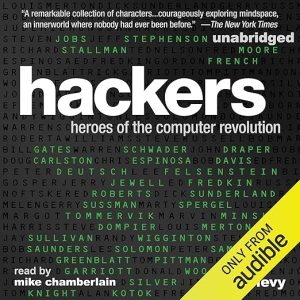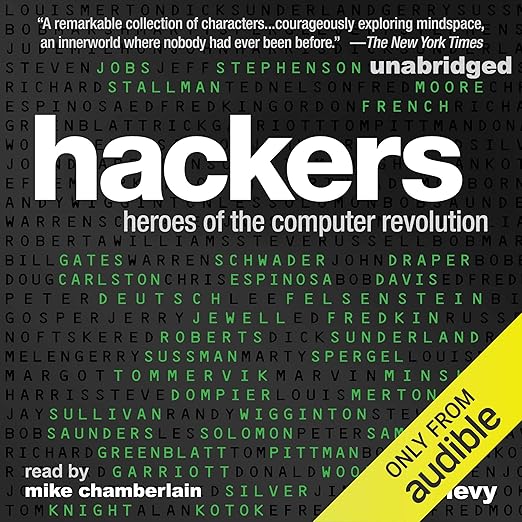
I came to Hackers later than I should have. I had been working in and around digital media for years before someone finally put a copy in my hands and said, essentially, you cannot understand any of this without reading this book first. They were right. Steven Levy's account of the original hacker culture, from the MIT Tech Model Railroad Club through the Homebrew Computer Club and the Apple II, is not just a history of early computing. It is an argument about what computing was supposed to mean, and about the particular ethical framework that the people who built the first machines carried into their work and then, imperfectly, passed down to the industry that followed them.
Mike Chamberlain narrates the updated edition, which includes new material from Bill Gates, Mark Zuckerberg, Richard Stallman, and Steve Wozniak. The updated interviews are interesting precisely because they create a frame that the original text could not have anticipated: the people who were the young idealists of 1984 are now the establishment against which any current hacker ethic must define itself. The distance between the early hackers' values and what Silicon Valley actually became is implicit in every page of the new material, and Chamberlain reads it with enough restraint to let the irony work without underlining it.
First, the Big Picture
Levy's central contribution to tech history is his articulation of the hacker ethic, the informal code of values that governed the early MIT hacker community: information should be free, computers should be universally accessible, and any system is always worth improving. These are not trivial principles. They shaped how the first generation of computing people thought about their work, their institutions, and their relationship to the machines they built. They are also the principles that created a permanent and still unresolved tension at the heart of the technology industry, between open access and intellectual property, between the commons and the enclosure.
What Levy captures so well is that these values were not simply pragmatic preferences but deeply felt moral commitments. The hackers at MIT were not just solving engineering problems; they were living out a particular vision of how knowledge should circulate and how human creativity should be organized. Reviewer Brian's note that the book explains why IDEs mark errors in red, a direct inheritance from early hacker culture's approach to useful and immediate feedback, is a small but precise example of how pervasive these origins remain in contemporary software practice. You cannot understand why modern programming culture looks the way it does without understanding where it came from.
What keeps Hackers readable across four decades is that Levy is a narrative journalist first and a tech historian second. The book is organized around people: Richard Greenblatt, Stewart Nelson, Peter Samson, Bill Gosper, Lee Felsenstein. These are not household names outside specialized circles, but Levy makes them vivid in ways that purely institutional history rarely achieves. The portrait of the MIT AI Lab, of the internal politics of the early computing community, of the specific social and intellectual environment that produced both the hacker ethic and its contradictions, is genuinely compelling biographical work at every level.
Chamberlain handles the ensemble cast with the right approach: he does not attempt dramatic character differentiation, which would have felt artificial in a work of journalism, but he gives the narrative enough energy and forward momentum that the 20-hour runtime feels substantially shorter than it is. Reviewer Gabriel's warmly personal account of recognizing the era Levy describes from his own early computing experience, from the ZX81 through the Commodore 64, captures something true about the book's documentary value: Levy preserved a world that was already vanishing when he wrote about it, and Chamberlain's narration honors that preservation with appropriate seriousness.
Weak Spots in Hackers: Heroes of the Computer Revolution
The updated material at the end of the book, with Gates, Zuckerberg, Stallman, and Wozniak revisiting their own histories, is both the edition's greatest addition and its most uncomfortable section. These interviews reveal how differently the hacker ethic was interpreted by different people who nominally shared it. Wozniak's vision of computing as liberation and Gates's vision of computing as property were both rooted in the same early culture, and their divergence is one of the defining economic and political stories of the last fifty years. Stallman's persistence in the original ethic, in the face of an industry that has largely abandoned it, makes him a figure of unusual integrity in the updated portrait.
Listeners who have only encountered the mythology of Silicon Valley through founder hagiographies and tech journalism will find this context genuinely disorienting in the best sense. The people who invented the culture that produced modern technology were not building toward what we have. That gap, between what the early hackers imagined and what actually arrived, deserves more examination than even this excellent book provides, and Levy wisely does not pretend to resolve it. He documents, he contextualizes, and he leaves the reckoning to the reader. Chamberlain's steady narration makes that process feel like a privilege rather than an obligation.
Is This One for You?
The reviewer who noted that Hackers is as much a philosophy of a way of life as a technology history is pointing at something important about why the book endures beyond its documentary value. Levy is not simply recording what happened in the MIT AI Lab or the Homebrew Computer Club. He is articulating a set of values that produced a particular kind of person: someone who believed that information wanted to be free, that systems should be open, that the right response to a closed door was to find a way through it. That value system is still active in every open-source debate, every argument about software patents, every discussion of who owns the data generated by the devices we carry.
For younger listeners who grew up with the mythology of Silicon Valley already firmly established, Hackers provides a disorienting but necessary corrective: the people who built the foundational culture of computing were not primarily motivated by the ambitions that now characterize the industry they inadvertently created. Understanding the gap between the hacker ethic and the tech industry as it actually exists is one of the more useful forms of historical awareness available to anyone working in or adjacent to technology today.
Do I need a technical background in computing to follow and enjoy Hackers?
No. Levy wrote for a general audience, and Chamberlain's narration handles the technical content accessibly. Several reviewers with minimal technical backgrounds report finding the book completely approachable. The emphasis throughout is on people and culture rather than code.
How does the updated edition with Gates, Zuckerberg, Wozniak, and Stallman change the book's argument?
The updates add a retrospective frame that the original could not have. Seeing how the early hackers' values evolved, diverged, or were abandoned across four decades gives the original chapters a layer of irony and historical weight that readers of the 1984 edition could not access.
Is this audiobook relevant to someone working in tech today, or is it primarily of historical interest?
Both simultaneously. The hacker ethic Levy documents is still actively present in open-source culture, in arguments about software freedom, and in debates about who owns data and code. Understanding its origins is useful for anyone thinking seriously about the culture of modern technology and why it takes the shape it does.
At 20 hours, is this audiobook manageable for listeners without a strong pre-existing interest in computing history?
Reviewer dachelpo describes it as a great read that works as philosophy of a way of life as much as technology history, and that framing is accurate. Levy's narrative journalism style and Chamberlain's pacing make the runtime feel shorter than it is. The book rewards generalist listeners who are curious about culture and ideas as much as those who come specifically for the computing history.