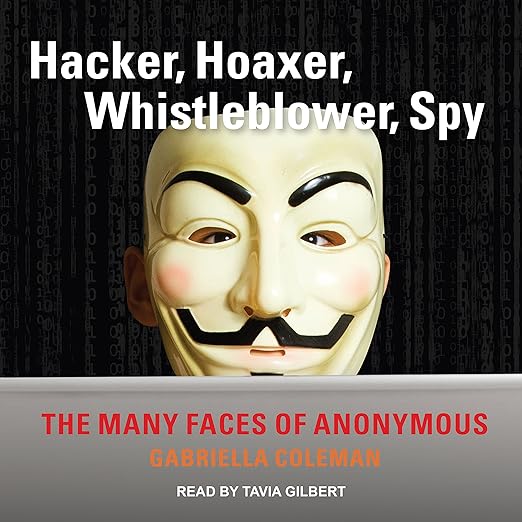
Quick Take
- Narration: Tavia Gilbert brings measured scholarly authority to Gabriella Coleman’s academic-meets-investigative voice, navigating the mix of field notes, theory, and dramatic narrative with reliable clarity.
- Themes: Digital activism and its limits, hacker ethics and identity, the anthropologist inside the story
- Mood: Dense and fascinating, with stretches of tension and moments of unexpected warmth for its subjects
- Verdict: The most academically rigorous and humanly textured account of Anonymous in any medium, and Gilbert’s narration holds the complex structure together across 13 hours.
I came to Hacker, Hoaxer, Whistleblower, Spy through a recommendation from a colleague who studies digital activism, and I remember being initially skeptical that an anthropological account of Anonymous could compete with the more cinematic treatments the subject had already received. I was wrong about that. What Gabriella Coleman has produced is something that the journalistic accounts of Anonymous could not quite manage: a portrait of the movement and its participants that takes them seriously as people with genuine political and ethical frameworks, even while documenting the chaos, the self-sabotage, and the recklessness those frameworks sometimes produced.
Coleman, described by the Huffington Post as someone who knows all of Anonymous’s deepest, darkest secrets, spent half a dozen years embedded in the movement’s orbit. Her “inside-outside status as Anon confidante, interpreter, and erstwhile mouthpiece” is not just acknowledged in the book, it becomes one of its organizing themes. The ethical complexity of an anthropologist who is both documenting a phenomenon and participating in its public representation is treated with more honesty than most embedded accounts manage.
The Semi-Legendary Cast of the Anon World
Coleman’s biggest achievement is making her subjects legible as complex human beings rather than as archetypal hackers or nihilistic trolls. Topiary, tflow, Anachaos, and Sabu all emerge from the narrative with enough individual texture that the reader understands why people built reputations and loyalties inside a nominally anonymous collective. Sabu’s eventual role as an FBI informant lands with particular weight because Coleman has spent enough time establishing his significance to the community that his cooperation reads as genuine betrayal rather than just plot development.
One reviewer described this as the best book on Anonymous available, and traced its achievement to the willingness to provide an “unvarnished view” of the movement from Project Chanology through the Arab Spring and into the collapse of the LulzSec period. That arc, from anti-Scientology activism through high-profile government hacks to FBI infiltration and legal consequences, is handled with the complexity it deserves rather than being flattened into either heroism or villainy.
Where the Anthropologist Shows Her Hand
The book’s more personal sections, where Coleman reflects on her own position within the story, divide readers. Some find these passages extraneous and self-indulgent, as one reviewer noted, while others find them essential to understanding what makes this account different from journalism. I lean toward the latter reading. Coleman is not pretending to be a neutral observer, and the sections where she acknowledges her own investment in the outcome force a useful transparency about what kind of account this is. It is not the Huffington Post’s framing of her as a keeper of secrets that defines the book; it is the more uncomfortable question of what obligations an anthropologist accumulates over years of close contact with people who trusted her.
The theoretical passages on hacker ethics and the cultural meaning of the internet draw on Coleman’s academic background in ways that will feel rewarding to some listeners and obstructive to others. They are not overwhelming in frequency, and they provide context for behavioral patterns that pure narrative would leave unexplained. But this is not a breezy listen, and it does not pretend to be one.
Tavia Gilbert and the Challenge of 13 Hours
Gilbert is an experienced narrator who has worked extensively in nonfiction across academic and trade publishing. She handles Coleman’s distinctive voice, which moves between field notes, theoretical argument, and the reported speech of hackers communicating in a very particular register, with consistent attentiveness. The online vernacular of Anon communications could easily sound condescending when read aloud by someone outside the culture; Gilbert reads it with appropriate neutrality, neither mocking nor performing. At 13 hours and 39 minutes, the runtime is substantive, but Gilbert’s pacing prevents the denser sections from becoming impenetrable.
Who Should Listen and Who Should Skip
Essential listening for: anyone interested in the history of digital activism, hacktivism, and online political organizing; students of internet culture and its relationship to real-world political movements; readers who followed the LulzSec prosecutions and want the full context. Less suited to: listeners who find scholarly self-reflexivity tedious or who want a faster-paced narrative account. The density is the book’s strength and its cost simultaneously, and knowing that ahead of time helps calibrate what you are signing up for.
Frequently Asked Questions
How does Gabriella Coleman’s anthropological approach differ from journalistic accounts of Anonymous?
Coleman treats her subjects as complex political and ethical actors rather than as either celebrities or criminals, building individual portraits of key figures over years of close contact. She also makes her own position within the story explicit, which distinguishes the book from journalistic accounts that claim neutral observer status. The result is more textured and more honest about its own limitations.
Does the book cover Sabu’s cooperation with the FBI and the LulzSec prosecutions?
Yes, and this is one of the most consequential sections of the book. Because Coleman has spent significant time establishing Sabu’s role in the community, his revelation as an FBI informant and the subsequent prosecutions land with appropriate weight. The book covers the legal aftermath and its effect on the broader movement.
Is prior knowledge of Anonymous or hacker culture necessary to follow this book?
Not required, but helpful. Coleman explains the culture’s internal logic and terminology as the narrative develops, but the sheer number of operations, personas, and technical references rewards some background familiarity. Readers with no prior exposure may find the first few hours denser than those with passing knowledge of the events covered.
Does Tavia Gilbert’s narration work for content that includes a lot of online vernacular and chat logs?
Generally yes. Gilbert reads the online vernacular with appropriate neutrality rather than performing it for comic effect or reading it with detachment. The chat logs and internal communications that Coleman uses as primary sources are handled with the same clarity as the main narrative text, which is the right call for material where the exact wording often matters.