Key Details
- Performance: Johnston self-narrates with no theatrical inflation. her deadpan delivery of genuinely harrowing material is precisely why this works better as an audiobook than a print read.
- What it covers: Addiction and self-destruction, the body as both enemy and evidence, survival without sentimentality.
- Feel: Raw and darkly comic, short and relentless.
- Our call: If the recovery memoir category usually leaves you cold, Johnston's refusal to perform redemption will pull you back in.
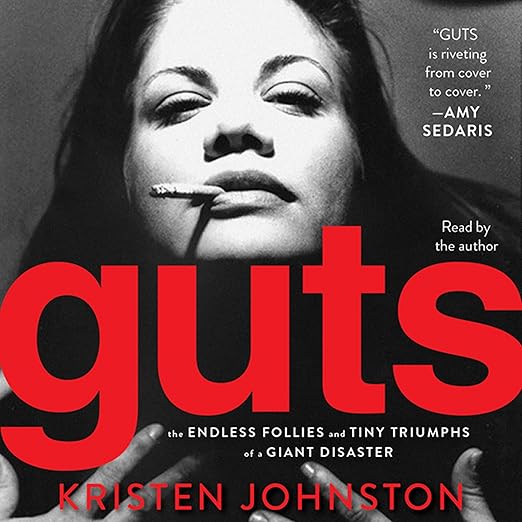
Kristen Johnston's Guts arrived in my listening queue on a quiet afternoon when I was between books and needed something with some honesty in it. I wasn't expecting to be stopped in my tracks. This audiobook, narrated by Johnston herself, opens with an epigraph she delivers like a confession: the image of speeding toward hell in a cocaine-designed DeLorean with no way out and no way to open the doors. It's an outrageous metaphor, and yet by the time Johnston reads it aloud in her own unmistakable voice, it sounds less like a joke and more like a precise description of what addiction actually feels like from the inside. I stayed in my car after pulling into the driveway to finish the chapter.
Johnston, best known for her Emmy-winning role on 3rd Rock from the Sun, is not the first actress to write a raw addiction memoir. But Guts stands out in a crowded genre not because of what happened to her, but because of how clearly she understands what her own mind was doing to her while it was happening. The writing, and her delivery of it, carries the kind of specificity that separates lived experience from performance.
Why It Works in Audio
The self-narration is the single most important reason to choose the audio format over the print edition. Johnston does not perform herself. She does not soften the most humiliating moments or punch them up for effect. When she reads the sections about her hospitalization in London, she conveys the quiet horror of nearly dying of a perforated intestine with a matter-of-factness that lands harder than any theatrical delivery would have. The voice of the writer and the voice of the narrator are identical, and that alignment creates something genuinely unusual in memoir audio: you are not listening to an interpretation. You are hearing the source.
Readers who have praised the book draw comparisons to Augusten Burroughs for its unflinching candor and David Sedaris for its dark humor, and those comparisons are not lazy. Johnston shares with Burroughs a talent for narrating her own worst moments without asking for sympathy she hasn't earned, and she shares with Sedaris an ability to make you laugh at something that should not, by any reasonable measure, be funny. The combination is rare. The fact that she delivers it in her own voice, in her own cadence, makes it rarer still.
At four hours and twenty-one minutes, Guts is short for a memoir. That brevity is earned. Johnston does not pad the runtime with therapeutic frameworks or recovery-industry boilerplate. The book covers what it covers, and then it stops. For listeners who have sat through bloated celebrity memoirs that mistake length for depth, this economy is a genuine relief.
Weak Spots in Guts
Listeners who arrive expecting a standard recovery narrative, with crisis, rock bottom, twelve steps, and gratitude, may be mildly disoriented. Johnston resists the genre's therapeutic scaffolding. She is funny where the genre expects earnestness, self-lacerating where it expects self-forgiveness, and impatient with her own story in ways that make the story better. This is not a how-to or a cautionary tale. It is one woman's account of what it felt like to be trapped in a body that was destroying itself, told by the woman who was inside it.
The book's title is literal. Johnston's near-fatal peritonitis, which resulted from years of pill addiction, is both the physical crisis at the center of the narrative and the organizing metaphor for everything that surrounds it. She writes about her guts in both senses: the organ that nearly killed her and the nerve it took to survive and then write about it. Johnston earns that double meaning honestly, through detail rather than declaration.
One listener, a father of a recovering addict who described having read more addiction books than he could count, noted that Guts landed differently from all the clinical or self-help material he had consumed. That is a meaningful data point. The book works for people who know addiction from the inside and for people who know it from the outside. That range is unusual, and Johnston's self-narration is what makes it possible. A professional narrator could read these words and produce something technically competent. Only Johnston can deliver the silences between them.
The addiction memoir has become a crowded form. What Johnston brings to it that most authors cannot is the comedic instinct to puncture the narrative's own self-importance at exactly the moment when another writer would reach for pathos. She earned the right to that instinct by living through the material. The audio format amplifies it because you hear the timing of those punctures in real time. The gap between what the joke says and what the story means is where the book lives, and that gap is narrower in headphones than it is on the page.
Who Will Get the Most From It
This audiobook is built for listeners who have experienced addiction firsthand or who love someone navigating it. Johnston's black humor and refusal to moralize make it accessible to listeners who would normally avoid the recovery memoir category. Fans of Burroughs, Sedaris, and Carr's The Night of the Gun will find a kindred sensibility here. Because of its short runtime and conversational delivery, it also works well for listeners who are new to the memoir format and want to start with something that moves quickly without asking them to sit with false resolution.
Listeners seeking structured recovery guidance, practical steps, or a more clinical treatment of addiction should look elsewhere. Johnston is not offering a program. She is offering herself, imperfectly, on the page and in the headphones. For listeners who find that kind of honesty more useful than any twelve-step framework, Guts delivers exactly what the title promises.
Before You Listen
Does Kristen Johnston narrate the Guts audiobook herself?
Yes, Johnston narrates the entire audiobook herself. Her performance is central to the book's effect. The alignment between her writer's voice and her spoken delivery creates an intimacy that a professional narrator could not replicate.
How does Guts compare to other celebrity addiction memoirs in audiobook form?
Johnston's book is shorter and funnier than most, and less structured around the conventional arc of crisis and redemption. Readers who found Burroughs' Dry or Carr's The Night of the Gun compelling will recognize a similar willingness to stay uncomfortable rather than wrap things up cleanly.