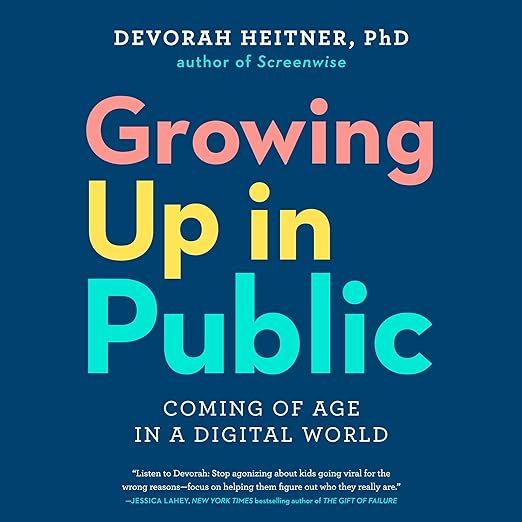
Devorah Heitner's audiobook on raising teenagers in the social media era is built on a distinction that sounds simple but turns out to be genuinely consequential: the difference between monitoring and mentoring. Growing Up in Public argues that the surveillance impulse, tracking your teenager's every move through apps, fixating on their digital footprint, anxiety-checking their grades within minutes of posting, adds pressure to kids navigating identity formation in a space that already competes aggressively for their attention and enforces constant judgment. What teenagers need instead, Heitner argues, is mentorship: relationships with adults who help them think through who they want to be when everyone is watching, rather than adults who watch them first and assume the worst. Heitner narrates her own work, and that decision is unambiguously the right one for this material.
Called the Freakonomics of Kids and Phones
The self-narration earns its place immediately. Heitner's voice has a warmth that neutralizes the topic's anxiety, and she delivers the book's research-backed arguments with the tone of someone who has sat with hundreds of kids and parents and genuinely understands what both sides are experiencing. Lori Gottlieb, whose endorsement appears with the book's promotional material, notes that Heitner illuminates how parental scrutiny and monitoring can intensify the stress of growing up with social media, and Heitner's own delivery makes that claim feel like observation rather than accusation. This is one of the audiobook's most useful qualities: it challenges parents without antagonizing them.
Reviewer Faith Rogow, a media literacy educator, praised the book specifically for respecting the complexity of the issue without sensationalizing or sermonizing, a difficult balance to maintain in technology-and-children discourse, where most writing swings between dismissiveness and doomsday framing. Reviewer Carmella Riley described Growing Up in Public as the Freakonomics of kids and phone use, which captures its willingness to drill down on what actually correlates with outcomes rather than repeating the most anxious assumptions. The hundreds of interviews with kids, parents, educators, clinicians, and scholars that Heitner conducted are visible in the texture of the book: the arguments arrive with supporting evidence, not just with the confidence of a practitioner asserting what she has seen in her work.
Hearing the Research in Heitner's Actual Voice
The audiobook format serves this book particularly well because Heitner's material is heavily story-based. The relatable parenting scenarios she uses to illustrate her research points, the awkward group chat situation, the moment a parent discovers their teenager's online persona looks nothing like the child they thought they knew, arrive with more emotional immediacy in audio than they would in print. At eight hours and ten minutes, the book has room to develop its arguments without rushing through the practical strategies sections, which is where many parenting books in this space run out of time before delivering on their central promises.
The chapters on character versus image are the book's philosophical core. Heitner's argument is that when parents and schools focus on managing kids' digital footprint, anxiety about canceled moments, college admissions exposure, permanent internet records, they inadvertently teach teenagers to perform for an audience rather than to develop a genuine sense of self. The alternative is to help kids understand who they actually are and what they actually value, treating the constant scrutiny of public digital life as something to navigate consciously rather than something to fear and hide from. This reframing is the book's central gift, and Heitner earns it through evidence rather than assertion.
The section on surveillance tools and their actual effects on teen behavior is one of the most practically useful in the book. Heitner examines the research on whether tracking apps and monitoring software achieve what parents hope they achieve, and the findings are more complicated than the products' marketing suggests. Hearing this presented in Heitner's own voice, a researcher who is not anti-technology but is deeply skeptical of technology deployed without intentionality, carries particular authority in audio form.
Cyberbullying and Radicalization Get Only Partial Coverage
The book is pitched primarily at parents of tweens and teens who are actively engaged with social media and smartphones. Listeners whose children are younger or older, or whose parenting context differs significantly from the middle-class, smartphone-equipped households that populate most of the book's examples, may need to do some extrapolation. The core arguments about identity formation and the limits of surveillance apply more broadly, but the illustrative scenarios are fairly consistent in their demographic framing.
Some listeners who come to this book with specific concerns, cyberbullying, eating disorder content, radicalization, may find that their particular anxiety is addressed but not comprehensively. Heitner's scope is wide, and the book is strongest as a general framework for thinking about teenagers and technology rather than as a deep-dive resource on any single issue. For those specific concerns, more targeted resources will be necessary alongside this one.
Also Useful for Teachers of Gen Z Students
This audiobook is ideal for parents of middle and high school students who are struggling to figure out how much to supervise, intervene, and worry about their teenager's online life. It is equally useful for teachers and school counselors who work with Gen Z students and want research-backed context for what those students are navigating daily. The tone is accessible enough for listeners without any background in developmental psychology or digital media research, and the practical strategies are concrete enough to apply immediately after finishing. Heitner's mentoring-not-monitoring framework is one that will shift how listeners approach conversations with their teenagers, and at eight hours it covers enough ground to earn that shift without padding the argument beyond its natural length.
Before You Press Play
- Read by: Devorah Heitner self-narrates, and the choice adds genuine warmth, her voice carries the empathy for both parents and teenagers that runs through the book's core argument, and the delivery feels like a conversation rather than a lecture.
- At its heart: Mentoring versus monitoring teenagers online, digital privacy and identity formation, parental anxiety in the age of social media
- Vibe: Grounded and reassuring, with the measured optimism of a researcher who has heard enough stories to know change is possible
- Short version: Heitner offers something rare in parenting technology discourse: evidence-based perspective without panic, and practical guidance without condescension.
Is this audiobook as relevant for parents of older teenagers as it is for parents of tweens just getting their first phones?
Yes, across the full tween-to-teen age range. Heitner's frameworks for mentoring rather than monitoring, and for helping kids develop character rather than digital performance, apply regardless of where a teenager is in that developmental window. Parents of older teens may find the earlier chapters on initial phone introduction less immediately relevant, but the core material on identity formation and the limits of surveillance is age-nonspecific.
Does Devorah Heitner's self-narration of this audiobook make it feel more personal than a standard professional narration would?
Notably so. Her delivery carries the empathy and nuance of someone who has done extensive interviews with both parents and teenagers, and the warmer moments, particularly in the anecdote-driven sections, land with more authenticity than a third-party narrator would likely achieve. The self-narration is one of the audiobook's genuine assets.
How practical is the guidance in this audiobook compared to other technology-and-parenting books?
More practical than most in the genre. Heitner moves from research to concrete strategies consistently throughout, and the chapters include specific conversation approaches, frameworks for setting expectations, and ways to evaluate whether monitoring tactics are working or backfiring. The book earns the comparison to Freakonomics in that it prioritizes what actually works over what sounds intuitively right to a worried parent.