Quick Take
- Narration: Olivia Scarlett-Watts captures the memoir’s warmth and dry British humor without overdoing either, making the Cornish countryside feel genuinely present.
- Themes: Rural escape and reinvention, the rhythms of farm life, raising children alongside chaos
- Mood: Warm and earthy, occasionally hilarious, quietly profound about time and seasons
- Verdict: One of the most genuinely charming farming memoirs in recent years, and a perfect audiobook for anyone who has ever daydreamed about leaving the city.
I listened to Growing Goats and Girls over three evenings in late winter, which turned out to be exactly the right context. There is something about reading about Cornish countryside and thirty years of farming life when the city outside your window is doing its grey, relentless thing that makes the contrast work in the book’s favor. Rosanne Hodin is not selling a fantasy. She is describing work, genuine hard physical and emotional work, alongside the specific joy that comes from doing that work over decades and watching it accumulate into something that looks, from a distance, like a life well built.
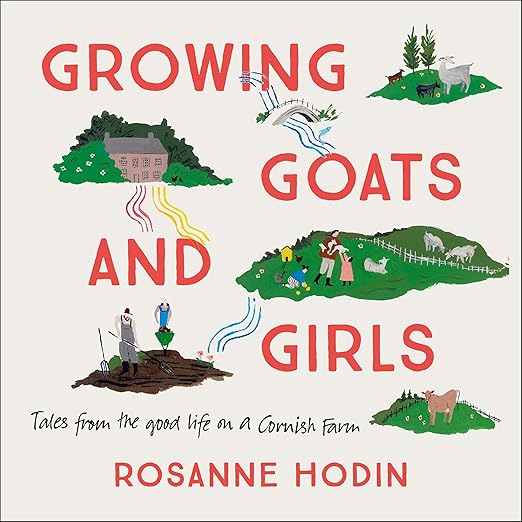
The endorsement from Salman Rushdie on the cover describes this as perfect escapist reading, and while escapism is part of it, that framing undersells what Hodin is doing. This is a memoir about thirty years of farming in Cornwall with her husband, raising two daughters, learning through repeated expensive failure how to keep goats and chickens and cows and bees, and discovering what it means to commit to a place long enough that the place starts to commit back to you. That is not escapism. That is a specific kind of wisdom, and Hodin communicates it without pretense.
Our Take on Growing Goats and Girls
The structure of the book is seasonal rather than strictly chronological, which suits the subject. You move through years by way of harvests and animal crises and the slow growth of the two daughters who give the book its other subject alongside the goats. Hodin writes in present tense throughout, a choice that keeps each scene immediate even though decades have passed. Reviewers have noted that this tense choice creates a specific kind of nostalgia: you are not looking back at something that happened, you are inside it as it happens, which gives the memoir an unusual intimacy.
The humor is consistent and dry in the particularly British way that involves describing disasters with almost academic detachment. Hodin is not performing rural comedy. She is reporting, with complete honesty, on things going catastrophically wrong, on machinery that refuses to function, on animals that make choices no manual prepared her for, on neighbors whose advice turns out to be neither reliable nor useful. The laughter comes from recognition of human fallibility rather than from jokes, which means it has a longer shelf life than most humor writing.
Why Listen to Growing Goats and Girls
Olivia Scarlett-Watts is well-matched to this material. Her delivery has warmth without sentimentality, and she handles the dry comic passages without telegraphing the punchlines in a way that would defuse them. The Cornish setting comes through in the narration in a way that feels grounded rather than performed: this is not an audiobook that leans on atmospheric delivery tricks to make the countryside feel present. It does the work through Hodin’s language, and Scarlett-Watts trusts that language.
At just under nine hours, the runtime is substantial for a memoir, but the material justifies it. Thirty years of farm life involves thirty years of seasons, and Hodin does not compress that unfairly. The book earns its length by making each phase of the farm’s life feel distinct. The early years of chaos and ignorance give way to the middle period of hard-won competence, and then to the reflective final chapters where Hodin is looking at the life she built and understanding what it cost and what it gave. That arc needs space to work, and the audio format gives it that space effectively.
What to Watch For in Growing Goats and Girls
One reviewer described the book as inspiring in a practical sense: after reading about Hodin’s grit and willingness to keep attempting things that failed repeatedly, they felt motivated in their own life. That is an unusual response to a farming memoir, and it says something about the quality of Hodin’s self-presentation. She is not a heroic figure in the conventional sense. She is frequently wrong, frequently overwhelmed, frequently exhausted. Her persistence is not dramatic. It is quiet and stubborn and sometimes funny, and it adds up over time into something that reads as genuinely admirable.
The daughters, the titular girls, are present throughout but are not the memoir’s primary subject. They grow up on the edges of the farming narrative, learning through proximity what their parents are learning through direct effort. Their adulthood arrives in the final sections of the book with a poignancy that Hodin earns because she has taken the time to show you who they were as children. This is not a book about parenting, but it becomes one by the end, which is one of its more elegant structural achievements.
Who Should Listen to Growing Goats and Girls
A strong recommendation for readers of James Rebanks’s The Shepherd’s Life or Adam Henson’s farming memoirs who want something with more domestic warmth and less agricultural policy. Fans of British countryside writing generally will find this rewarding. It is also genuinely accessible to city-based readers who have no farming background, since Hodin begins from exactly that position. Skip it only if you need narrative tension or plot momentum from your nonfiction. This is a book about duration, not drama.
Frequently Asked Questions
Is Growing Goats and Girls strictly a farming memoir, or does it cover other aspects of Hodin’s life in equal depth?
The farm is the organizing structure, but the memoir encompasses marriage, parenthood, friendship, and the texture of rural community over thirty years. The goats and agricultural details are present throughout, but they are vehicles for larger reflections about how a life gets built rather than the book’s primary subject.
How does Olivia Scarlett-Watts’s narration handle the humor in the text without overdoing it?
Scarlett-Watts delivers the comic passages with restraint, trusting Hodin’s language to carry the humor rather than emphasizing it through vocal performance. This is the right approach for dry British humor: the funnier moments land because she does not flag them in advance.
The book covers thirty years, does it feel repetitive or does it find ways to distinguish the different phases of farm life?
It does not feel repetitive. The seasonal structure and the growth of the daughters provide natural markers, and Hodin’s relationship to the farm itself changes across the decades in ways that feel observationally honest. The early chapters have a different emotional texture from the middle and late ones.
Is this a book that glamorizes rural life, or does it engage honestly with the difficulty and failure involved in farming?
It is honest to a fault about difficulty and failure. Hodin repeatedly describes expensive mistakes, equipment that does not work, animals that do not cooperate, and plans that collapse entirely. The book’s warmth coexists with realism about what farming in Cornwall actually requires.