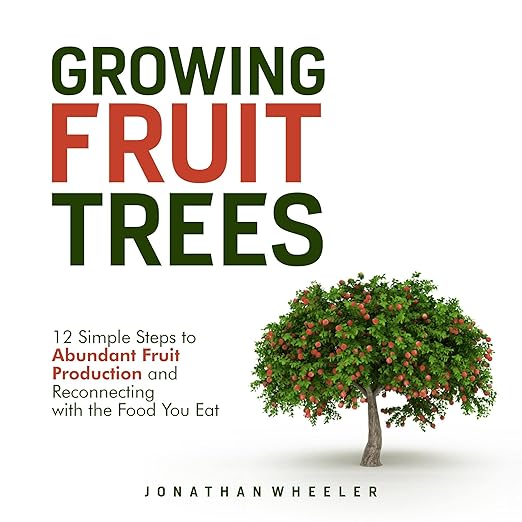
Quick Take
- Narration: Paul Underwood reads with an unhurried, instructional clarity appropriate for reference-style content; the delivery is warm without being folksy, which suits a book that takes its subject seriously without being dry.
- Themes: Sustainable backyard food production, seasonal tree care, site selection and species matching
- Mood: Practical and quietly enthusiastic, like advice from a knowledgeable neighbor
- Verdict: A well-organized introduction to growing fruit trees at home that covers the full arc from site selection to harvest, with enough specificity to be genuinely useful rather than aspirationally vague.
I started listening to Growing Fruit Trees in late March, when the ornamental pear tree in my backyard was blooming uselessly and I was, for the first time in several years, actually thinking about using the space behind it for something edible. I do not have a large garden. I have what a real estate listing would call a charming urban outdoor area, which is to say a small paved square with two raised beds and some ambitions. So I approached Jonathan Wheeler’s book as someone with limited space, zero prior experience with fruit trees specifically, and a reasonable willingness to learn.
Wheeler opens with the image of biting into fruit plucked directly from your own tree, which is the kind of opening that would normally make me skeptical about the practical depth of what follows. But the book earns its enthusiasm. Within the first twenty minutes, Wheeler is discussing USDA Hardiness zones, the difference between self-pollinating and cross-pollinating varieties, and what it means to give the right home to a tree in terms of soil chemistry and drainage. This is a book written by someone who gardens, not someone who writes about gardening from a comfortable distance.
Our Take on Growing Fruit Trees
The structure is one of the book’s genuine strengths. Wheeler organizes the content as a twelve-step progression from pre-planting decisions through to long-term harvest and storage, and the logic of that sequence is clear. Each chapter builds on the previous one in a way that makes the accumulation of information feel like developing competence rather than taking on a list of obligations. One reviewer described reading it in the evenings before bed dreaming about ways to begin and maintain their small orchard, which captures the book’s aspirational energy accurately. Wheeler makes fruit-growing sound achievable without pretending the challenges are trivial.
The pest and disease sections are particularly thorough for a book of this scope. Wheeler covers twenty common diseases and seven common categories of animal and insect damage, which is more comprehensive than most introductory gardening audiobooks of under four hours. The four-season tree care plan, addressing watering, fertilizing, mulching, and weeding across the full growing calendar, gives the book reference value beyond an initial listen. Reviewers consistently noted returning to specific chapters when they needed to look something up, which is the best indicator of genuine practical utility.
Why Listen to Growing Fruit Trees
Paul Underwood narrates with the kind of measured, clear delivery that makes reference material genuinely listenable rather than tedious. He does not try to make the technical sections exciting. He reads them accurately, at a pace that allows the information to land, with enough warmth to prevent the experience from feeling like a manual read aloud. For a book that covers soil preparation, rootstock selection, and pollination mechanics in the same runtime, that tonal consistency is not a small achievement.
Wheeler uses a fictional character, a gardener named Johnny who appears throughout the chapters as a running practical illustration, to make the abstract principles more concrete. One reviewer specifically appreciated this device, noting it made the book more relatable and easier to follow through parallel real-world examples. In audio format, this narrative through-line is especially effective, giving the listener something to track alongside the technical content. The companion PDF, available as a download with purchase, includes additional reference materials for the things best experienced visually, like pruning diagrams.
What to Watch For in Growing Fruit Trees
At three hours and twenty-nine minutes, this is a short listen for the scope of what it covers, and there are areas where that brevity is felt. The sections on specific fruit varieties, while introducing the category of USDA zone matching, cannot go deeply into the peculiarities of individual species. A grower trying to decide between a semi-dwarf apple and a standard espalier trained pear will need to supplement Wheeler’s general framework with variety-specific research. The book is excellent at giving you the questions to ask. It cannot always give you the specific answers for your particular situation.
One reviewer wished the book had pictures or diagrams to clarify some techniques, particularly around pruning. This is the inherent limitation of gardening instruction in audio format. The companion PDF addresses some of this, but hands-on techniques like training young branches, shaping espaliers, and thinning fruit do benefit from visual demonstration in ways that even very good description struggles to replicate fully. Listeners planning to act on the advice will want to supplement the audio with video demonstrations of the physical techniques.
Who Should Listen to Growing Fruit Trees
This is an excellent first listen for anyone considering planting their first fruit tree, whether in a spacious backyard or a constrained urban space. Wheeler explicitly addresses limited-space growing options, and one of the book’s recurring themes is that the right tree for the right location matters more than having the perfect conditions. Reviewers at both the beginner and experienced end of the gardening spectrum found value here, though beginners will extract more from the foundational content.
Skip it if you are an experienced orchardist looking for advanced content on commercial-scale pest management or specialized rootstock selection. This is home-garden focused throughout. Also note that the audio format, while well-executed, limits the utility of the more technique-specific sections. Pair this with a good visual resource on pruning and training, and the combination covers most of what a home grower needs to get started confidently.
Frequently Asked Questions
Does Growing Fruit Trees cover specific varieties, or is the advice general enough to apply to any tree?
Wheeler covers a range of fruit types including apples, pears, stone fruits, and citrus, with guidance on matching species to USDA Hardiness zones and local climate conditions. The variety-specific depth is introductory rather than exhaustive. For specific cultivar comparisons within a species, you will need to supplement with variety trial data from your local agricultural extension service or a species-specific resource.
Is this book useful for someone with a small urban garden, or is it designed for people with significant land?
Wheeler explicitly addresses limited-space growing, including dwarf and semi-dwarf rootstock options, container growing, and espalier training for small spaces. The site selection guidance is scale-neutral. Urban and suburban gardeners with limited space are a clearly intended part of the audience, not an afterthought.
The audiobook includes a companion PDF. What is in it, and is it essential?
The companion PDF contains additional reference materials including diagrams and charts referenced in the text. For a subject where some techniques are best demonstrated visually, particularly pruning shapes and training methods, the PDF supplements the audio meaningfully. It is not essential for understanding the conceptual content but adds practical value for listeners who intend to apply the techniques.
Who is Johnny, the recurring character in the book, and why does Wheeler use this device?
Johnny is a fictional home gardener Wheeler uses as a running practical illustration throughout the chapters, following his decisions and challenges as a parallel example alongside the instructional content. The device makes abstract principles more concrete and gives the listener a narrative thread to track alongside the technical material. Reviewers found the character effective at making the book more relatable and easier to follow.