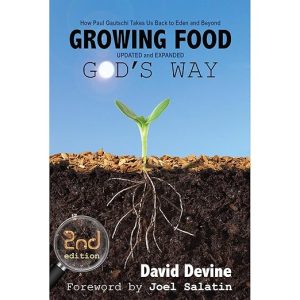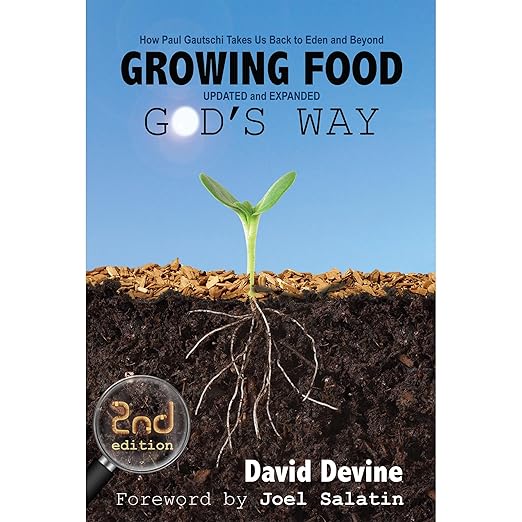
I was not the target audience for Growing Food God's Way and I knew it going in. I do not garden, I have a complicated relationship with explicitly faith-integrated how-to guides, and I had not seen the Back to Eden documentary that apparently introduced much of the world to Paul Gautschi and his wood chip mulching approach. And yet I finished this nearly eight-hour audiobook with a genuine sense of what Gautschi is doing and why it matters to the people it matters to. That is a reliable sign that a book has done its job regardless of who initially picks it up.
David Devine's authorized biography of Gautschi is honest about what it is from the outset: not primarily a gardening manual, but a portrait of a person whose approach to growing food cannot be separated from his approach to faith, community, and what he understands as faithful stewardship of the natural world. The author is direct about this framing in the introduction and maintains it consistently throughout the full runtime. The subtitle claims this is not a book about gardening but about life and wisdom, and that is accurate. The gardening is real, the wood chip method is extensively documented, but it is the vehicle rather than the destination Devine is pointing toward.
Wood Chips Mimicking a Forest Floor, Worldwide
For listeners unfamiliar with the documentary that preceded this book, Gautschi is an arborist and home gardener from the Pacific Northwest who developed a gardening approach built around deep wood chip mulching as a way to mimic the natural forest floor. The results, which reviewers who have tried the method describe in terms of dramatically improved soil health, reduced water use, and increased yield, were documented in a film that has since reached gardeners in more than 200 countries. The biography provides the context for how someone arrives at that kind of unconventional method: through sustained observation, through faith-driven willingness to experiment outside the conventional horticultural consensus, and through the long process of learning what a particular plot of land actually needs rather than imposing assumptions about what it should need.
One reviewer described the method producing a 400 percent increase in soil ecosystem diversity, reflecting the kind of claims that have made Gautschi's approach both widely popular and occasionally controversial in conventional horticultural circles. Devine does not engage extensively with the skeptical arguments; this is an authorized biography written for an audience already sympathetic to the project, and it does not pretend otherwise.
Faith Shapes the Method, More Than the Backdrop
What separates this from most gardening books, and what will either draw or repel listeners depending on their own orientation, is the degree to which Christian faith is not background to Gautschi's method but structural to it. He gardens the way he does because he understands himself as tending creation on behalf of its creator, and that theological commitment shapes every practical decision from soil amendment choices to water management to how he thinks about the relationship between human effort and natural process. For readers who share that framework, this will feel like a deeply nourishing alignment of values and practice. For readers who do not share it, the information is still accessible, but the framing requires continuous effort to bracket across eight hours of material.
One reviewer noted that the title is potentially misleading for people who might not expect this level of spiritual integration, and wished the book could reach a broader audience. That observation is accurate. The wood chip mulching method itself has broad applicability regardless of faith background; the packaging is specifically evangelical Christian, which defines the book's natural readership more narrowly than the method's actual reach in the global gardening community warrants.
AI Narration Undercuts the Spiritual Testimony
Like several other titles currently available through Audible, Growing Food God's Way is narrated by Virtual Voice, Audible's AI narration technology. For a book that is part biography and part spiritual testimony, the absence of human warmth in the narration is a more significant limitation than it would be for purely instructional content. The affection Gautschi's community clearly feels for him, the sense of an actual person's life unfolding through faith and trial and eventual hard-won understanding, is material that benefits from a narrator who can modulate around it. Virtual Voice delivers the content competently but cannot deliver the emotional texture that would make the biographical sections genuinely moving rather than merely informative.
Listeners who are specifically drawn to the wood chip gardening method for practical reasons will find the audiobook useful regardless of narration style. Listeners who are drawn primarily to the biographical and spiritual dimensions will likely get more from the written version, which can be read at a pace that allows the more meditative passages to land as their author intended.
Documentary Fans and Christian Gardeners Will Connect Most
Listen if: You watched the Back to Eden documentary and want the full biographical context for Gautschi's approach; you are a home gardener with a Christian faith background looking for a book that integrates those two parts of your life; or you are open to faith-integrated nature writing and want something that takes both the gardening practice and the theology seriously without treating either as incidental.
Skip if: You want a secular, evidence-based guide to mulch gardening without theological framing; you find the Virtual Voice narration detracts too significantly from biographical content; or you are looking for a book that engages substantively with conventional horticultural science alongside the faith-based approach to growing food.
In Brief
- Narrator: Virtual Voice delivers the biographical and instructional content adequately; the warmth of Paul Gautschi's story would benefit from a human narrator, but the information comes through clearly.
- Subjects: Faith-integrated gardening, wood chip mulching as creation care, the garden as a site of spiritual practice
- Tone: Earnest and community-minded, quietly evangelical in the best sense of that word
- Bottom line: Part biography, part gardening philosophy, entirely sincere; Christian gardeners and Back to Eden documentary fans will find it most rewarding.
Common Questions
Do I need to have seen the Back to Eden documentary to get full value from this book?
No, but it helps provide visual context for the gardening method Gautschi developed. The book provides biographical context and practical elaboration that stands on its own. Listeners who have seen the documentary will find additional depth in areas the film could only sketch.
Is this primarily a practical gardening guide or primarily a biography?
Primarily a biography. Devine is clear that this is a book about life and wisdom rather than a how-to manual. Practical information about the wood chip mulching method is present but woven into the biographical narrative rather than organized as a step-by-step guide.
Is Growing Food God's Way available as a free audiobook?
Yes, it is listed at $0.00 for eligible Audible members. New members can also access this free audiobook through an Audible trial. Check the current listing to confirm availability under your membership.