Quick Take
- Narration: Julie Brierley brings the same clear, technically confident delivery she has demonstrated across other Manning-published titles, making the conceptual passages accessible without losing precision.
- Themes: Algorithm fundamentals, data structure performance, computer science for working programmers
- Mood: Patient and genuinely encouraging without being condescending
- Verdict: The most accessible algorithms text available in audio, but the accompanying PDF is essential given the book’s dependence on 400-plus diagrams that cannot be recreated in narration alone.
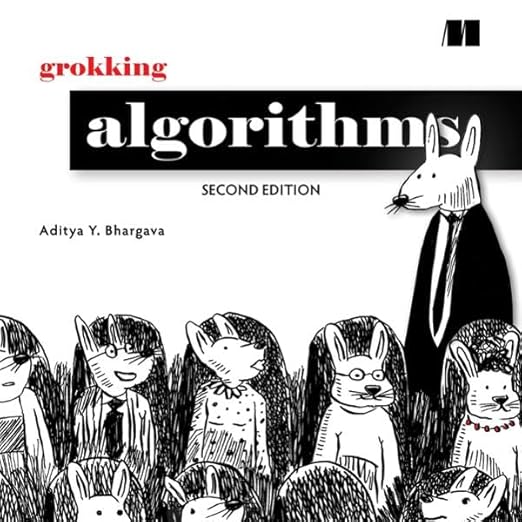
I was deep in preparation for a technical interview cycle when I decided to listen to Grokking Algorithms during my evening walks. I had read the first edition in print years earlier, and I was curious whether the audio version would work for content that is, by the author’s own design, built around visual illustration. The answer is: better than expected, but the PDF companion is not optional. I say that as someone who rarely prints supplementary materials and started listening without it. By chapter three, I had downloaded it.
Aditya Bhargava’s book is the most widely recommended algorithms introduction in English for people who are not computer science graduates. The combination of illustrated explanations, Python code examples, and Bhargava’s clear analogical thinking has introduced over 100,000 readers to concepts that have a reputation for being either too mathematical or too dry to engage with. The second edition adds substantial new content on trees, including binary search trees, balanced trees, and B-trees, along with updated code samples in Python 3 and material on modern CPU performance characteristics that was missing from the first edition.
Julie Brierley and the Manning Narration Standard
Brierley has narrated several Manning-published technical titles and has developed a reliable approach to the specific challenge of narrating instructional computer science content: she reads with consistent precision, handles technical terminology without hesitation, and modulates her pace to match the explanatory density of individual passages. When Bhargava is building an analogy, she slows. When he is stating a definition, she sharpens. That calibration matters more in algorithms content than in most technical books because the difference between understanding a concept and missing it often comes down to whether you have absorbed the one key sentence that ties the analogy to the formal definition.
The limitation is fundamental rather than performance-related. Bhargava’s book has over 400 illustrations, and those illustrations are doing real explanatory work. The binary search visualization, the linked list diagrams, the graph traversal walkthroughs: Brierley can describe what Bhargava is showing, but the cognitive work of building a spatial model of a data structure is genuinely different when you are constructing it from narrated description rather than seeing it diagrammed. The PDF companion makes the audio version workable. Without it, you are getting approximately 70 percent of the book’s explanatory power.
What the Second Edition Adds and Why It Matters
The tree content is the most substantial addition to the second edition, and it is also the content that most benefits from visual illustration. Binary search trees, balanced trees such as AVL and red-black, and B-trees are spatial data structures: understanding how they maintain their properties requires seeing what happens to the shape of the tree when you insert and delete nodes. Brierley’s narration of these sections is clear, but I would strongly recommend having the PDF open while listening to the tree chapters rather than trying to reconstruct the visual structure from description alone.
The updates to Python 3 and the fresh material on modern CPU performance characteristics are more audio-friendly. These are primarily conceptual and empirical rather than visual, and Brierley handles them well.
The Range of Listener This Serves
Reviewers have noted that the book is useful both for beginners and for experienced practitioners refreshing their understanding of specific concepts. That range is genuine. Bhargava writes with the kind of humility that makes beginners feel safe and the kind of precision that does not bore people who already know the basics. One reviewer called it an excellent resource for those starting their journey to writing mature code, and another noted it works for those who simply want to refresh their understanding. Both are accurate.
The no-advanced-math-required positioning is also accurate. Bhargava uses Big-O notation but explains it through analogy and example rather than formal proof. If you have been putting off algorithms study because you were afraid it required a stronger mathematical background than you have, this book is the appropriate starting point.
Who Should Listen and Who Should Skip
Listen if you are preparing for technical interviews and need a fast, accessible refresher on search, sort, and graph algorithms, or if you are a self-taught developer who never formally studied data structures and want to fill that gap. Download the PDF companion before you start. Skip if you need formal algorithm analysis at the level of Cormen, Leiserson, Rivest, and Stein, where proofs of correctness and asymptotic analysis are the core content. Grokking Algorithms is an introduction, and a very good one, but it is not a replacement for a rigorous algorithms textbook.
Frequently Asked Questions
Is the PDF companion essential for the audio version of Grokking Algorithms, or can you follow along without it?
The PDF is strongly recommended. Bhargava’s book is built around over 400 illustrations, and the visual diagrams do real explanatory work that narration alone cannot fully replace. The audio version is comprehensible without it, but you will absorb significantly more from the tree chapters and graph traversal sections with the PDF open.
Does Julie Brierley’s narration handle programming terminology and algorithm names accurately?
Yes. Brierley has narrated multiple technical computer science titles for Manning and handles technical vocabulary with consistent precision. Pronunciation of algorithm names, data structure types, and Python syntax is clean throughout.
How different is the second edition from the first? Is it worth purchasing if you already own the first edition?
The second edition adds substantial new coverage of trees, including binary search trees, balanced trees, and B-trees, which were not in the first edition. It also updates all code samples to Python 3 and adds new material on modern CPU performance characteristics. If you use the book for interview prep or active reference, the update is worthwhile.
Does the book cover NP-complete problems and greedy algorithms, or only basic sorting and searching?
It covers both. The synopsis explicitly lists NP-complete problems and greedy algorithms alongside search, sort, and graph algorithms. Bhargava covers these advanced topics with the same accessible approach as the foundational content.