Before You Press Play
- Read by: A Virtual Voice credit, meaning generated rather than performed, facing acronyms, control identifiers and cross-framework mappings.
- At its heart: Governance risk and compliance, NIST CSF 2.0 implementation, framework crosswalks, career entry
- Vibe: Methodical and career-minded
- Short version: A clear on-ramp into GRC, provided you keep a searchable copy open beside it.
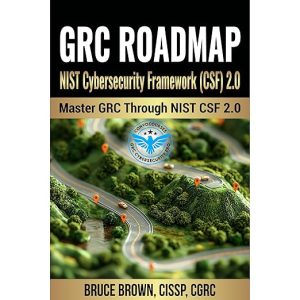
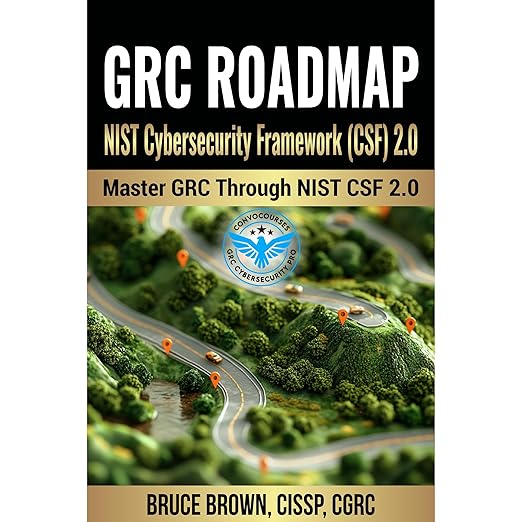
Compliance frameworks do not usually collect perfect scores, and that is where I would start with this audiobook. Bruce Brown's GRC RoadMap runs seven hours and nineteen minutes, the reader of record is listed as Virtual Voice, and nineteen ratings deliver an average of a flat 5.0. Governance, risk and compliance material tends to be graded harshly by the people who have to implement it, so an unbroken sweep from a technical readership is either a strong signal or a small sample. Here it is some of each.
Crosswalking NIST CSF Against Other Frameworks
Brown's premise is a bridge rather than a summary, and that distinction carries the book. The publisher's copy names the gap it means to close, describing organizations that cannot get from lofty compliance standards to practical implementation, and it positions the NIST Cybersecurity Framework 2.0 as the vehicle for crossing. That framing is what separates this from a standards document. NIST publishes the framework itself at no cost; what nobody publishes is a map of how a working professional threads it into a GRC program that already exists and already has commitments.
Promises arrive as five bullets in the description, and all five open with a verb: go, gain, see, learn, be. That is a small tell about register. This is instruction, not reference, and it intends to move you from wherever you currently stand toward a defined next step. The most technically interesting of the five undertakes to show how other frameworks, NIST 800 RMF and the Cloud Controls Matrix among them, align with NIST CSF. Crosswalking is where the daily work of this discipline actually happens, and a book willing to attempt it in audio has set itself something difficult.
Seven hours and nineteen minutes is worth measuring against that scope. NIST CSF 2.0 is built from functions and outcomes, as one reviewer describes it, and a complete walkthrough at any real depth would run considerably longer than a single working day. What this runtime buys is orientation supported by worked examples rather than exhaustive coverage, and that matches the promise the copy actually makes rather than the one a title in capital letters implies.
An Implementer, a Student, and a Generalist
Reviewers are unusually specific about who benefits, and the specificity is why I take them seriously. One notice reports applying controls inside a real organization and credits the book with breaking each function and outcome down "into understandable terms that make achieving the outcomes easy." Another, from somebody writing a cybersecurity thesis, says it simplifies the complexities of the subject in a clearer way. A third describes an approach "well-suited for both newcomers and seasoned professionals" and points at the straightforward structure, the real-world examples and the hands-on strategies. Between them those three cover an implementer, a student and a generalist, which is a wider spread than nineteen ratings would normally supply.
Credentials are stated rather than implied. The description identifies Brown as CGRC and CISSP certified with years of real-world application behind the writing, and one reviewer picks the point up independently, observing that the insights come from the perspective of someone currently working in the field. In a discipline where a great deal of published guidance is produced by people who have never had to survive an audit, that difference is not cosmetic. It also explains why the examples land: they read as things that happened rather than things constructed to illustrate a principle.
Nobody Discusses How Virtual Voice Handles This
Format is the central question here and it deserves a blunt answer. Virtual Voice indicates a generated reading, and this is close to the least forgiving material one could be handed: acronym-dense, thick with framework function names, control references and cross-framework mappings. Nobody who wrote here discusses the recording, and only one response so much as mentions the act of reading, so this page carries no report at all on how a synthesized delivery copes with a string like NIST 800 RMF. Closing that gap with a sample is your job rather than theirs.
Then the tables, which you cannot see. Framework material is built on grids: functions against categories, controls against outcomes, one standard mapped onto another. A promise to show how other frameworks align with NIST CSF describes something inherently visual, and seven hours of linear audio cannot render a mapping the way a page renders it. Treat this as the narrative half of a study process and keep a searchable document open for the half made of rows and columns.
Smaller oddities are worth listing anyway. This listing places the book third in a NIST Cybersecurity Framework series, which the title never signals, so check what the earlier volumes cover before assuming it stands alone. The description also calls the book "the GRC Roadmap: Mastering the NIST CSF 2.0 Framework," a different rendering from the title on the listing, and it closes with a retail instruction to click a buy button, which is storefront copy pasted into a product description. None of that touches the content. All of it says the listing was assembled in a hurry.
Listen Before the Real Work Starts
Professionals moving into GRC from an adjacent technical role are the clearest audience. If you have done security work and now own compliance, this supplies a structured route in, and the description says as much when it offers to pick you up in whatever industry you currently occupy. Students and thesis writers get a plain-language on-ramp to documentation that otherwise assumes fluency on page one. Anyone already implementing NIST CSF will find the function-by-function breakdown the most immediately usable material in the seven hours.
Hold off if what you need is a reference you can search. Generated audio makes a poor substitute for a document you will return to twenty times while drafting a policy, and the crosswalk material in particular wants a screen and a scroll bar. Anyone running a mature program will find the level pitched below them, and the copy concedes as much when it talks about first steps on a lifelong journey. That concession is worth trusting, because a guide willing to name its own ceiling is usually honest about the floor as well. Listen to this before the real work starts, not while it is happening.
Does this audiobook work if you are completely new to GRC?
That is its stated target. The description promises to take you from whatever industry you are in and orient you, and one reviewer recommends it specifically for people newer to the field. A thesis writer in the pool describes it as simplifying the subject, which supports the claim about accessibility.
Can you follow the framework crosswalks without seeing the tables?
Only partly. Mapping NIST CSF against NIST 800 RMF or the Cloud Controls Matrix is grid-shaped work, and linear audio cannot reproduce a grid. The conceptual explanation travels fine. For the actual mappings, plan on having a document open rather than relying on the recording alone.
Is this audiobook part of a series, and do the earlier books matter?
The listing files it as the third entry in a NIST Cybersecurity Framework series, though the title gives no hint of that. Nothing in the description assumes prior volumes, and no reviewer mentions an earlier book. Still worth checking what the earlier titles cover before deciding.