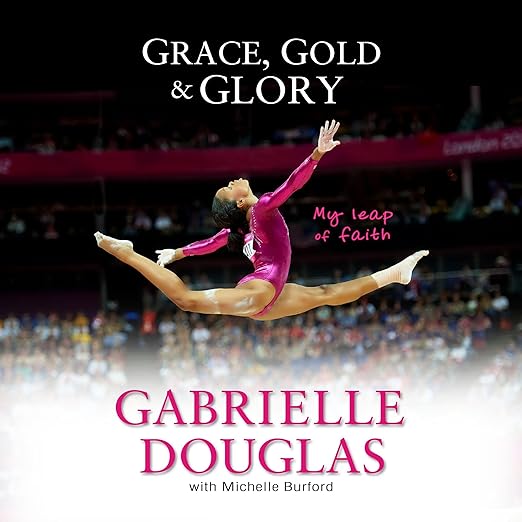
The subtitle survives only inside the description. Grace, Gold, and Glory is what the title field carries; the copy underneath names the book Grace, Gold, and Glory My Leap of Faith, twice over, and that missing half is the part telling a buyer what sort of audiobook this actually is. Faith is not a closing chapter here. It is the organizing frame of a four-hour autobiography about an Olympic champion, and anyone arriving for a sports memoir and finding a testimony has been misdirected by a truncated field.
Our Take on Grace, Gold, and Glory
Gabrielle Douglas was the first African-American gymnast in Olympic history to become individual All-Around champion, and the first American gymnast to win gold in both the individual All-Around and the team competition at the same Games. The copy states both of those, then states them again in a bullet list, alongside the 2012 Sportswoman of the Year award from the Women's Sports Foundation. That repetition is not a drafting accident. A marketing sheet has been pasted onto the listing whole, bullet points and a stray singular typo included.
One vote holds up a 4.6 badge with five signed responses sitting beneath it, arithmetic that cannot be made to close, and it is the least interesting problem on the page. The more useful question is when those responses were written. Two of them predate the January 15, 2014 recording: one from December 2012 and one from January 2013, both composed while London was still recent, and neither could have been describing an edition that did not yet exist.
Zonderkidz published it and the framing follows directly from that. VJ's response opens by asking whether you are a teen athlete or the parent supporting the dream of one, then describes Gabby giving the glory to God and standing as living proof that faith and family sustain a person when the body and the mind fall short. That is a fair account of the book's argument. Anyone shopping for a technical view of elite gymnastics should read that entry as a warning rather than as an endorsement.
Why Listen to Grace, Gold, and Glory
Amy B's account is the most concretely useful thing on this page. A ten-year-old daughter read it and then passed it around a fourth-grade class, where it went over well with everybody. The same response notes that the book is written in the first person, almost like a journal, and that for grade-schoolers growing curious about the teenage years, suitable material is genuinely hard to come by. Both observations carry more weight for an audio edition than they would for a printed one. First-person writing at that reading level is precisely what audio handles well, since a young listener follows a voice talking about itself far more easily than one describing somebody else from outside.
Haleakala Wilson reads it, and Gabrielle Douglas does not. An autobiography written in the first person, in the voice of a teenager recounting her own life, has been handed to a different performer, which is an ordinary publishing decision and a consequential one in this case. The appeal of the book, on Amy B's own evidence, is that it sounds like a journal. A journal read aloud by somebody other than the person who kept it becomes a different object. Four hours and sixteen minutes of I and me, spoken by a voice that is not the I under discussion.
Chapter 18 is where VJ's response stops being general and turns specific. That entry describes reaching the end of it and filling with tears, then explains the reason: a daughter competing as a Junior Olympic athlete in another sport entirely, and a conflict the book apparently names exactly. A response that can point to a numbered chapter is worth more than a paragraph of praise, because it establishes that at least one passage lands hard enough to be located afterward. The entry signed Grace supplies the other kind of evidence, describing a book already read three times and picked up for a fourth, which is a rereading pattern rather than a single inspirational hit.
What to Watch For in Grace, Gold, and Glory
Young readers are the stated target, ages thirteen and up according to copy that says so twice and mistypes it the second time. The listing files the book under teen and tags it Biographies. Amy B's ten-year-old handled it comfortably and so did an entire fourth-grade class, so the floor sits lower than thirteen in practice. The ceiling is the real question: an adult wanting training detail, coaching relationships or competitive pressure in any depth will get four hours of an inspirational arc instead, and the copy never promised more.
Three separate things on this page fail to line up, and none of them is fatal on its own. The rating cannot be produced by its own vote counter. Two responses were written before the recording existed. And the entry signed Grace explains buying the book because of the 2008 Olympics, where this book is built on 2012 and the copy never mentions an earlier Games at all. Any one of those could be an honest slip. Together they describe a page assembled quickly around a title that was selling on a name.
Who Should Listen to Grace, Gold, and Glory
Gymnasts and their families are the obvious audience, and the responses confirm the pipeline works: a parent of a Junior Olympic diver located a daughter's own conflict somewhere in these pages. Families wanting a sports story with an explicit faith frame form the second group, and the copy is honest about that from the first words of the subtitle it declines to print. A response signed Caspro I. reports buying five extra copies to hand out as gifts, and the four-star entry picks out the strong, hard-working single mother who taught the values that carried Douglas to Olympic gold, which is the household this book spends most of its time inside. Anyone who watched London in 2012 and wants the version told from the inside can have it in a single afternoon.
Parents looking for a training memoir are shopping in the wrong place, and so is anybody who wants the faith material kept in the background rather than out front. This is a testimony written for listeners who will be encouraged by it, which is a legitimate thing for a book to be and an unwelcome surprise for anyone who did not sign up for one. Douglas earned the achievements the copy keeps repeating, and four hours in her own words, spoken by somebody else, is a reasonable way to meet them.
In Brief
- Narration: Haleakala Wilson reads a first-person autobiography that its subject did not record, which shifts the register of a book one response calls almost a journal.
- Themes: Olympic gold and everything before it, faith and family, a single mother's household, perseverance written for teenagers.
- Mood: Warm, encouraging, openly devotional.
- Verdict: An inspirational testimony first and a sports memoir second, with the subtitle that says so missing from the title.
Who reads the Grace, Gold, and Glory audiobook?
Haleakala Wilson, across four hours and sixteen minutes. Gabrielle Douglas does not read her own book, which matters more here than usual: one response describes the writing as first person, almost like a journal, and a journal delivered by another voice becomes a slightly different object.
Is this audiobook suitable for listeners younger than thirteen?
The copy says ages thirteen and up, twice. In practice the floor sits lower: one response describes a ten-year-old finishing it and passing it around a fourth-grade class where it landed well. Nothing in the material appears aimed above that age either.