
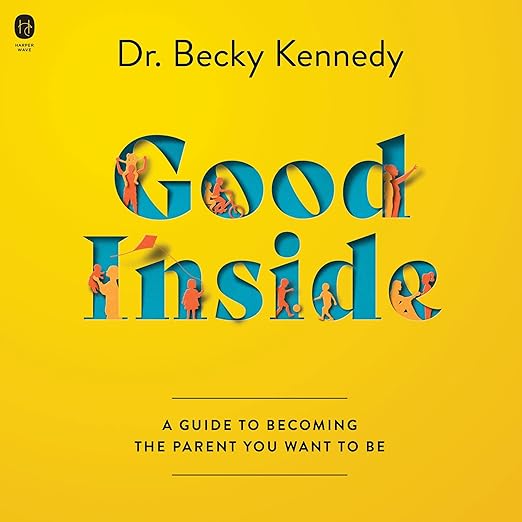
Becky Kennedy reads her own parenting book, which counts for more here than it usually would, because a large share of the audience already knows this voice. Millions of parents found Dr. Becky through an Instagram account and a podcast well before Harper Wave printed anything, so the audiobook is arguably the native format and the page the adaptation. Nearly ten hours of it poses a fair question: does guidance built for short spoken segments hold its shape at length?
Behavior, Worth, and the Parent's Own Upbringing
The governing move is to separate a child's behavior from a child's worth and then build discipline on the second rather than the first. Kennedy's objection to reward charts and time outs is not that they fail to shift conduct; it is that conduct was the wrong target, since those tools shape surface behavior without building the skills a person needs later and ignore what the child is feeling underneath. Connection over correction is the slogan. Confidence and sturdy leadership are what the description promises on the other side of it.
Its second subject is the parent, and that is where this separates from the shelf around it. Kennedy keeps circling back to the adult's own upbringing, working from the premise that most of what derails a calm response was installed decades before any child arrived. The description is unusually blunt that caregivers reach this material feeling lost, burned out, and privately certain they are failing. A parenting book willing to spend real time on a parent's shame is doing something structurally different from a troubleshooting manual.
Kennedy's Own Voice Closes the Tone Gap
Hearing Kennedy deliver it herself closes a gap the page leaves open. The method depends on tone, since the identical sentence said warmly and said briskly produces very different outcomes with a five-year-old, and the book supplies specific language for scenarios like tantrums, sibling rivalry, and separation anxiety. A reader can only infer intended delivery from punctuation. A listener receives it straight from the person who wrote the lines, which makes those passages markedly easier to actually use.
Attachment Science Behind Ten Hours of Scenarios
Megan Thompson, who works as a child and family therapist and parent coach and jokes about having read a million parenting books, places this one in the top three encountered and points to its grounding in attachment research and neuroscience. That detail is the load-bearing one. The warmth on the surface rests on an actual theoretical spine, which is not something every title in this category can claim.
Nearly ten hours is a long run for a book whose central ideas could be summarized in a paragraph, and the length is doing specific work. The principles are simple; the application is not. Most of the recording goes to scenarios, to what you say when a clean principle meets a screaming child at bedtime. That is precisely the material that benefits from repetition on a commute, and it explains why this functions better as a book you re-enter than one you finish.
Another argument for hearing it: Kennedy is pushing against a default most listeners absorbed without ever choosing it. Reward charts and time outs are not fringe practices; they are what the surrounding culture hands a new parent. A book asking someone to surrender the tools they were raised with has to be persuasive rather than merely correct, and a voice doing that persuading holds an advantage over a page attempting the same.
Fit Is Uneven, and the Numbers Look Off
Fit is not universal, and the four-star response on this page is the honest one. McKenzie Bauer found parts of the book not especially applicable to what was happening at home at the time, while still coming away with takeaways about recognizing their own goodness as a parent alongside their children's. That is a fair account of the book's shape: strong on framework, uneven on whether the particular situation you are living through gets a section of its own.
Kennedy's register will not suit everyone either. Kennedy writes and speaks in the language of validation, and anyone wanting brisk behavioral instruction may find the emotional scaffolding slow going. The book also quietly assumes a degree of capacity: time, attention, a second adult or at minimum a quiet moment. Parents operating in genuine crisis conditions can find the distance between the ideal response and the available one discouraging rather than liberating.
On the listing itself, the numbers deserve a squint. Five written responses sit beneath a counter reporting four ratings, and the visible scores average exactly the figure displayed above them, which suggests the tally and the text are not drawn from the same pool. Treat the average as a rough signal about the writing rather than a precise measurement of anything at all.
Readership Runs Wider Than the Cover Implies
Readership runs wider than the cover implies. Linda Robertson, writing as the mother of grown children, argues that although the book presents itself as aimed at parents of young kids, it functions as a resource for anyone trying to understand the people they love most, and credits it with strengthening a resolve to listen far more than to speak and to prioritize understanding over convincing. That reframing deserves consideration before you rule yourself out on age grounds.
Parents hunting for a behavior-management system with numbered steps and timelines are in the wrong place, because Kennedy argues explicitly against that model and buying this in search of one will feel like a quarrel you never picked. Those who have already absorbed the approach through her shorter formats should sample first and judge how much of this is genuinely new before committing ten hours.
The strongest case is for the parent who suspects the tools they inherited are not working and cannot yet name a replacement. Nearly ten hours is enough time to shift a default, which is what the book is really asking for. Take it slowly, expect to argue with a section or two along the way, and treat the scripted language as a first draft rather than lines you are obliged to deliver word for word.







