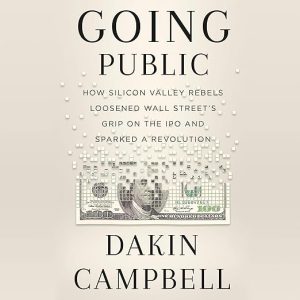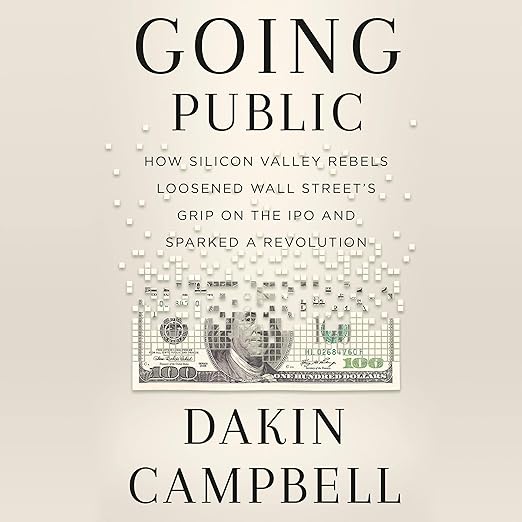
Nothing about an initial public offering is supposed to be improvised, and yet the single most consequential number in the whole process still comes down to human judgment in a market that automated nearly everything else decades ago. That anomaly is where Dakin Campbell sets up, and the audiobook that results plays closer to a heist procedural than to a finance seminar. Brian Troxell reads it. The spine of the story is a music streaming company's 2018 decision to skip the traditional offering entirely, list its shares directly, and find out who would try to stop it.
Frances L. Asks Why a Stock Pop Is Good
Frances L., who has family inside investment banking and had been hearing the back-room version for years, frames the provocation better than the publisher copy manages: why is it treated as a good outcome when a stock pops on its first day of trading, given that no other financial asset is expected to be sold that far below what the market will immediately pay for it? Put that question in a listener's head early and the remaining ten hours become an answer with defendants.
Campbell builds the answer out of people rather than mechanisms. Barry McCarthy, the understated chief financial officer, and Daniel Ek, the shy founder, take a wild idea and lobby securities watchdogs and exchange staff into rewriting the rules around it. Bill Hambrecht, one of Silicon Valley's earliest bankers, supplies the prehistory with an online share auction that Larry Page and Sergey Brin took up in 2004. Airbnb and DoorDash arrive later as test cases for whether the crack held.
Reporting is where the book earns its shelf position. Campbell reconstructs conversations from inside rooms that ordinarily leak nothing, and the specificity is what lifts it above the commentary that surrounded the same events in real time. Wall Street has spent forty years defending the profitability of underwriting, and a journalist who can show precisely how that defense was mounted, meeting by meeting, is offering something the quarterly coverage structurally could not.
Troxell Must Help Listeners Retain Dozens of Names
A December 2022 response reaches for Michael Lewis and James Stewart as reference points, and the comparison is fair on structure if not on scope. Campbell narrows to one mechanism and follows it exhaustively, where Lewis tends to widen into cultural diagnosis. The result is a narrative that behaves like a thriller with a fixed question at its center, which is precisely the shape that survives being listened to rather than read.
Format helps more than usual here. This is finance writing with no tables to squint at, no charts to interpret, and no appendix demanding a bookmark. What it does demand is name retention, since the cast runs to dozens of bankers, executives, regulators, and venture investors across a decade. Troxell's task is less about drama than about keeping those handoffs legible, and the chapter structure helps by returning again and again to the same handful of principals.
Regulatory maneuvering is quietly the most interesting material here, and the least covered anywhere else. Getting a direct listing approved meant persuading exchange staff and securities regulators that a company could go public without a bank pricing the shares, which is a rule change disguised as a paperwork question. Campbell gives that lobbying campaign the same attention given to the boardroom scenes, and it rewards the patience.
Written Reviews Are the Enthusiastic End of the Room
Run the numbers on this listing before you read the responses as a verdict. The page reports 4.4 across twenty-seven ratings, while all five visible written entries carry five stars. If the displayed average is rounded, the twenty-seven votes together total somewhere between 118 and 120 stars. Remove the twenty-five contributed by those five, and the remaining twenty-two votes average roughly 4.2 to 4.3. The written pool is the enthusiastic end of a noticeably cooler room.
The book's calendar is the other thing to weigh. Published in July 2022, it closes with the blank-check boom presented as the hottest new route into public markets, a description that stopped being accurate almost immediately afterward. Two years on, in February 2024, James Donohue still found it informative on the practicalities from inside the market, which suggests the mechanics hold up even where the market commentary has been overtaken by events.
Expect fair-mindedness rather than prosecution. Campbell documents how banks protected their fee structures across four decades, then lets those bankers explain their reasoning at length. Listeners who want a demolition will find something more careful and, depending on temperament, either more persuasive or less satisfying. The book also assumes you know what an underwriter is; it explains its own subject well, but it never stops to define the furniture.
Anyone Who Wondered Who Paid for the Fireworks
"A real page-turner" is how a January 2023 entry from a decades-long stock investor puts it, and the detail that matters in that response is the confession attached: the underwriters and technology companies were all familiar names, and the inside story was entirely new. That gap, between following the news competently and knowing what actually happened, is the exact space this book occupies.
It suits anyone who works near capital markets, anyone who has held shares in a company that listed badly, and anyone who enjoys reported business narrative for its own sake. It suits day traders and options hobbyists considerably less, since nothing here is actionable. Listeners hoping for a primer on how to buy into offerings should look elsewhere; this explains why the system is shaped as it is, not how to profit from the shape.
Nobody needs a finance background to follow this, but the listeners who get the most out of it are the ones who have watched a listing pop on day one and quietly wondered who paid for the fireworks.
Common Questions
Does the audiobook cover the blank-check boom, and how well has that section aged?
It covers it as the newest route into public markets at the time of writing, which was accurate in July 2022 and became less so within a year. The mechanics Campbell explains remain correct. The market judgment attached to them is the part a listener should date-stamp while going.
Which companies does the reporting actually go inside?
The direct listing at the center supplies the spine, with Airbnb and DoorDash following as later tests and a 2004 online share auction providing the prehistory. A September 2022 response describes the effect precisely as lifting the curtain on companies people already rely on daily, which is the book's most consistent pleasure.
Is this audiobook a takedown of Wall Street banks?
It is not. Campbell shows exactly how underwriting profits were protected for forty years, then gives the bankers room to explain why they believe the system works. The effect is closer to a dissection than an indictment, and readers who want an argument delivered at volume will find it frustratingly balanced.