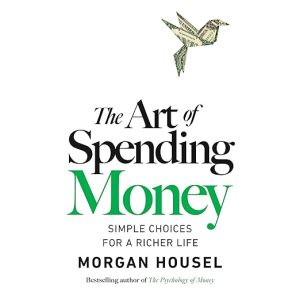
Morgan Housel built his reputation with The Psychology of Money, a book that reframed personal finance by arguing that good financial outcomes have less to do with knowledge of markets than with behavioral patterns and self-understanding. The Art of Spending Money, narrated by Chris Hill, applies the same analytical frame to the side of the equation that conventional financial advice typically ignores: not how to earn, save, or invest, but how to spend, and why most people are doing it in ways that leave them less satisfied rather than more. At five hours and fifty-three minutes, this audiobook is compact by personal finance standards, and the compression suits Housel's essayistic approach well.
Expectations Matter More Than Income Does
Housel's central diagnosis is that most spending decisions are driven by the wrong metric. We chase things that impress others but leave us cold. We save endlessly, afraid to spend on what would actually make life better. We confuse admiration, which is brief and unstable, with envy, which is directional and actionable. We confuse comfort with excess and utility with status. These confusions are not character failures; they are predictable outcomes of social animals operating in environments saturated with status signals. Housel does not moralize about them. He maps them, explains why they persist, and then offers a different frame for evaluating spending decisions.
The book explicitly refuses to be a budgeting guide. No spreadsheets, no one-size-fits-all solutions, no optimized allocation frameworks. What Housel offers instead is a set of conceptual tools for thinking about spending, including the counterintuitive argument that expectations matter more than income. Two people with identical salaries and spending patterns can have radically different financial satisfaction depending on what they expected their circumstances to look like. This is not a novel observation in behavioral economics, but Housel makes it with particular clarity and backs it with the warm, narrative-driven argument that made The Psychology of Money resonate with a wide readership that would never otherwise pick up a personal finance book.
The argument that the most valuable return on investment is peace of mind is a genuine reframe of how financial success is typically measured in personal finance writing. Housel does not present this as a consolation prize for people who fail to maximize returns. He presents it as the actual goal that most financial behavior is gesturing at without ever quite articulating, and the book is structured around making that goal explicit so that spending decisions can actually be evaluated against it.
Hill's Delivery Suits an Essayistic Style
Chris Hill's narration is well-suited to Housel's style. The book is essayistic rather than argumentative, building through accumulated insight rather than logical proof, and Hill's delivery reflects that quality. The listening experience has the texture of receiving a series of well-constructed ideas in sequence. One reviewer described it as one of the best books they had read this year and planned to buy it as gifts. Another, more measured, called it well-written and entertaining, noting that they found a few specific ideas that changed how they think about spending and what they are trying to accomplish with it. A third offered unequivocal enthusiasm, calling it deeply insightful and noting that Housel blends storytelling, psychology, and timeless wisdom to illuminate what money really means in daily life.
The five-hour runtime is appropriate for what the book is doing, which is less about comprehensive coverage of spending psychology than about establishing a different frame for approaching the question. Housel is interested in the shift from thinking about money as a scoreboard to thinking about it as a tool for building a specific kind of life, and that shift does not require six hundred pages of supporting data. The compression is a feature, not a limitation.
What Is Money Actually For in Your Life?
The book's strength is conceptual framing rather than tactical guidance. Readers who want to know specifically where to cut expenses or how to allocate discretionary spending will not find the instruction they are looking for. What they will find is a more useful prior question: what is money actually for in your life, and are you spending it in ways that reflect that answer? Housel treats the inability to answer that question clearly as the root of most financial dissatisfaction, and the book is an attempt to provide the conceptual vocabulary for doing so.
One reviewer offered a balanced assessment, calling the book good but not great, noting that the research and storytelling are solid and the framing questions are useful but that the book does not break entirely new ground for readers already familiar with behavioral economics literature. That assessment is fair. The Art of Spending Money is more synthesis and application than discovery. For listeners coming to Housel fresh, or those who have read The Psychology of Money and want the natural continuation, the book delivers considerable value. For behavioral economics specialists, it covers familiar territory with elegance rather than novelty.
Budget Templates Live at a Different Level
Existing Housel readers will find this a natural extension of his previous work, completing the framework that The Psychology of Money began. Listeners new to Housel will find this a strong entry point, though The Psychology of Money provides more evidential density for the behavioral claims the two books share.
Listeners seeking tactical personal finance guidance, budget templates, or investment-adjacent spending frameworks will find the book operates at a different level than they are looking for. It is a philosophical intervention in how you think about spending, not a spending plan. That intervention is worth nearly six hours if you approach it honestly: fewer people have a clear answer to what money is for in their life than would admit it, and this audiobook is a good tool for developing one.
A Few Questions About The Art of Spending Money
Do I need to have listened to The Psychology of Money before this audiobook?
No. The Art of Spending Money stands on its own and introduces its core concepts independently. Existing Housel readers will notice thematic continuity, but the book does not assume familiarity with his earlier work.
Does The Art of Spending Money audiobook provide practical budgeting tools or frameworks?
No. Housel explicitly avoids budgets, hacks, and prescriptive rules. The book offers conceptual framing for thinking about spending decisions differently, not a system for managing them. Listeners seeking tactical personal finance guidance should look elsewhere.
How does Chris Hill's narration serve this audiobook format for personal finance content?
Well. Hill's delivery suits Housel's essayistic, narrative-driven style, maintaining an easy conversational register across the full runtime without adding dramatic weight the material does not call for.
Is The Art of Spending Money audiobook worth the time for someone who already manages money carefully?
Probably yes. The book's argument is less about financial discipline than about whether your spending reflects your actual values and what genuinely produces satisfaction. Careful money managers may still find the reframes around expectations, admiration, and status worth the five hours.